




Interior design has an unusual marketing problem. The work is intensely visual, so designers pour everything into imagery, and then wonder why a beautiful portfolio produces so few enquiries.
The gap is that a homeowner about to spend fifty or a hundred thousand pounds on a renovation is not shopping for pictures. They are trying to answer a much harder question: can I trust this person with my home, my budget, and eighteen months of my life.
Pictures alone do not answer that. This is what does.
The short answer
High value residential clients decide slowly and quietly. They will research you for weeks before making contact, and they are looking for evidence of process and reliability far more than evidence of taste. The designers who win online are the ones who make the invisible parts of the job visible.
Taste gets you onto the list. Process gets you the contract.
Why the usual advice fails designers
Most marketing advice assumes a transaction. A shopper sees a product, wants it, buys it. Interior design breaks that in three ways, and each one changes what you should do.
The consideration period is very long. Someone may follow your work for a year before a renovation becomes real. That means content that stays useful over time beats campaigns that demand an immediate response.
The decision is emotional and financial at once. Your prospect is excited about the vision and frightened about the cost and disruption. Marketing that only sells the vision leaves the fear entirely unaddressed, and the fear is what stops people booking.
The client base is small and specific. You do not need thousands of leads. You need a handful of the right ones a year. That makes broad reach almost worthless and precision extremely valuable.
Your portfolio is doing half a job
Nearly every designer's portfolio is a gallery of finished rooms. Beautiful, and much less persuasive than it could be.
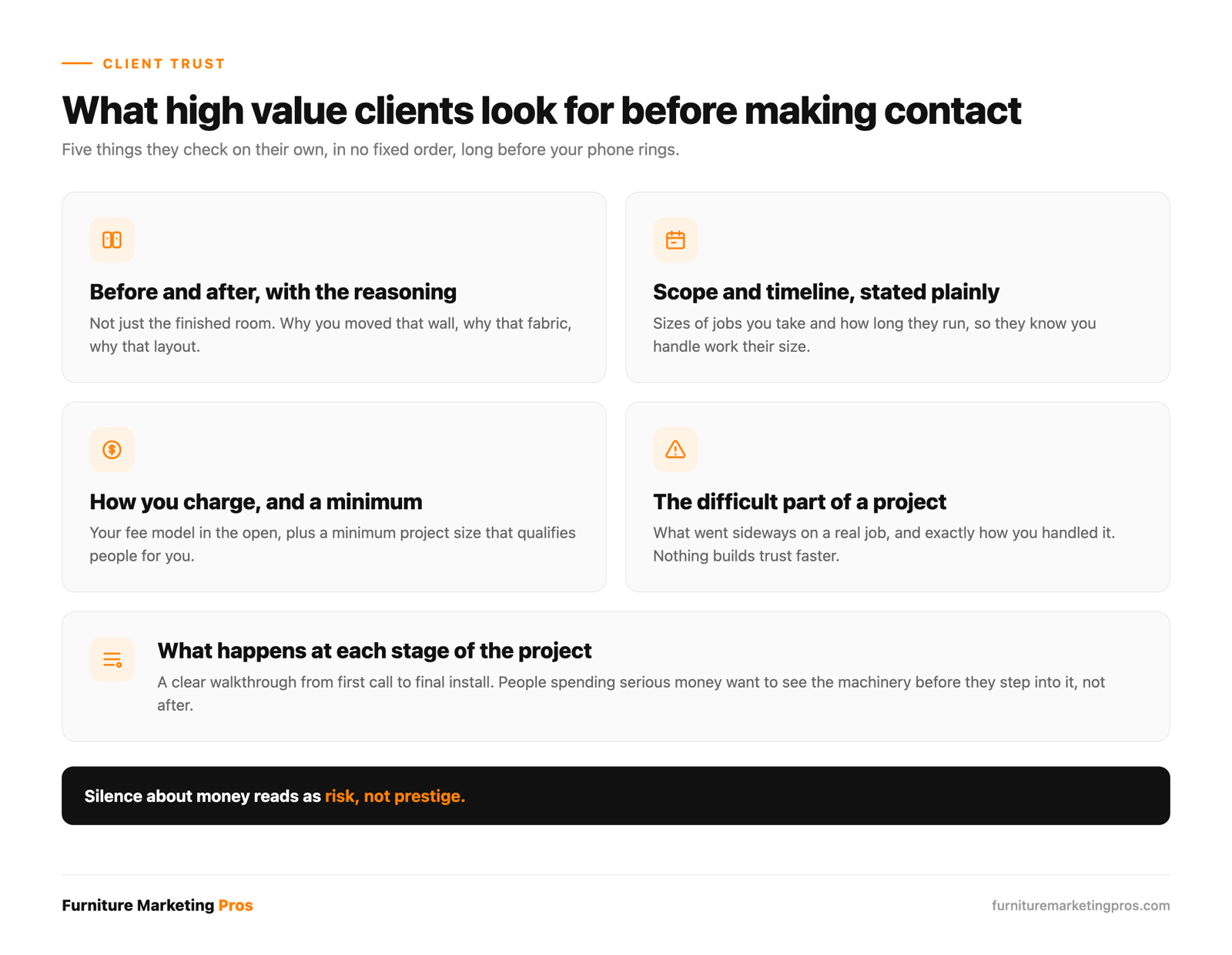
Show the brief, not just the result. What did the client want, what constraints did you work within, what did the space look like before. A finished room tells a prospect you have taste. A before and after with the reasoning tells them you can solve a problem like theirs.
Name the scope and the timeline. "Full renovation of a four bedroom Victorian, kitchen and two bathrooms, delivered in fourteen weeks" tells a prospect whether you handle jobs their size. Vagueness here means everyone self selects out.
Include the difficult bit. The stairwell that would not take the sofa. The supplier who let you down and how you recovered. Nothing builds confidence like evidence that things went wrong and you handled it, because every prospect knows something will.
Make each project its own page. A single gallery page cannot rank for anything specific. A page per project, with real text, can rank for the style, the property type, and the location. That is where the search traffic actually lives.
The searches that matter, and the ones that do not
Designers routinely chase the wrong terms.
Broad style terms are a trap. "Modern living room ideas" brings enormous volume and almost no clients. The searcher is browsing for inspiration and is often on another continent.
Service plus location is where your clients are. Interior designer plus your city or a specific neighbourhood. Low volume, extremely high intent, and a search a national platform cannot answer better than you.
Property type plus location converts unusually well. Someone searching for a designer who works on period properties, or new builds, or apartments in a particular area, has already qualified themselves.
Question searches build the relationship early. What does an interior designer actually charge. How long does a full renovation take. Do I need a designer or just a decorator. These arrive long before the enquiry and they are how you get remembered.
That last group matters more than it looks. It is the same pattern we described in how the modern buyer journey works: the decision is largely made before anyone contacts you, so the goal is to be present and useful during the invisible phase.
For the local side of this, our local SEO work covers the profile and ranking mechanics in more depth.
Talk about money before they ask
This is the single most avoided topic in interior design marketing, and avoiding it costs you the clients you most want.
A homeowner with a serious budget is not afraid of your fee. They are afraid of an open ended commitment with no visible ceiling. Silence on price does not read as premium positioning, it reads as risk.
You do not need to publish a price list. You need to make the shape of the money legible.
Explain how you charge. Percentage of project, flat fee per room, hourly for consultation. The model matters more than the number.
Give a minimum project size. This is the most useful filter you can publish. It removes the enquiries that waste your time and signals seriousness to the ones that do not.
Describe what a typical project costs, in ranges. Broad is fine. A prospect who cannot form any picture of the cost usually does nothing.
Say what is not included. Furniture, contractors, permits. Ambiguity here is where relationships sour.
Houzz, Pinterest, and Instagram do different jobs
Treating these as one activity called social media is why they underperform.
Pinterest is a search engine, not a social network. People use it with intent, saving to boards for projects that may be a year away. Pins keep working for years, which suits a long consideration cycle better than almost any other channel. Pin your own project photography, linked to the project page, not to your homepage.
Houzz is a shortlist tool. People arrive there already intending to hire someone. A complete profile with a full project history, clear scope, and reviews does most of the work. An empty profile on a platform where prospects are actively comparing is worse than no profile.
Instagram builds familiarity, rarely enquiries directly. Its real value is that a prospect who found you elsewhere checks your Instagram to see whether you are still active and still good. Treat it as verification rather than acquisition.
Your website has one job
Not to impress other designers. To convert a warm prospect who has been quietly following you for months.
Make contact effortless and low commitment. A prospect not yet ready to commission will never fill in a twelve field brief. Offer something smaller, a short consultation, a call.
Answer the fear, in writing. What happens at each stage, how long it takes, what you need from them, who manages the contractors. This is the content that turns interest into an enquiry, and almost nobody writes it.
Load fast on a phone. Large photography is the point of your site and also the thing most likely to make it slow. Compression is not optional. Our web development work exists largely because visual businesses keep losing prospects to slow galleries.
Put testimonials next to the decision. A quote about how calm the process felt, sitting beside your contact form, does more than a testimonials page nobody visits.
Key takeaways
- High value clients research for weeks before contact. Be useful during that phase or be absent from the decision.
- Taste gets you shortlisted. Evidence of process and reliability gets you hired.
- Build a page per project with the brief, scope, timeline and the problem you solved, not just finished photographs.
- Chase service plus location and property type plus location. Broad style searches bring inspiration browsers, not clients.
- Publish how you charge and a minimum project size. Silence on money reads as risk, not as prestige.
- Pinterest is a long lived search engine, Houzz is a shortlist tool, Instagram is verification. Different jobs, different content.
Frequently asked questions
How do interior designers get clients online?
By being present during the long research phase rather than only at the point of enquiry. That means project pages that rank for service and location searches, content answering the practical questions about cost and process, and a complete Houzz profile, because that is where people compare designers when they are ready to hire.
What keywords should an interior designer target?
Service plus location, property type plus location, and the practical questions clients ask before enquiring. Avoid broad style and inspiration terms, which carry high volume but attract browsers rather than prospective clients.
Should interior designers publish their prices?
Publish the model and a minimum project size rather than a price list. Serious clients are not put off by cost, they are put off by an open ended commitment with no visible ceiling, and a stated minimum also filters out enquiries that were never going to convert.
Is Pinterest or Instagram better for interior designers?
They do different jobs. Pinterest behaves like a search engine where pins keep working for years, which suits a long decision cycle. Instagram is where a prospect verifies you are still active and still good after finding you somewhere else.
How long does interior design marketing take to work?
Longer than most channels, because the buying cycle itself is long. Content and local search work typically take a few months to build visibility, and then keep compounding, which is why cutting it during a quiet period is usually the expensive choice.
Where to start
If you want to know which searches in your area are winnable and what a prospect actually sees when they research you, that is the first thing we map.
Book a free strategy call and we will look at your portfolio structure, your local visibility, and where your enquiries are currently coming from. No pressure and no commitment.