




A store owner told me recently that his floor traffic was down but his closing rate had never been better. He thought something was broken. Nothing was broken. He was describing the single biggest change in furniture retail, and he was describing it accurately.
Fewer people are walking in. The ones who do walk in are far more likely to buy. Those two facts are the same fact, and understanding why changes where you should be spending your money.
The short answer
The furniture buying decision no longer starts in your showroom. By the time someone walks through your door they have usually chosen the category, the rough budget, and a shortlist of two or three stores. Your showroom is where the decision gets confirmed, not where it gets made.
That means the competition you lose to is rarely the store across town with a better floor. It is the store that made the shortlist while you were invisible.
What the journey actually looks like now
Industry research on furniture retail consistently finds that the large majority of buying journeys begin online, and our own client data matches that pattern. What matters more than the exact percentage is the shape of the path, because the shape tells you where you can intervene.
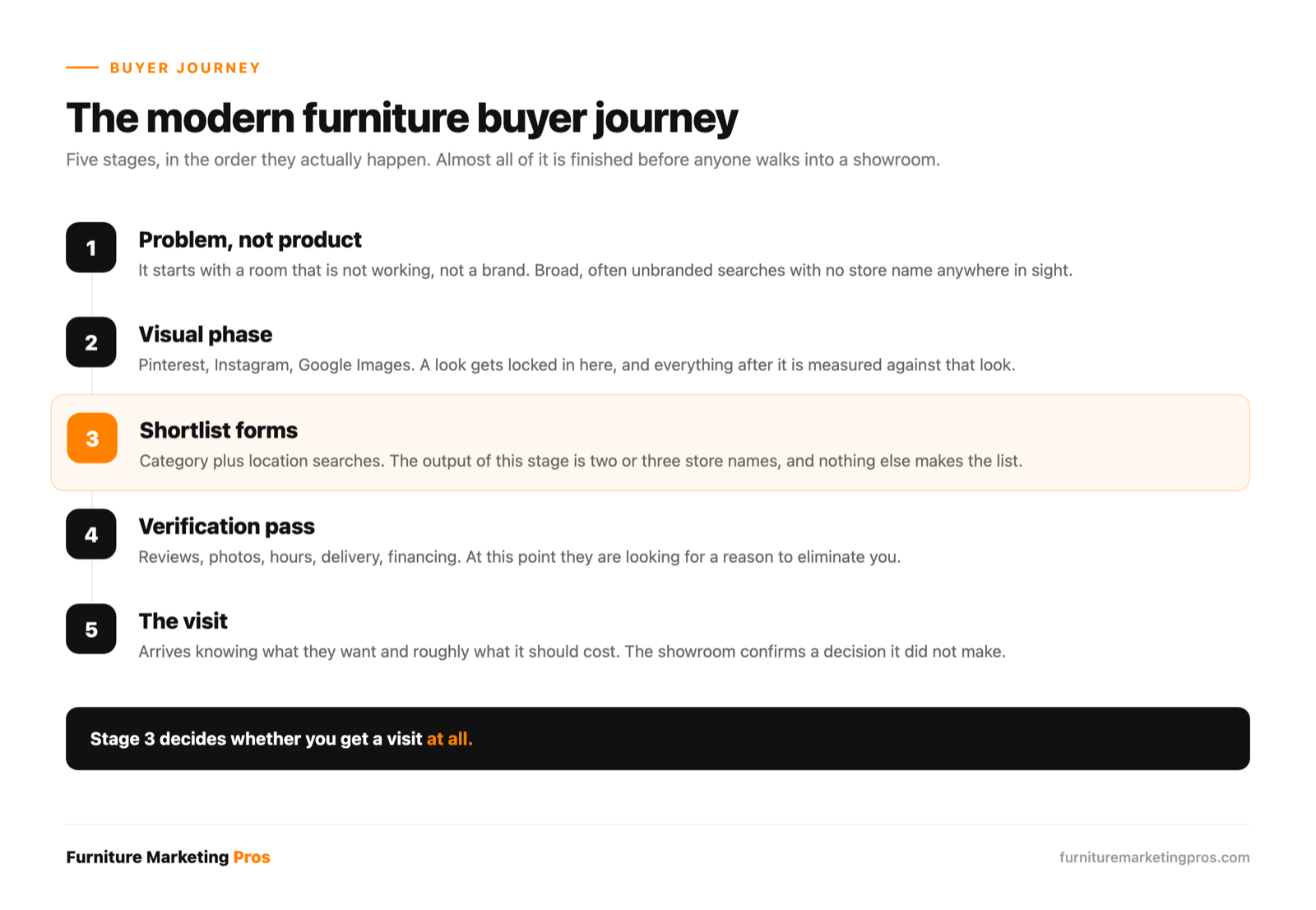
It starts with a problem, not a product. Nobody wakes up wanting a 96 inch sectional. They want a living room that works when their family visits. The first searches are broad and often unbranded.
Then comes the visual phase. Pinterest, Instagram, Google Images. This is where a look gets locked in, and it is the phase most independent stores ignore entirely because it does not produce a measurable lead.
Then the shortlist forms. This is the phase that decides whether you get a visit. Searches become specific and local. Someone types a category plus a place, or asks an AI assistant which stores near them carry a particular style. The output of this phase is two or three store names. If you are not one of them, nothing else you do matters.
Then the verification pass. Reviews, photos, hours, delivery terms, financing. A shopper is now looking for a reason to eliminate you rather than a reason to choose you. A closed showroom on a Sunday, an unanswered one star review, or a photo library from 2019 are all elimination triggers.
Then, and only then, the visit. By this point the shopper has invested hours. They arrive knowing roughly what they want and what it should cost.
Why your floor traffic and your close rate moved in opposite directions
This is the part that confuses owners, and it should not.
When shoppers did their comparing on showroom floors, you got a lot of visits and closed a small share of them. People walked in to browse, to price check, to kill a Saturday. Now the comparing happens before the visit, so the browsing traffic never arrives. What arrives is pre qualified.
Lower traffic and a higher close rate is not a symptom of decline. It is a symptom of the funnel moving upstream, out of your building and onto a screen where you may not be present.
The danger is what it does to your instincts. When traffic drops, the reflex is to discount, to run another sale, to spend on whatever gets bodies through the door this weekend. That reflex treats a visibility problem as a pricing problem, and it is expensive to be wrong about that.
The part you cannot see, and how to measure it
The uncomfortable truth about the pre visit phase is that most of it leaves no trace in your reporting. Someone can see you five times, form an opinion, and never click anything.
This is why measuring only online conversions misleads furniture retailers so badly. If online orders are a fifth of your revenue and you judge your marketing on online conversions alone, you are grading the whole programme on a fifth of its work.
There are three things worth measuring instead.
Verified store visits. Google can connect ad exposure to actual foot traffic. For Saloni Furniture US we track this directly, and the campaigns we manage have driven 4,824 verified in store visits. That is the number that tells you whether the invisible phase is working.
Local search position for buying intent. Not your brand name, which people search after they already know you. The category and place searches that build the shortlist. Saloni now ranks first for terms like "furniture stores leesburg va", which carries around 260 searches a month in their market.
Assisted revenue, not last click. A shopper who found you through a blog post in March and bought in May shows up in your reporting as direct traffic or a walk in. For Statements by J, organic search grew from zero to $75,967 in revenue over nine months with no ad spend attached to it. Last click attribution would have credited almost none of that to the work that caused it.
Where independent stores actually win this
The pre visit phase sounds like it favours whoever spends the most. It does not, and this is the genuinely good news.
Local intent is not for sale at scale. A national retailer cannot be the most relevant result for a specific town. You can. That relevance is earned through your Google Business Profile, local content, and reviews, and it is the one competitive position a bigger budget cannot simply buy from you.
Expertise survives the screen. The shopper in the visual phase has a question no catalogue answers. Which fabric survives a dog. Whether that sectional fits through a narrow stairwell. Answering those questions publicly, in writing and on video, is how you get into the shortlist conversation. Most stores never publish a word.
Real photographs of real inventory beat renders. Shoppers verifying a shortlist want to see the actual floor, not a manufacturer's studio shot they have already seen on four other sites.
AI assistants recommend specifics. When someone asks an assistant for the best furniture store in a city, the answer is assembled from your business profile, your reviews, and content that clearly states what you carry and who you serve. Vague positioning gets skipped. We covered how this works in what GEO means for furniture stores.
What to do about it this quarter
Fix the shortlist phase first. This is the highest leverage point in the entire journey, because everything downstream depends on making the list. That means your Google Business Profile and your local search presence before anything else. The profile fixes we published are the right starting order.
Audit your own verification pass. Search your store the way a shopper would, on a phone, and look at what a stranger sees. Recent photos or old ones. Answered reviews or ignored ones. Correct holiday hours or a wasted trip.
Publish the answers you already give in person. Your sales staff answer the same fifteen questions every week. Each one is a piece of content that works during the invisible phase.
Stop judging the top of the funnel on last click. Set up store visit tracking, look at assisted conversions, and give compounding channels time to compound before you cut them.
Do not reflexively discount. If the shortlist phase is where you are losing, a sale price fixes nothing. You are invisible, not expensive.
Key takeaways
- The furniture decision is mostly made before the showroom visit. Your floor confirms a choice rather than creating it.
- Falling traffic alongside a rising close rate is the funnel moving upstream, not a business in decline.
- The shortlist phase decides everything. If you are not one of the two or three stores a shopper considers, nothing downstream helps.
- Most of the pre visit phase leaves no trace in analytics, so measure verified store visits and assisted revenue rather than online conversions alone.
- Local relevance, real expertise, and photographs of actual inventory are advantages a national competitor cannot outspend.
- Discounting is the wrong answer to a visibility problem, and an expensive one.
Frequently asked questions
How much of the furniture buying decision happens before the showroom visit?
Most of it. Shoppers typically arrive having settled the category, a rough budget, and a shortlist of two or three stores. The showroom visit is where they confirm the choice and check the physical product, which is why closing rates rise even as visit counts fall.
Why is my furniture store traffic down but my closing rate up?
Because the browsing and comparing that used to happen on your floor now happens online. The casual browsers never arrive, so the people who do walk in are already pre qualified. It is the same shift viewed from two angles, not two separate problems.
How do I know if my store is being shortlisted online?
Look at whether you rank for category plus location searches rather than your own brand name, and track verified store visits so you can connect online visibility to actual foot traffic. Brand searches tell you about people who already know you, which is the wrong audience for this question.
Should I cut my marketing budget if showroom traffic is falling?
Almost never, and especially not the local search and content work, since that is what builds the shortlist. Falling traffic with steady sales usually means the top of your funnel moved online rather than disappeared, so cutting the online work removes the thing that is still feeding you.
Can an independent furniture store really compete with Wayfair and Ashley online?
Yes, on local intent specifically. A national retailer cannot be the most relevant answer for one town, and that relevance comes from your business profile, reviews, and locally focused content. Competing on breadth of catalogue or ad budget is the losing framing.
Where to start
If you want to know whether shoppers in your market are shortlisting you or skipping you, that is one of the first things we check for every furniture store we talk to, and we will tell you what we find either way.
Book a free strategy call and we will look at your local visibility, your profile, and what your shoppers actually see before they decide. No pressure and no commitment.