




Most furniture store owners think of their Google Business Profile as a phone book entry. Somewhere your address lives, so people can find the store. Set it up once, forget about it.
That view is expensive. For a furniture retailer, your Google Business Profile is closer to a second storefront, and for a growing share of shoppers it is the only storefront they will ever see before deciding whether to visit you or your competitor two towns over.
This guide covers what is actually costing you sales, and exactly how to fix each item.
The short answer
Your Google Business Profile is the single highest-leverage free marketing asset a furniture store owns. It determines whether you appear in the local map results, and it now feeds the AI answers that recommend stores. A complete, actively maintained profile beats a neglected one from a bigger competitor.
That last point matters. You cannot outspend Ashley or Wayfair. You can absolutely out-maintain them locally.
Why this matters more for furniture than for most businesses
Your customers are making a high-value local decision. Nobody drives 40 minutes to compare coffee shops. They will absolutely drive 40 minutes to sit on a sectional before spending $2,000 on it. That means your profile is competing across a wide radius, not just your own street.
The showroom visit is the conversion. Most furniture sales still finish in person. Your profile is the bridge between an online search and a person walking through your door, and Google can now measure that walk. For one client we track verified in-store visits directly, and the volume was 4,824 over the engagement.
AI answers now read your profile. Google AI Overviews and Gemini pull heavily from Google Business data. When someone asks an AI for the best furniture store in your city, an incomplete profile makes you invisible to that answer. We wrote about that shift in what GEO means for furniture stores.
The gaps that are costing you sales
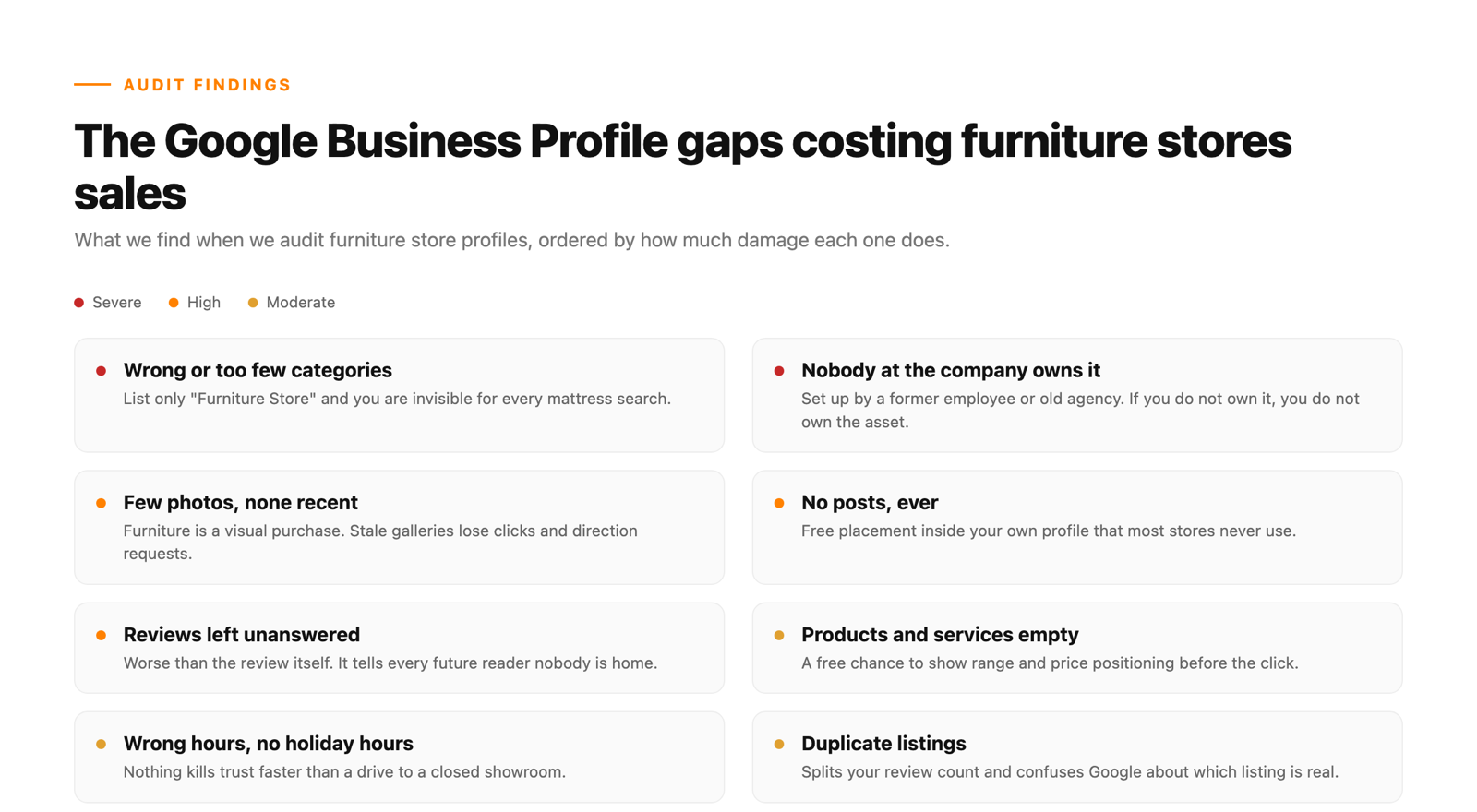
Here is what we find when we audit furniture store profiles, roughly in order of how much damage each one does.
Your categories are wrong or too few. This is the most common and most damaging error. Google uses your primary category to decide which searches you are eligible for. A store selling sofas, mattresses, and dining sets that lists only "Furniture Store" is invisible for mattress searches. Set the most accurate primary category, then add every legitimate secondary one: Mattress Store, Bedroom Furniture Store, Outdoor Furniture Store, Interior Designer if you offer it.
You have almost no photos, and none of them are recent. Furniture is a visual purchase. Profiles with a deep, current photo library get more clicks and more direction requests. You need exterior shots so people recognize the building, interior shots that show the scale of the showroom, and product shots of what you actually stock now.
You are not posting. Google Business posts are free placement inside your own profile, and most furniture stores never use them. New arrivals, a sale, a delivery promise, a design service. For our clients we publish four posts a month as a standing deliverable, because consistency is what keeps the profile active in Google's eyes.
Your reviews are unanswered. Review volume, recency, rating, and whether you respond all feed both local ranking and the confidence AI engines have in recommending you. An unanswered negative review is worse than the review itself, because it tells every future reader that nobody is home.
Your product and service lists are empty. Google lets you list products and services directly on the profile. Furniture stores almost never fill this in, which is a wasted opportunity to show range and price positioning before the click.
Your hours are wrong, especially holiday hours. Nothing kills trust faster than a customer driving to a closed showroom. Holiday hours in particular are the ones nobody updates.
You have duplicate or unclaimed listings. Old locations, a second listing someone created years ago, a slightly different business name. Duplicates split your review count and confuse Google about which listing is real.
Nobody at your company controls the profile. We have seen stores where the profile was set up by a former employee or a past agency and the owner has no access. Fix this before anything else. If you do not own the account, you do not own the asset.
The fix, in order
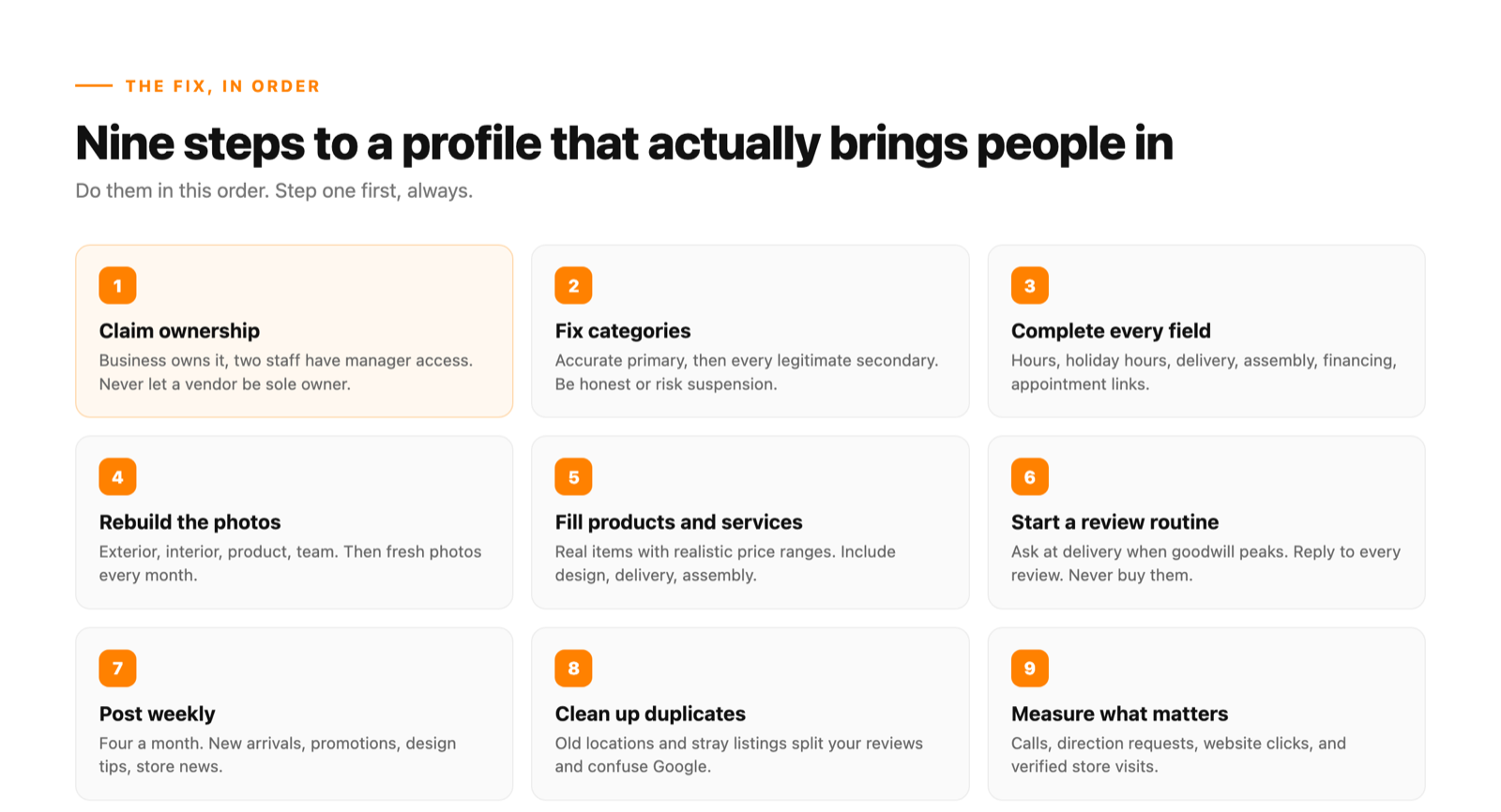
Step 1. Claim ownership and confirm access. Make sure the business owns the profile and at least two people at your company have manager access. Never let a vendor be the sole owner of your listing.
Step 2. Fix categories. Set the most accurate primary category, then add all legitimate secondary ones. Be honest here. Adding categories you do not serve gets listings suspended.
Step 3. Complete every field. Description, hours, holiday hours, attributes like delivery, assembly, financing, wheelchair access, appointment links. Google rewards completeness, and each attribute is a filter a shopper might use.
Step 4. Rebuild the photo library. Exterior, interior, product, team. Then add fresh photos monthly. This single habit separates active profiles from dormant ones.
Step 5. Fill in products and services. Load your main categories with real items and realistic price ranges. Include the services that differentiate you, like design consultation, delivery, and assembly.
Step 6. Start a review routine. Ask every satisfied buyer at the point of delivery, when goodwill is highest. Respond to every review, positive and negative, within a few days. Never buy reviews.
Step 7. Post weekly. Four posts a month is the cadence we run for clients. Rotate between new arrivals, promotions, design tips, and store news.
Step 8. Clean up duplicates. Search your business name and address variations, and request removal or merging of anything stale.
Step 9. Measure the right things. In the profile insights, watch calls, direction requests, and website clicks. If you run Google Ads, turn on store visit tracking so you can connect spend to actual foot traffic rather than guessing.
What good looks like
This work is unglamorous and it compounds. Two examples from our own accounts.
For Saloni Furniture US, monthly Google Business optimization runs alongside their SEO program. They now rank number one for local intent searches like "furniture stores leesburg va" at 260 searches a month, and Google verified 4,824 in-store visits driven by the campaigns we manage.
For Sullivan Outdoor Furniture, four Google Business posts a month plus monthly profile optimization are standing deliverables, part of the program that took them from zero organic presence to 2,900 ranking keywords.
Neither result came from a clever trick. Both came from doing the boring things every single month while competitors did them once.
Mistakes to avoid
Keyword stuffing your business name. Adding "Furniture Store Cheap Sofas Dallas" to your name is a violation and a suspension risk. Use your real name.
Fake or incentivized reviews. Google has become aggressive about detecting review manipulation. The downside risk of a suspension far outweighs a few extra stars.
Setting a service area you do not serve. Overstating your radius dilutes relevance rather than expanding reach.
Letting the profile go quiet for months. A profile with no new photos, posts, or review responses reads as a business that might not be operating.
Key takeaways
- Your Google Business Profile is a second storefront, not a directory entry, and for many shoppers it is the first one they see.
- Wrong or missing categories are the most common and most costly error. Fix those first.
- Completeness matters. Fill every field, including products, services, attributes, and holiday hours.
- Post four times a month and respond to every review. Consistency beats intensity.
- Confirm your business owns the profile. Never let an agency or former employee be the sole owner.
- Google Business data now feeds AI answers, so a neglected profile makes you invisible to AI recommendations too.
Frequently asked questions
Does a Google Business Profile really affect furniture store sales?
Yes, directly. It determines whether you appear in local map results for searches like "furniture store near me," and it drives calls, direction requests, and showroom visits. Google can even verify in-store visits driven by your campaigns, which for one of our clients totaled 4,824.
How often should a furniture store post on Google Business Profile?
We run four posts a month for clients, which works out to roughly weekly. Consistency matters more than volume, because an actively maintained profile signals an operating business to both Google and AI engines.
What is the most important Google Business Profile setting for a furniture store?
Your categories. The primary category determines which searches you are eligible to appear in, and missing secondary categories like Mattress Store or Outdoor Furniture Store make you invisible for entire product lines you actually sell.
How do I get more Google reviews for my furniture store?
Ask at delivery, when customer satisfaction peaks and the product is in their home. Make it a standard part of the delivery process rather than an afterthought, and respond to every review you receive. Never buy reviews, since the suspension risk is far greater than the benefit.
Does Google Business Profile affect whether AI recommends my store?
Yes. Google AI Overviews and Gemini draw heavily on Google Business data when answering local questions. An incomplete profile limits your visibility in AI answers regardless of how good your website is.
Where to start
If you want to know exactly what is missing from your profile, that is one of the first things we audit for every furniture store we work with, and we will tell you what we find whether or not you hire us.
Book a free strategy call and we will go through your Google Business Profile together, category by category. No pressure and no commitment.