




One of our best clients found us in a way that would have been impossible three years ago. They did not click a Google ad. They did not find us on page one of Google. They asked ChatGPT for the best marketing agency for furniture stores, and ChatGPT recommended us. They signed a few weeks later.
That is not a cute story about AI. That is a preview of how your next customer is going to find, or not find, your furniture store.
This post explains Generative Engine Optimization (GEO) in plain language for furniture and mattress store owners. No jargon, no hype. What it is, why it matters more for furniture than for almost any other retail category, and exactly what to do about it.
What is GEO? The plain answer
Generative Engine Optimization (GEO) is the practice of making your business visible and recommendable to AI engines like ChatGPT, Google AI Overviews, Gemini, and Perplexity. Where SEO helps you rank in a list of ten blue links, GEO helps you become the answer when a shopper asks an AI a question like "what is the best furniture store near me" or "where should I buy a quality sectional under $2,000."
The difference matters because AI answers do not show a list of twenty options. They name two or three. Either your store is in that answer, or it does not exist for that shopper.
GEO, SEO, and AEO. What is the difference?
You will hear these three terms used together, and they overlap, but they are not the same thing.
SEO (Search Engine Optimization) gets your website ranked in traditional search results. It is still the foundation. AI engines learn about your store largely from the same content and signals that Google reads.
AEO (Answer Engine Optimization) structures your content so search engines can lift direct answers from it. Think FAQ pages, clear question and answer headings, and schema markup that feeds featured snippets and AI Overviews.
GEO (Generative Engine Optimization) goes one step further. It is about being cited and recommended inside generated answers. That includes what ChatGPT says when someone asks it to compare furniture stores in your city, and which businesses Google's AI Overview names before anyone scrolls to the organic results.
You cannot do GEO without SEO underneath it. But SEO alone no longer finishes the job.
Why furniture stores are more exposed to this shift than almost anyone
Furniture is a research purchase. Shoppers spend weeks comparing styles, materials, prices, and stores before they buy, and around 90 percent of furniture buying journeys now start online, even when the sale finishes in a showroom. The average shopper visits fewer than two stores in person before making a decision. The store they walk into was chosen during the research phase.
Now that research phase is moving into AI. Shoppers ask ChatGPT how to choose between a memory foam and a hybrid mattress. They ask Google whether cast aluminum patio furniture holds up in coastal weather. They ask Perplexity which local stores deliver and assemble. Every one of those answers now names specific businesses and products.
Here is the uncomfortable math. If AI answers name three stores and yours is not one of them, you lost that customer before you ever knew they existed. There is no page two of a ChatGPT answer.
How AI engines decide which furniture stores to recommend
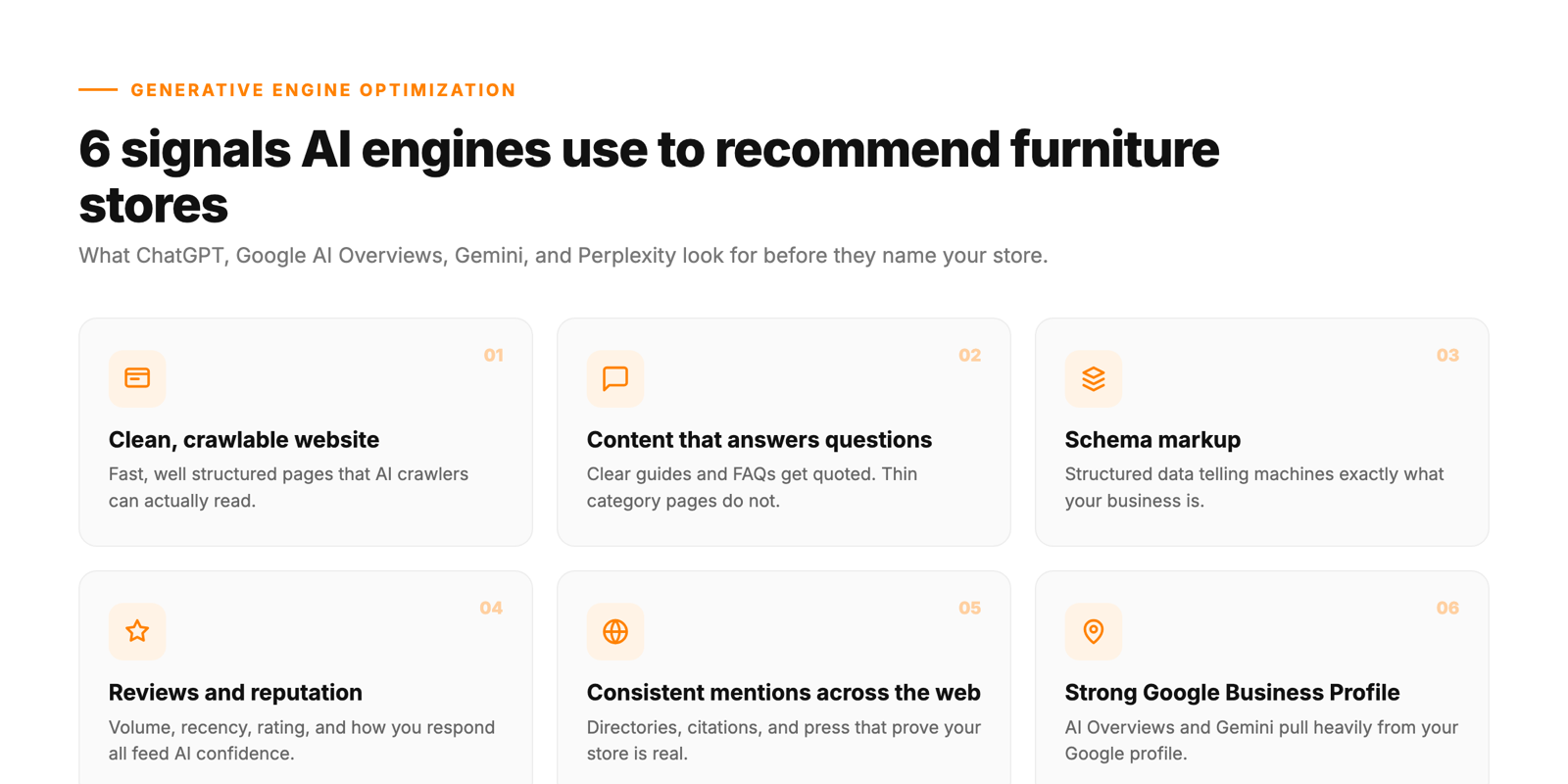
AI engines do not pick names out of thin air. They synthesize what they find across the web, and they favor businesses that look consistent, credible, and well documented. From the GEO work we do across furniture retailers, these are the signals that move the needle:
1. A technically clean, crawlable website. If AI crawlers cannot read your site, you are invisible. Fast pages, clean structure, and no walls between your content and the bots that read it.
2. Content that actually answers questions. AI engines quote content that explains things clearly. Buying guides, comparison articles, FAQ pages, and honest educational content get cited. Thin category pages with three sentences of copy do not.
3. Schema markup. Structured data tells machines exactly what you are: a furniture store, at this address, with these hours, these products, these reviews. It is the difference between an AI guessing about your business and an AI knowing.
4. Reviews and reputation. AI answers lean heavily on review signals. Volume, recency, rating, and how you respond all feed the machine's confidence in recommending you.
5. Consistent mentions across the web. Directory listings, local citations, press mentions, and industry coverage all teach AI engines that your store is real and established. Inconsistent names, addresses, and phone numbers do the opposite.
6. A strong Google Business Profile. AI Overviews and Gemini pull heavily from Google's own business data. An incomplete or stale profile caps your visibility no matter how good your website is.
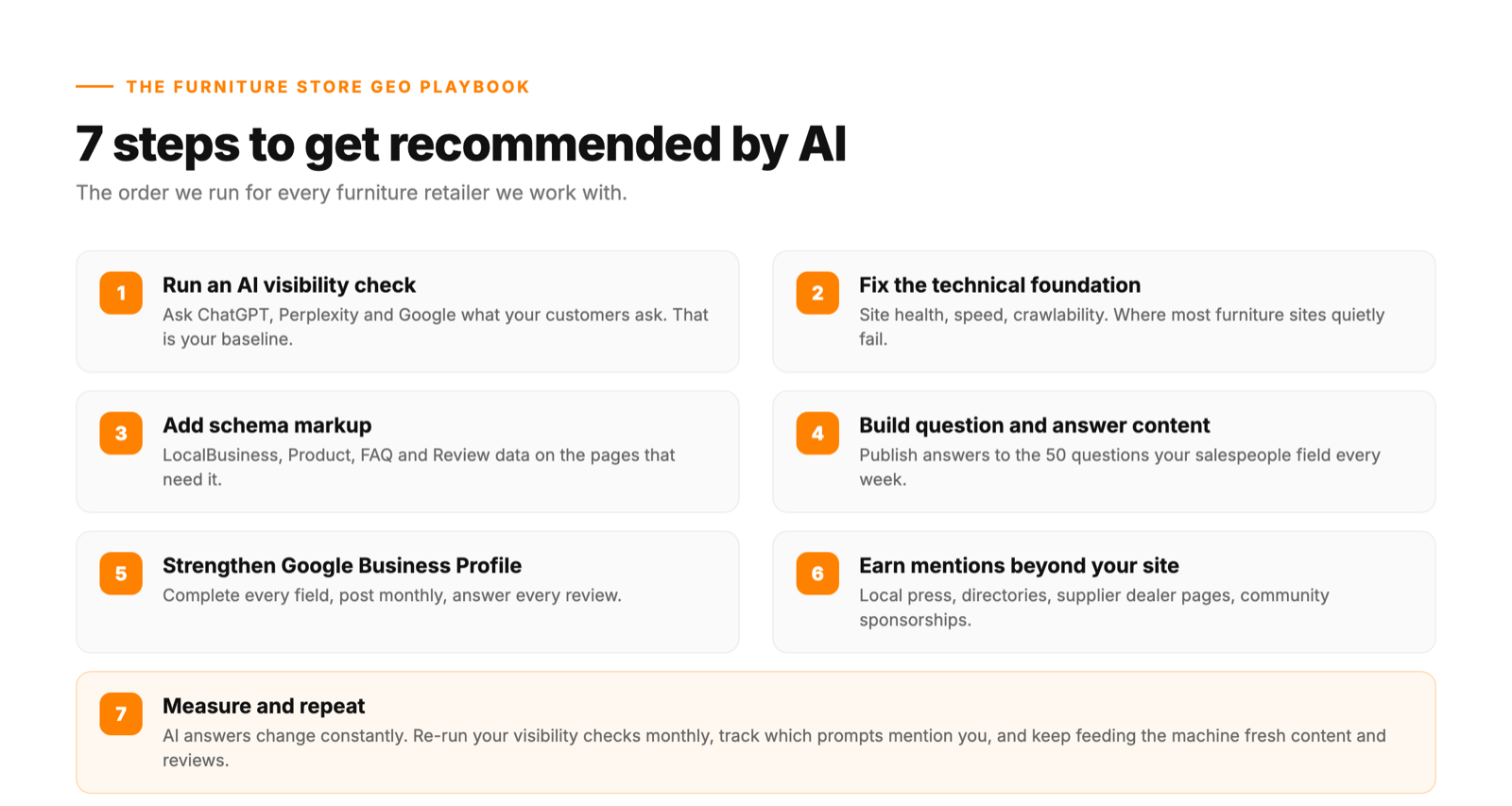
The furniture store GEO playbook: 7 steps
Here is where we start with every furniture retailer, in order.
Step 1. Run an AI visibility check. Ask ChatGPT, Perplexity, and Google (with AI Overviews on) the questions your customers ask. Best furniture store in your city. Best place to buy a mattress near you. Your store name plus reviews. Write down what comes back. That is your baseline.
Step 2. Fix the technical foundation. Site health, page speed, crawlability, and indexation. This is unglamorous and it is where most furniture sites quietly fail.
Step 3. Add schema markup everywhere it belongs. LocalBusiness or FurnitureStore schema on your location pages, Product schema on product pages, FAQ schema on question pages, Review schema where you show reviews.
Step 4. Build question and answer content. Take the fifty questions your salespeople answer on the floor every week and publish clear, direct answers to each one. This single habit produces the content AI engines cite most.
Step 5. Strengthen your Google Business Profile. Complete every field, add photos monthly, post updates, and answer every review. Treat it like a second homepage, because for AI it often is.
Step 6. Earn mentions beyond your own website. Local press, industry directories, supplier dealer pages, community sponsorships. Every credible mention is another vote that AI engines count.
Step 7. Measure and repeat. AI answers change constantly. Re run your visibility checks monthly, track which prompts mention you, and keep feeding the machine fresh content and reviews.
Does this actually work? Two real furniture stores
We do this work every day, so we can show receipts.
Sullivan Outdoor Furniture went from zero organic presence to 2,900 ranking keywords, with multiple number one positions on high intent terms, and survived a complete rebrand and domain migration without losing a single ranking. The owner found us the same way this post began, through a ChatGPT recommendation.
Saloni Furniture US shares its brand name with two other furniture companies, including an established Italian brand. Focused GEO and SEO work took them to the number one position for their own brand terms in the US market, with strong positive sentiment across ChatGPT, Gemini, Perplexity, and Google AI Mode.
Key takeaways
- GEO is how your store gets recommended by ChatGPT, Google AI Overviews, Gemini, and Perplexity, not just ranked in traditional search.
- AI answers name two or three businesses. There is no page two. Absence is invisibility.
- Furniture is uniquely exposed because the entire research phase, where stores are chosen, is moving into AI conversations.
- The winning signals are a clean technical foundation, genuine question answering content, schema markup, reviews, and consistent mentions across the web.
- SEO is still the foundation. GEO is the layer on top that turns rankings into recommendations.
- Start by checking what AI engines say about your store today. You cannot fix what you have not measured.
Frequently asked questions
What does GEO stand for in marketing?
GEO stands for Generative Engine Optimization. It is the practice of optimizing your business and website so AI engines like ChatGPT, Google AI Overviews, Gemini, and Perplexity mention and recommend you in their generated answers.
Is GEO different from SEO?
Yes. SEO earns you a position in a list of search results. GEO earns you a place inside the AI generated answer itself. They share the same foundation, and strong SEO makes GEO possible, but GEO requires extra work on structured data, question answering content, and reputation signals.
How do I know if my furniture store shows up in AI search results?
Ask the engines directly. Prompt ChatGPT, Perplexity, and Google with the questions your customers ask, such as the best furniture store in your city or the best mattress store near you. If your store is not named, or is described inaccurately, you have a GEO gap.
How long does GEO take to show results?
Foundational fixes like schema markup and Google Business Profile improvements can influence AI answers within weeks. Content authority and consistent mentions build over months. Most furniture retailers see meaningful movement inside one to two quarters of consistent work.
Can a small independent furniture store really compete with Wayfair and Ashley in AI results?
Yes, especially locally. AI engines favor specific, well documented, well reviewed local answers for local questions. A national brand cannot out answer you on "best furniture store in your city" if your store has the stronger local signals. That is exactly the fight independent retailers can win.
Where to start
If you want to know exactly where your store stands in AI search today, that is literally what we do. We are the furniture industry's marketing agency, and AI visibility is now the first thing we audit for every store we work with.
Book a free strategy call and we will run your store's AI visibility check together, no charge and no obligation. Or grab the free Furniture Marketing Book and read the full playbook first. Either way, do not wait until your competitor is the store ChatGPT recommends in your city.