




There is a version of online shopping that is close enough to plan for and far enough away that almost nobody has. Instead of a person searching, comparing and buying, they describe what they need and an AI assistant does the searching, comparing, and increasingly the buying.
For most retail categories that is a distant curiosity. For furniture it matters sooner than you would think, and the reason is your data.
The short answer
AI assistants are moving from recommending products to transacting on a shopper's behalf. An agent cannot consider a product it cannot read, so the retailers who stay visible will be the ones whose product data is complete, structured, and machine readable. For furniture that means dimensions, materials, stock, delivery and lead times, in fields rather than in prose.
The work required is unglamorous. It is also work you should be doing for human shoppers anyway, which is what makes it worth starting now rather than waiting to see how it plays out.
What agentic actually means
The word is doing a lot of work, so it is worth being precise, and worth being honest about what is speculative.
What is already happening. AI assistants recommend specific retailers by name. We can measure this. Across tracked AI answers our own brand appears in roughly 40 percent of them, and assistants already send real converting traffic to our clients' sites. That part is not a forecast.
What is emerging. Assistants that complete a purchase inside the conversation, using stored payment details and a retailer's data feed. The infrastructure for this is being built now by the large platforms.
What is genuinely uncertain. Whether furniture buyers will actually delegate a three thousand pound sectional to an agent. My honest view is mostly not, at least not soon. Furniture is high consideration, physical, and frequently needs to be sat on.
So why care. Because the agent does not need to complete the purchase to decide your fate. It only needs to build the shortlist. And a shortlist assembled from structured data will exclude you silently if your data is thin.
Why furniture is unusually exposed
Furniture has more machine unreadable complexity than almost any other category.
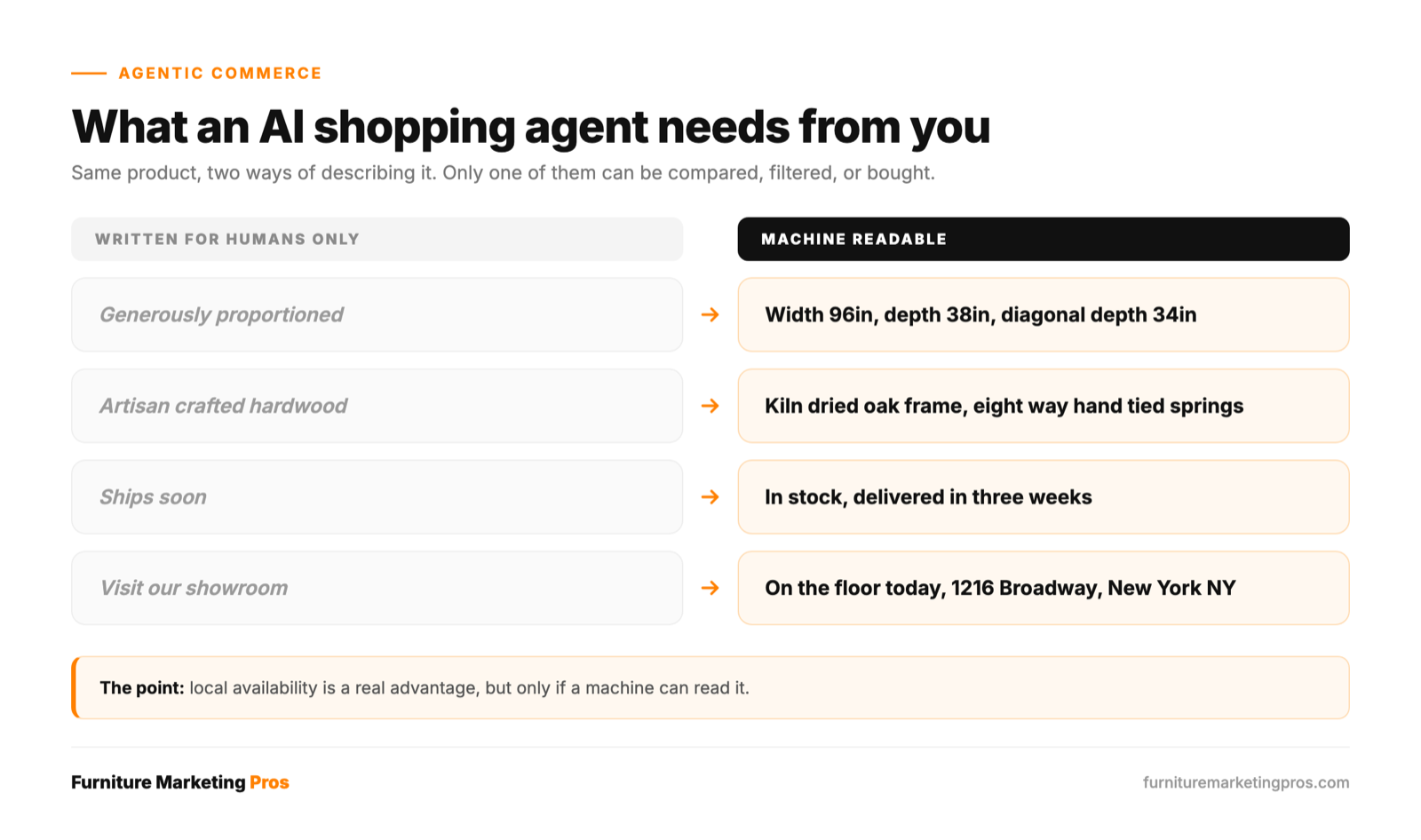
Dimensions decide everything and are usually buried. Whether a sofa fits through a doorway is the single most common reason a furniture purchase fails. That information typically lives in a paragraph, or a PDF, or a photograph of a spec sheet. An agent filtering for "fits a 32 inch doorway" cannot read any of those.
Materials and construction matter and are described poetically. "Artisan crafted hardwood frame" is marketing copy. "Kiln dried oak frame, eight way hand tied springs" is data. Only one of those can be matched against a query.
Lead times are the real product. In furniture, whether something ships in three weeks or sixteen frequently decides the sale. Most sites either hide this or state it vaguely, which means an agent comparing availability cannot include you.
Local stock is your actual advantage and it is invisible. Having the piece on your floor today is the thing a national warehouse cannot match. If that is not expressed anywhere a machine can read, the advantage does not exist as far as the agent is concerned.
That last point is the one I would think hardest about. Agentic shopping could genuinely favour local retailers, because immediacy and physical availability are real differentiators. But only if they are legible.
What to do now, in order of payback
Everything here helps human shoppers too. That is the test I would apply to any AI readiness advice: if it only helps machines, be suspicious of it.
Get dimensions into structured fields. Width, depth, height, seat height, and where relevant the diagonal depth that determines whether it gets through a door. Not in a paragraph. In fields, on the page, in your feed.
Separate materials from marketing. Keep the evocative copy, and add a plain specification block underneath. Frame material, upholstery composition, cushion fill, finish.
State availability and lead time explicitly. In stock, in the showroom, weeks to delivery. Vagueness reads as unavailable to anything automated.
Mark up your products properly. Product schema with price, availability, and dimensions, so the data is machine readable rather than merely visible. This is the same structured data work that makes you eligible for rich results, which is why it pays twice.
Clean your feed. If you run Shopping campaigns you already have a feed, and it is probably the most complete product data you own. It is also probably full of gaps. Fixing it improves your ads and your agent readiness in one pass. Our ecommerce SEO work covers the feed side.
Publish the constraints. Delivery radius, assembly, stairs, removal of old furniture. These are exactly the filters an agent applies and exactly the questions a human asks.
Then do the entity work. Business markup with your address, clear statements of who you serve, real reviews. This is what lets an assistant place you and decide to mention you. Our GEO and AEO work is about this, and the foundations are in what GEO means for furniture stores.
What I would not do
Do not rebuild your site for agents. The infrastructure is unsettled and anyone selling you an agentic commerce platform today is selling a guess.
Do not block AI crawlers reflexively. Some retailers have, reasoning that assistants take traffic. If an assistant cannot read you it cannot recommend you, and recommendation is where this is heading. Worth checking your CDN, since some now block them by default.
Do not assume it replaces the showroom. Furniture closes in person more often than not. Agentic shopping most plausibly changes how the shortlist forms, not where the sale happens.
Do not wait for certainty. Not because of hype, but because the preparation is just good product data. That has been worth doing for a decade.
Key takeaways
- AI assistants already recommend retailers by name and send converting traffic. The transacting part is emerging, the recommending part is here.
- An agent cannot consider what it cannot read. Thin product data means silent exclusion from the shortlist.
- Furniture is unusually exposed because dimensions, materials, lead times and local stock are the deciding factors and are usually written for humans only.
- Local availability could be a genuine advantage in agentic shopping, but only if it is expressed in machine readable form.
- Every useful step here also helps human shoppers. If a recommendation only helps machines, be sceptical of it.
- Do not rebuild for agents and do not block AI crawlers. Clean your data and do the entity work.
Frequently asked questions
What is agentic AI shopping?
It is when an AI assistant does the searching, comparing and increasingly the purchasing on a shopper's behalf, rather than the person browsing themselves. The recommending part already happens today. Completing transactions inside the conversation is emerging.
Will people really let AI buy furniture for them?
Probably not often, at least not soon. Furniture is high consideration and physical, and most buyers want to see and sit on it. The reason it still matters is that the agent builds the shortlist, and if your data is unreadable you are excluded from that shortlist regardless of who completes the purchase.
How do I make my furniture store AI ready?
Put dimensions, materials, availability and lead times into structured fields rather than prose, add Product schema, clean your product feed, publish your delivery and assembly constraints, and make sure business markup with your address is in place. All of it helps human shoppers too.
Should I block AI crawlers from my furniture website?
No. An assistant that cannot read your site cannot recommend it, and recommendation is where this is going. Check your CDN settings too, since some now block AI crawlers by default without you choosing that.
Does agentic shopping favour big retailers or local stores?
It could genuinely favour local stores, because immediate availability and physical stock are real differentiators a national warehouse cannot match. That only holds if the availability is expressed somewhere a machine can read, which for most local retailers it currently is not.
Where to start
If you want to know whether your product data would survive an agent's filter, that is a concrete thing we can check, and the same audit improves what human shoppers see.
Book a free strategy call and we will look at your product data, your feed, and your entity markup. No pressure and no commitment.