




Most furniture store websites are brochures. They state that the store exists, show some rooms, list the hours, and wait.
That was adequate when the website's job was to confirm a store was real. It is not adequate now that most of the buying decision happens before anyone walks in. A brochure describes. A lead machine captures.
The difference is mostly not design. It is a handful of specific mechanics that are either present or absent.
The short answer
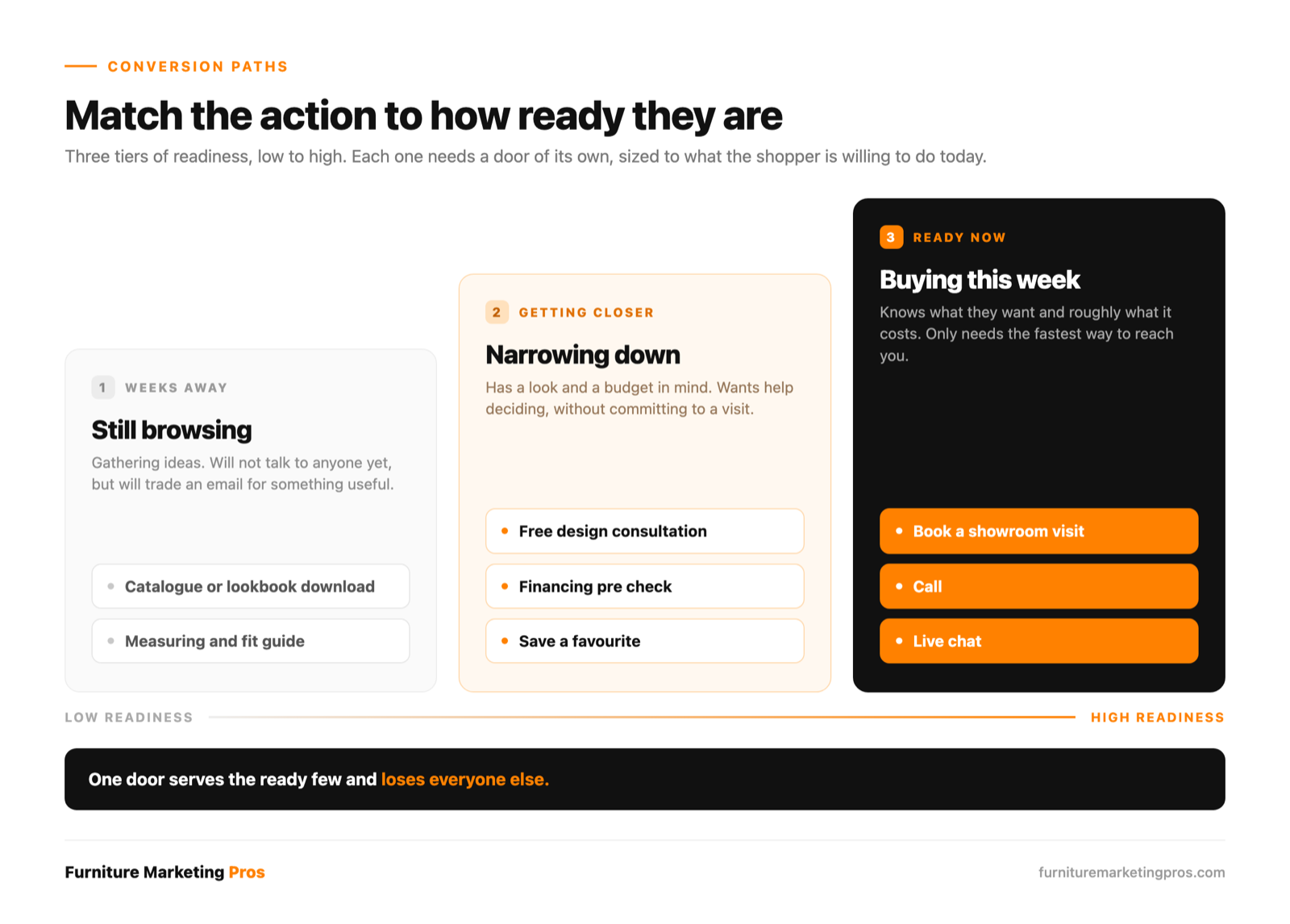
A furniture store website becomes a lead machine when it gives visitors something to do at every stage of readiness, not just at the point of purchase. Most sites offer exactly one action, buy now or visit us, which serves the small fraction of visitors who are ready and abandons everyone else.
Your traffic is not one audience. It is people three weeks apart in their decision, being offered the same single door.
Start by finding out what your site actually does
Before changing anything, get the honest numbers. Almost every store is surprised.
How many visitors do anything at all? Not sessions. Not pageviews. Actions. Form submissions, calls, chats, appointment bookings, catalogue downloads.
Where do they leave? If a category page bleeds visitors, that is a content problem. If your contact page does, that is a friction problem, and a much easier fix.
What share of your traffic is mobile, and does it behave differently? For most furniture sites mobile is well over half of visitors and engages far worse. On our own site mobile was 58 percent of sessions at 26 percent engaged against desktop at 43 percent, and the cause turned out to be load time rather than content.
Are calls being counted? A large share of furniture enquiries are phone calls. If the phone number is not tracked, a meaningful part of your website's output is invisible and it will look like the site is not working.
That last one matters more than people expect. We have taken over accounts where the site appeared to produce almost nothing because every call it generated was uncounted.
The friction that costs you the most
Speed, before anything else. A slow site does not annoy visitors, it loses them silently before they see anything. Test on a throttled mobile connection rather than your office wifi. Compressing images and deferring third party scripts is usually where the time is. On our own site the heaviest asset turned out to be a partner logo shipping at 95KB to be displayed 40 pixels tall.
Forms that ask too much too early. A nine field form is appropriate for a design consultation and absurd for someone who wants a price. Match the ask to the readiness.
A phone number that is not tappable on mobile. Genuinely still common, and it is a one line fix.
No visible next step on category pages. A visitor who likes a collection but is not ready to visit has nowhere to go, so they leave.
Hiding delivery and financing. These are the two questions that stop furniture purchases. Answering them prominently converts more than any headline change.
Give people something to do before they are ready
This is the actual mechanism, and where most brochures fail. You need a low commitment action for a visitor who is interested but weeks away.
A catalogue or lookbook download. Costs nothing, gives you an email, and gives them something useful for a decision they have not made yet.
A design consultation booking, framed as advice rather than sales. Free, thirty minutes, no obligation. The framing does the work.
A measuring or fit guide. Will it fit is the most common furniture anxiety. A guide that helps answer it earns the contact detail.
A financing pre check. For a category with high average order values, knowing what they can afford is often the real blocker.
Save or favourite a piece. Requires an email, gives you intent data about the exact item, and gives them something genuinely convenient.
Live chat, if it is actually answered. Chat that nobody staffs is worse than no chat, because it teaches visitors you are unresponsive.
You do not need all six. You need two or three, matched to how your customers actually behave, each with a clear job.
The pages that do the converting
Not your homepage. Almost never your homepage.
Category pages are where most search traffic lands and where most sites offer nothing but a grid. Add real written context about who the collection suits, what the materials are, delivery expectations, and a next step.
Product pages need the information that decides the sale. Full dimensions including whether it fits through a door, materials in plain language, lead time stated explicitly, and delivery terms. Vagueness reads as unavailable.
The location or visit page is high intent and usually neglected. Parking, what to expect, whether to book, who they will meet.
Question pages answering what your staff answer daily. These bring in search traffic and build trust simultaneously.
Proof pages. Real projects, real customers, real numbers. For Statements by J organic search went from zero to $75,967 in revenue over nine months, largely on the back of content and structure work rather than ad spend.
Then make sure the lead survives contact
Capturing a lead you then lose is worse than not capturing it, because you have spent the trust.
Respond fast. Furniture enquiry response times are frequently measured in days. The shortlist is decided in hours.
Route the lead somewhere accountable. A shared inbox nobody owns is where enquiries go to die. This is what a CRM is actually for, and our FMP CRM exists because so many stores were losing leads at exactly this step.
Follow up more than once. Given how long the furniture consideration cycle is, one email is not a follow up.
Ask for the review afterwards, at delivery when goodwill peaks. That feeds back into reviews and reputation and into local ranking.
Key takeaways
- Your traffic is not one audience. Offering only buy now or visit us serves the ready few and abandons everyone else.
- Measure actions, not sessions. And track calls, or a large share of your site's real output stays invisible.
- Speed is the first conversion fix, not a technical footnote. Test on a throttled mobile connection.
- Add two or three low commitment actions for visitors who are weeks away, not six.
- Category and product pages convert, not the homepage. Dimensions, materials, lead time and delivery decide furniture sales.
- A captured lead that nobody follows up is worse than no lead, because you spent the trust to get it.
Frequently asked questions
Why does my furniture store website get traffic but no leads?
Usually because it offers only one action, buy or visit, which suits the small fraction of visitors who are ready today. Add a low commitment option for people who are weeks away, and check that phone calls are being tracked, since a large share of furniture enquiries arrive by phone and often go uncounted.
What features does a furniture store website need to generate leads?
Fast mobile load, a tappable phone number, full dimensions and lead times on product pages, visible delivery and financing information, and two or three low commitment actions such as a catalogue download or a free design consultation. Live chat only if somebody actually answers it.
How fast should a furniture store website load?
Under about three seconds on a mobile connection, tested with real throttling rather than on office wifi. Speed is a conversion issue rather than a technical nicety, because a slow site loses visitors before they ever see the content.
Is a website redesign worth it for a furniture store?
Often the mechanics matter more than the design. Before commissioning a redesign, check whether the current site is slow, whether calls are tracked, whether product pages state dimensions and lead times, and whether there is any action for a visitor who is not ready yet. Those usually explain the lead volume.
Which pages on a furniture website convert best?
Category and product pages, because that is where search traffic lands and where the deciding information belongs. The homepage is rarely where conversion happens, which is why homepage redesigns so often fail to change lead volume.
Where to start
If you want to know what your website is actually producing and where it is leaking, that is exactly what a website audit covers, and we will tell you what we find whether or not you hire us.
Book a free strategy call and we will look at your speed, your tracking, and what your site offers a visitor who is not ready today. No pressure and no commitment.