




"How much should I be spending on marketing?" is the question we get on almost every first call with a furniture store owner. The honest answer is that most owners are not spending the wrong amount. They are spending the right amount in the wrong places.
This guide gives you the framework we use with furniture and mattress retailers: what percentage of revenue to budget, how to split it across channels, and what each channel actually costs, using real numbers from accounts we manage today.
The short answer
Most furniture retailers should budget between 5 and 10 percent of gross revenue for marketing. Spend closer to 5 percent if you are protecting an established position, and closer to 10 percent if you are trying to grow, open a location, or recover lost ground.
If you are under $1 million in revenue, treat that percentage as a floor rather than a ceiling. Small budgets have to buy visibility before they can buy volume, and there is a minimum spend below which paid channels simply cannot gather enough data to work.
Why furniture is different from other retail
Generic marketing budget advice fails furniture stores for three specific reasons.
Your average order value is high. A $1,410 average order, which is what one of our clients runs, changes everything about acceptable acquisition cost. A cost per lead that would bankrupt a coffee shop is perfectly healthy for a sectional sale.
Your consideration cycle is long. Shoppers research for weeks. That means you are paying to be present across multiple visits and multiple channels before a single sale closes, and it means last-click attribution will always undercount your real winners.
Most of your sales still happen in the showroom. Around 90 percent of furniture buying journeys start online, but the transaction often finishes in person. If you measure only online conversions, you will conclude that your marketing is failing when it is actually working.
Budget by revenue tier
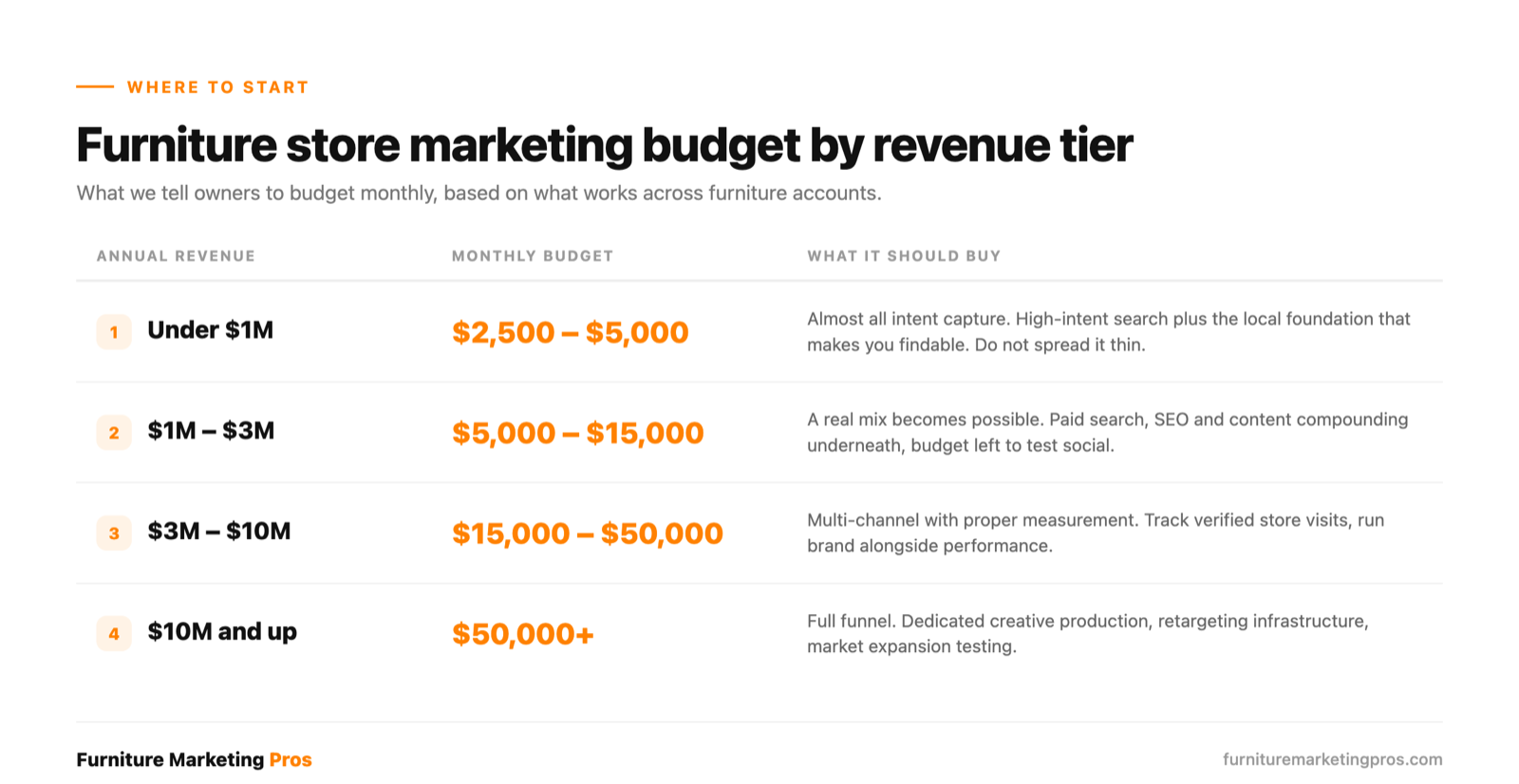
Here is where we tell owners to start, based on what we see working across furniture accounts.
Under $1 million: $2,500 to $5,000 per month. At this stage almost everything should go to intent capture. People already searching for what you sell, plus the local search foundation that makes you findable at all. Do not spread this budget across five channels.
$1 million to $3 million: $5,000 to $15,000 per month. This is where a real mix becomes possible. Paid search for demand capture, SEO and content building compounding value underneath, and enough left to test social.
$3 million to $10 million: $15,000 to $50,000 per month. Multi-channel with proper measurement. At this level you should be tracking verified store visits, not just clicks, and running brand campaigns alongside performance ones.
$10 million and above: $50,000 per month and up. Full-funnel with dedicated creative production, retargeting infrastructure, and market-level expansion testing.
The tiers overlap on purpose. A $3 million store opening a second showroom should budget like a $6 million store for two quarters.
How to split the budget across channels
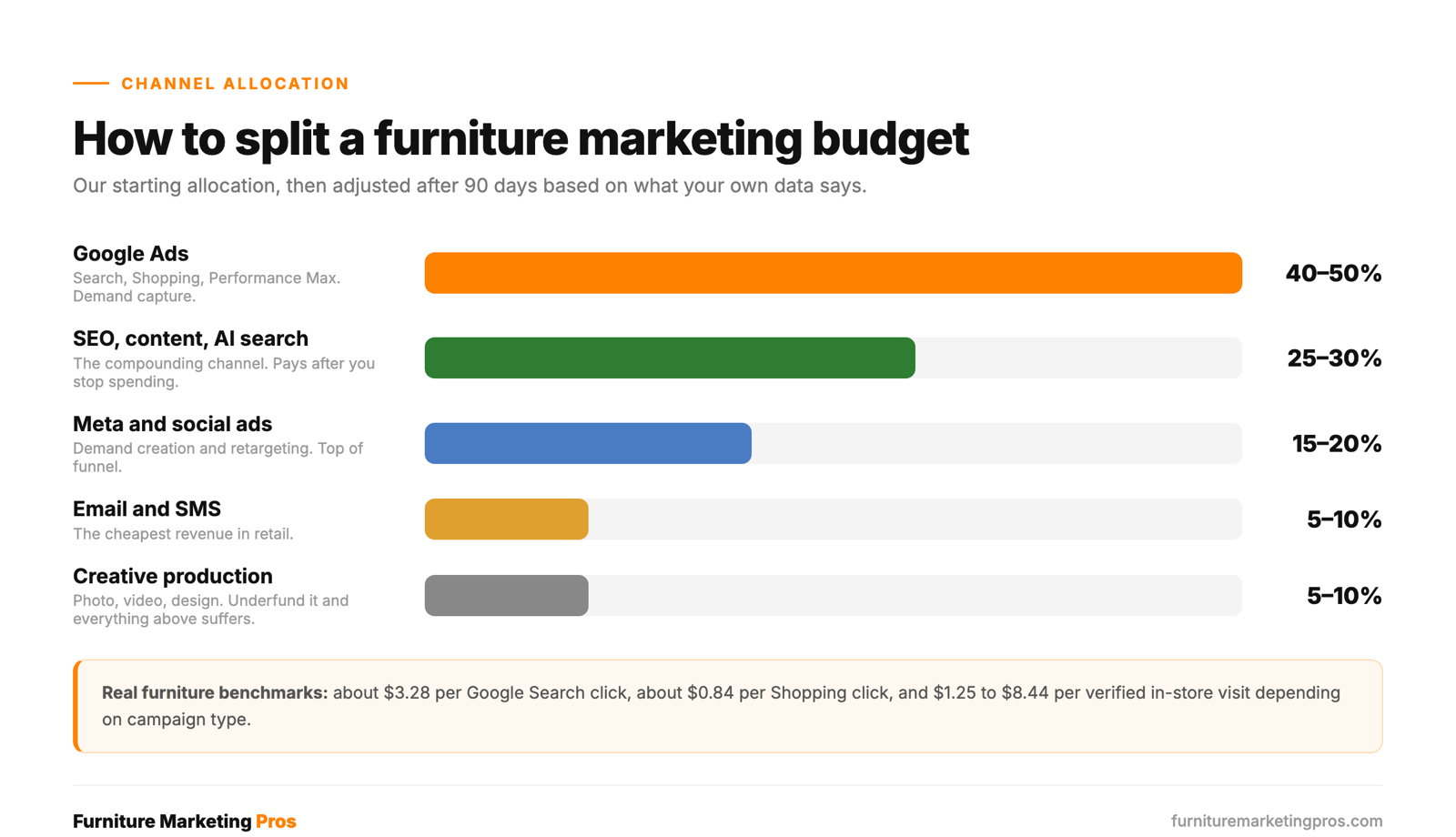
This is the allocation we start with for a typical furniture retailer, then adjust based on what the data says after 90 days.
Google Ads: 40 to 50 percent. Search, Shopping, and Performance Max. This is your demand capture. Somebody typing "sectional sofa near me" is the highest intent signal in your entire funnel, and you should not lose that click to a competitor.
SEO, content, and AI search: 25 to 30 percent. The compounding channel. It costs money for months before it pays, and then it pays without you spending per click. Increasingly this includes being recommended by ChatGPT and Google AI Overviews, not just ranking.
Meta and social ads: 15 to 20 percent. Demand creation and retargeting. Furniture is visual and aspirational, which suits these platforms, but treat them as top of funnel rather than expecting last-click sales.
Email and SMS: 5 to 10 percent. The cheapest revenue in retail. If you have a customer list and you are not marketing to it monthly, you are leaving money on the table.
Creative production: 5 to 10 percent. Photography, video, and design. Underfunding this quietly ruins the performance of every channel above it.
What each channel actually costs
Percentages are useless without real numbers. These are from live accounts we manage.
Google Search clicks in furniture run about $3.28 on average. In one account's first month after a rebuild, across nine structured campaigns, that was the blended cost per click.
Google Shopping is dramatically cheaper per click, around $0.84 in that same account. Shopping is usually the most efficient entry point for furniture retailers with a product feed.
Verified in-store visits can cost between $1.25 and $8.44. For a client with a physical showroom, our local campaigns drove store visits at $1.25 each while Performance Max came in at $8.44. Same store, same period, very different efficiency, which is exactly why you measure by channel instead of in aggregate.
Branded search is your cheapest, highest-converting inventory. One account showed a 5.70 percent click-through rate on branded terms and 12.25 percent on specific material keywords, versus roughly 1 percent on broad product campaigns.
Organic search costs nothing per click once it works. One of our clients now generates organic traffic worth about $5,500 per month in equivalent ad spend. Another went from zero organic revenue to $75,967 in nine months, without a dollar of ad spend attached to it.
The mistakes that waste furniture marketing budgets
Measuring the wrong thing. We took over an account where the previous agency was counting page scrolls and time on site as conversions. The reports looked excellent. The store had no idea how many people actually walked in. We rebuilt the measurement around verified store visits, and the picture changed completely.
Spreading a small budget too thin. A $3,000 monthly budget split across Google, Meta, TikTok, and display will underperform the same $3,000 spent entirely on high-intent search. Channels have minimum viable spends.
Cutting SEO when things get tight. Paid search stops the day you stop paying. Organic keeps working. Cutting the compounding channel to protect the rented one is the most common expensive mistake we see.
Treating brand terms as optional. If you are not bidding on your own name, you are letting competitors intercept people who were specifically looking for you.
Ignoring the showroom in the math. If online orders are 20 percent of your revenue and you only measure online conversions, you are judging your entire marketing program on a fifth of its actual impact.
A simple way to sanity check your budget
Work backwards from a sale instead of forwards from a percentage.
Take your average order value and your gross margin. If your average order is $1,400 and your margin is 45 percent, each sale contributes about $630. If you are willing to spend a third of that contribution to acquire the sale, your target acquisition cost is roughly $200. At a 2 percent conversion rate from click to sale, that supports about $4 per click, which is comfortably above furniture search CPCs.
Run that math with your own numbers and you will know within ten minutes whether your budget is realistic or whether your expectations are.
Key takeaways
- Budget 5 to 10 percent of gross revenue, toward the higher end if you are growing or opening a location.
- Under $1 million in revenue, concentrate spend on high-intent search rather than spreading it thin.
- A reasonable starting split is 40 to 50 percent paid search, 25 to 30 percent SEO and content, 15 to 20 percent social, 5 to 10 percent email and SMS, 5 to 10 percent creative.
- Real furniture benchmarks: about $3.28 per search click, about $0.84 per Shopping click, $1.25 to $8.44 per verified store visit.
- Measure verified store visits, not just online conversions, or you will misjudge everything.
- Protect the SEO line item. It is the only channel that keeps paying after you stop spending.
Frequently asked questions
How much should a furniture store spend on marketing?
Most furniture retailers should budget 5 to 10 percent of gross revenue. Established stores protecting their position can operate near 5 percent, while stores that are growing, opening a location, or recovering lost visibility should plan for closer to 10 percent.
What is a good marketing budget for a small furniture store?
For a store under $1 million in revenue, $2,500 to $5,000 per month is a realistic starting range. The important part is concentration. A smaller budget performs far better focused on high-intent search and local visibility than split across many channels.
How should a furniture retailer split the marketing budget between channels?
A practical starting allocation is 40 to 50 percent to Google Ads, 25 to 30 percent to SEO and content including AI search, 15 to 20 percent to Meta and social, 5 to 10 percent to email and SMS, and 5 to 10 percent to creative production. Adjust after 90 days based on your own channel data.
What is a good return on ad spend for a furniture store?
It depends on margin and average order value more than on any industry benchmark. Work backwards instead: multiply your average order value by your gross margin, decide what share of that contribution you will spend to win the sale, and use that as your target acquisition cost.
Is SEO or paid advertising better for furniture stores?
You need both, and they do different jobs. Paid search captures demand immediately but stops the day you stop paying. SEO and AI search compound and keep delivering afterward. We have seen a client build organic search into a $75,967 revenue channel from zero in nine months with no ad spend attached.
Where to start
If you want a straight answer about whether your current budget is right for your revenue and your market, that is exactly what our free strategy call covers. We will look at what you are spending, where it is going, and what the numbers say should change.
Book a free strategy call and bring your current numbers. No pressure and no commitment, just an honest read on your budget from people who only work with furniture retailers.