




Mattress retail has a search problem that furniture retail does not, and once you see it you cannot unsee it.
Nobody searches for a mattress. They search for a problem. Back pain, a hot sleeper, a partner who moves all night, a bad hip, a pregnancy, a teenager who has outgrown a twin. The product is the answer to the question, and the question is what gets typed.
Most mattress stores build websites organised entirely around the product. Brands, sizes, firmness levels, price tiers. Then they wonder why they get no organic traffic while a mattress review site with no showroom outranks them in their own town.
The short answer
Mattress shoppers search by condition, not by product. The stores that win organic traffic build pages that match a specific sleep problem to a specific solution, in a specific place. Condition plus location is the highest intent, lowest competition search in mattress retail, and almost no local store claims it.
Your advantage over a national review site is that you can be locally relevant and you have the product in a building someone can lie down in. Neither of those helps if you have no page that matches the question.
Why condition searches are worth more than brand searches
It is tempting to chase brand terms because the volume looks bigger. That is usually the wrong trade.
Condition searches are further along the decision. Someone typing a brand name is often comparison shopping or price checking, frequently against a national seller who will undercut you. Someone describing a problem is looking for guidance and is much more open to a recommendation.
Condition searches favour explanation, which favours you. A brand page is a commodity. Twenty sellers have the same page. An explanation of which mattress construction actually helps a specific problem is expertise, and expertise ranks.
Condition plus location has almost no competition. National review sites go after the condition term nationally. Local stores go after brand and generic terms. The combination of a condition and a place is frequently uncontested, which is the rarest thing in search.
And it converts. In accounts we manage, specific intent heavy terms consistently and dramatically outperform broad product campaigns. One account produced 12.25 percent click through rates on highly specific material keywords against roughly 1 percent on broad product campaigns. The specific search is not a smaller opportunity, it is a better one.
The page structure that actually ranks
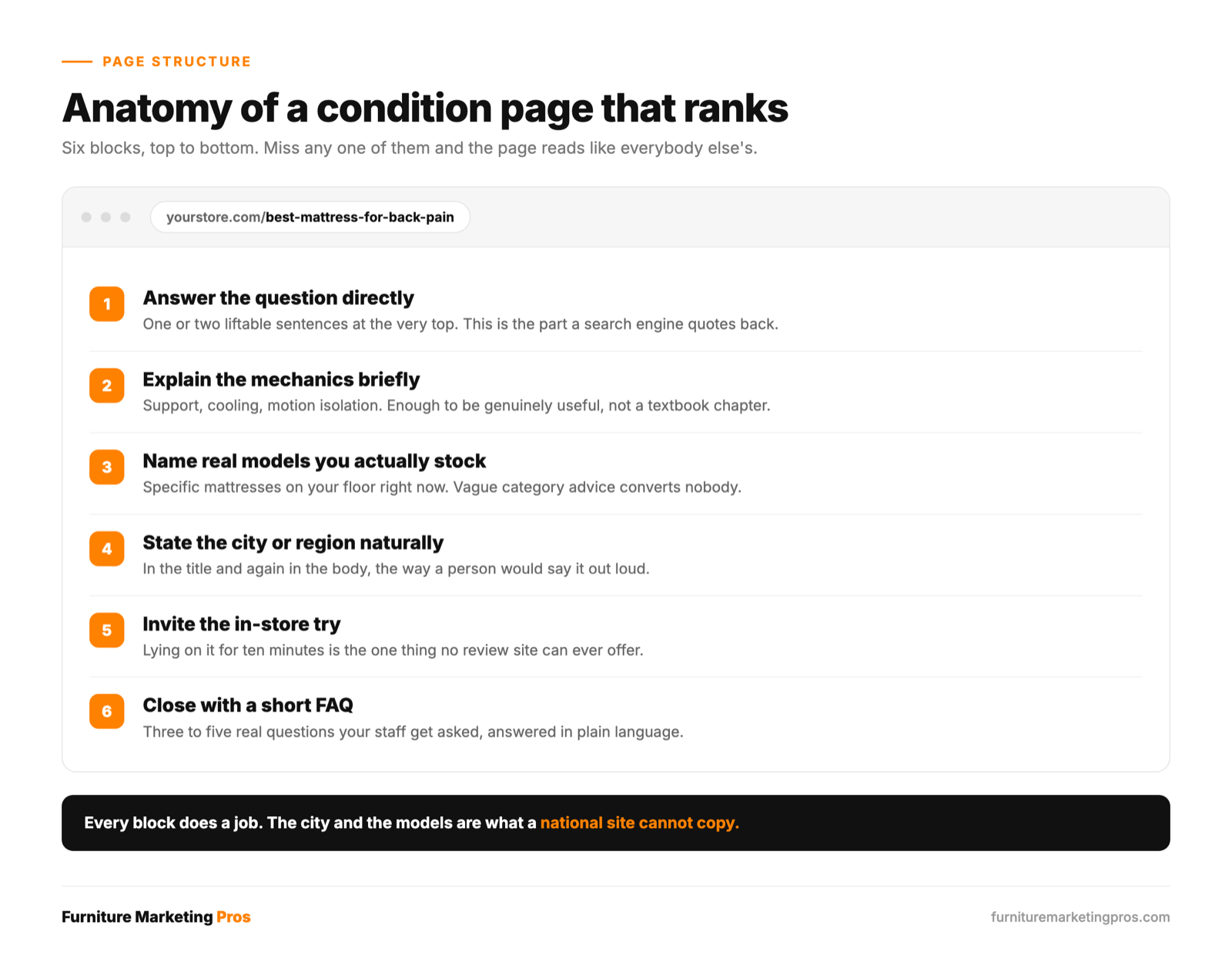
A condition page that works has a shape. It is not a product listing with a keyword dropped into the heading.
Open by answering the question directly. In one or two sentences, state what generally helps this problem. This is the passage a search engine or an AI assistant will lift, so make it clean and standalone. Vague openings get skipped.
Explain the why, briefly. What is happening physically, and what property of a mattress addresses it. Support, not just softness, for back pain. Heat dissipation and cover material for hot sleepers. Motion isolation for restless partners. Two or three honest paragraphs, not a medical essay.
Then name real options you actually stock. This is where most content marketing advice fails mattress retailers. A generic guide with no purchasable outcome is a bounce. Name the models on your floor that fit the need, with a sentence on who each suits.
Be explicit about the place. Your city or region in the heading, the body, and the page title, written naturally. This is what makes you the locally relevant answer rather than competing nationally.
Invite the one thing only you can offer. A national review site cannot let anyone lie down on anything. Say plainly that they can come and try these in person, and make booking that easy.
Add a short FAQ. Three to five real questions, answered in a couple of sentences each, phrased the way people ask them out loud.
Which conditions to build first
Do not build thirty pages. Build the handful that match real demand and real inventory, then expand.
Back pain is almost always the highest volume condition term in any market, and the most competitive nationally. Locally it is usually wide open.
Hot sleepers is consistently strong and maps cleanly to cooling constructions you likely already stock.
Side sleepers, and hip or shoulder pain is high intent and specific, and the explanation genuinely helps people.
Couples with different preferences is an underserved search with an obvious in store answer, since split firmness is easier to demonstrate than describe.
Heavier sleepers is a genuinely underserved query where support and durability advice is scarce and useful.
Pregnancy, and older adults are smaller volumes with very high intent and almost no local competition.
Start with three. Publish them properly rather than publishing ten thin ones, because a set of shallow pages is worse than a few good ones.
The local foundation this sits on
Content pages will underperform if the local basics are missing, because both feed the same relevance signal.
Your Google Business Profile is the first dependency. Correct primary category, and crucially the secondary ones. A store that sells mattresses but lists only "Furniture Store" is invisible for mattress searches, which is the single most common and most damaging profile error we find. The full fix list is here.
Reviews that mention the problem. A review saying a salesperson helped with back pain is both social proof and a relevance signal. Asking satisfied buyers to mention what they came in for is a small change with compounding effect.
Consistent name, address and phone everywhere. Conflicting details across your site, your profile, and directories quietly undermine everything above.
And the measurement that proves it worked. Track verified store visits, not just form fills. For Saloni Furniture US we track this directly, and the campaigns we manage have produced 4,824 Google verified in store visits. For a mattress store, where the sale almost always finishes in person, that is the only number that describes the whole picture.
If you want the underlying mechanics, our local SEO work covers the profile, citation and ranking side in more depth.
Mistakes that waste the opportunity
Making medical claims. Say what a construction does mechanically. Do not claim to treat a condition. This matters legally and it matters for trust.
Publishing guides with no purchasable outcome. Traffic that cannot buy anything from you is a vanity metric.
One page stuffed with every condition. Each condition is a separate search with separate intent. Combining them means ranking for none.
Copying manufacturer descriptions. Every other retailer has the same text. Duplicated content cannot differentiate you.
Ignoring the phone. Condition searches produce callers with questions. If nobody answers well, the ranking is wasted.
Key takeaways
- Mattress shoppers search by problem, not product. Build pages that match a condition to a solution in a specific place.
- Condition plus location is high intent and usually uncontested, because national sites chase the condition and local stores chase brands.
- A page that ranks opens with a direct, liftable answer, explains the mechanics briefly, then names real stock you carry.
- Start with three conditions done properly rather than ten thin pages. Back pain, hot sleepers, and side sleepers are the usual first three.
- Missing secondary categories on your Google Business Profile makes you invisible for mattress searches even if you sell them.
- Measure verified store visits, because the mattress sale finishes in person and online conversions alone will understate everything.
Frequently asked questions
What keywords should a mattress store target locally?
Condition based terms combined with your city, such as the best mattress for a specific problem in your market, plus the questions customers ask in store. These convert far better than brand or generic product terms, where you are competing against national sellers on price.
Why do national review sites outrank my mattress store?
Because they publish detailed answers to the condition questions people actually search, and most local stores publish only product listings. They cannot beat you on local relevance or on letting someone try a mattress, but they will beat you on any question you have not answered.
How many condition pages should a mattress store build?
Start with three done thoroughly, then expand. Back pain, hot sleepers, and side sleepers cover the most common high intent searches in most markets. A few strong pages outperform a large set of thin ones.
Can I say a mattress helps back pain?
Describe what the construction does mechanically, such as how firmer support affects spinal alignment, rather than claiming to treat or cure a condition. That keeps you accurate and keeps trust intact.
Do mattress store reviews affect local rankings?
Yes, and the wording matters as well as the count. Reviews that mention the specific problem a customer came in with reinforce your relevance for those searches, so it is worth asking buyers to mention what they were shopping for.
Where to start
If you want to know which condition searches are winnable in your specific market and which are already locked up, that is exactly the kind of gap we map before recommending anything.
Book a free strategy call and we will look at your local visibility, your profile categories, and the searches your market is actually running. No pressure and no commitment.