




We spent years on a showroom floor before we ever ran an ad, and one thing stuck with us: how often a customer walked in already knowing what they wanted. They had the photo on their phone, our online price and the price across town, our reviews and the other store's reviews. The visit was not the beginning of the sale. It was the last step of a decision that had formed over weeks on a screen.
Most furniture marketing still treats the website and the showroom as two separate businesses. The website looks like an ecommerce brand, the floor runs the way it always has, and the handoff between them is a parking lot. Customers fall through that gap every week without the store ever seeing it, because the ones who fall through never show up. This guide is about closing it.
The short answer
Winning customers who start online and finish in store means designing one journey, not two channels. The shopper settles most of the decision during a research window of two to twelve weeks, so make your store easy to shortlist in that window. Make the website match the floor: real inventory, honest prices, photos of your actual showroom and staff, and a one tap way to book a visit or ask whether a piece is in stock. Run store visit campaigns around the showroom. Hand the online conversation to the floor through the CRM so the customer is greeted by name. Close in person on touch, trust and expertise, follow up online, and judge the system on showroom visits and sales.
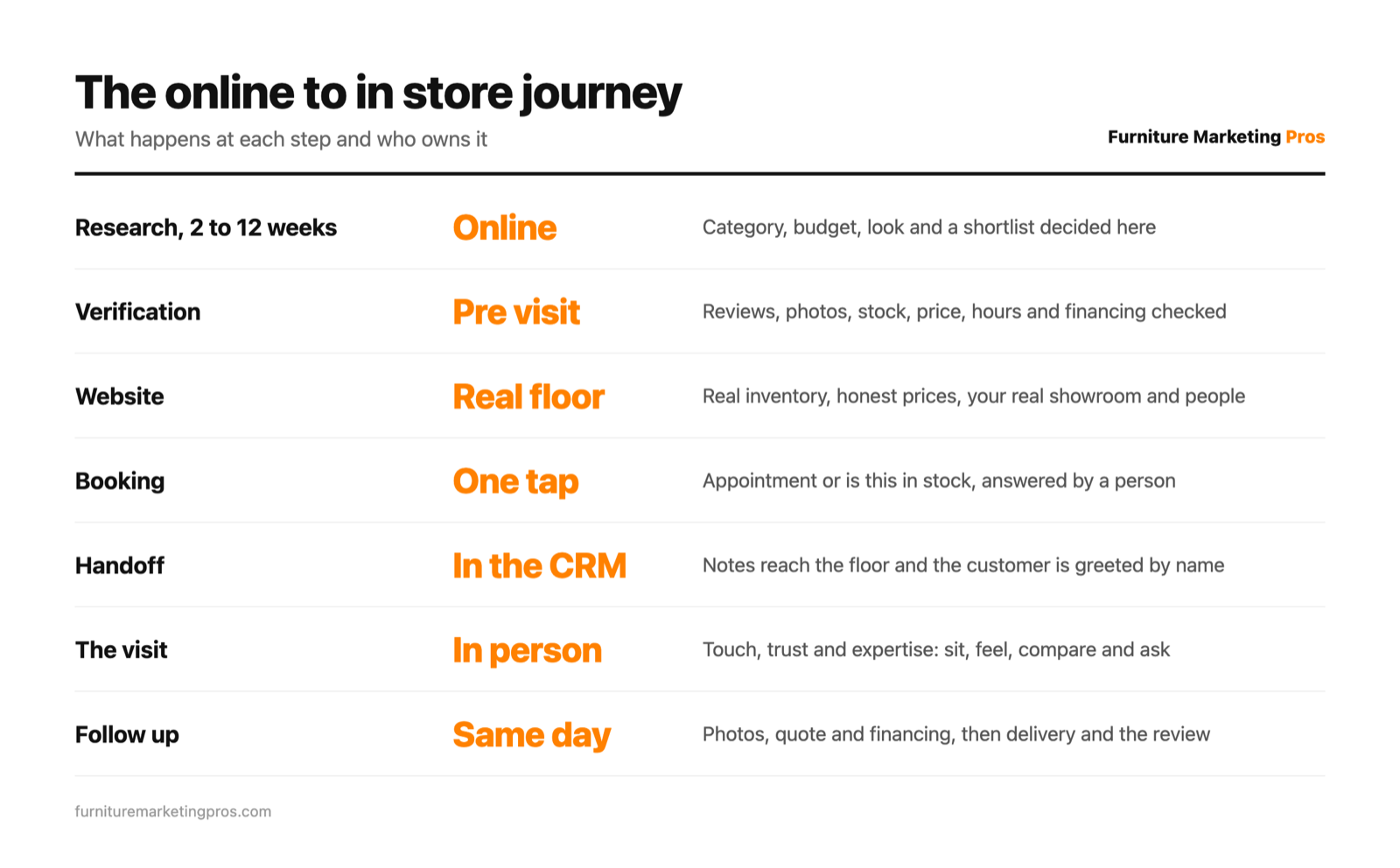
What the shopper has already decided before they walk in
Furniture is a considered purchase. From first search to sale typically takes two to twelve weeks, with mattresses at the short end and whole rooms at the long end. In that window the shopper settles the category, the rough budget, the look and a shortlist of two or three stores worth the drive. We wrote about that shift in the furniture shopper has changed. By the time someone walks in, the question is not whether they will buy. It is whether they will buy from you or from the other store on their list.
What they have not decided is the part that needs a body in a room. Whether the sofa is as deep as it looked, whether the leather feels the way the photo promised, whether the salesperson knows more than the product page did. Those are the showroom's questions, and no website answers them.
So the job of your online presence is not to replace the showroom. It is to get onto the shortlist, remove every reason to eliminate you during the verification pass, and deliver the customer to the floor with the context the floor needs.
The three things only a showroom can sell
The sales we watched close on the floor were rarely about price. They were about three things digital cannot deliver, and your marketing should sell all three before the visit.
Touch. Seat depth, cushion firmness, the weight of a drawer, a finish under real light. A shopper who has spent three weeks staring at renders is hungry to touch something. Come sit on it is a stronger call to action for a furniture store than shop now.
Trust. A store with a building, a delivery crew and a face behind the desk is a lower risk than a warehouse behind a website, and shoppers know it. Photos, reviews and delivery promises establish that trust before the visit, and the visit confirms it.
Expertise. The person who can look at a photo of the room and say which of three sectionals will fit, which fabric will survive the dog and how the delivery will get through the stairwell. A chat widget cannot do that. Your floor can, if your website says so.
Make the website match the floor
The most common way the journey breaks is a website that describes a different store from the one the customer walks into.
Show real inventory. If a piece is on the floor, say so. If it is a special order with a six week lead time, say that too. Nothing kills a visit faster than driving forty minutes to sit on a sofa that was never in the building. A clean feed of what you carry and what is on display is the foundation, and we cover it in catalog integration for furniture retailers.
Be honest about price. The shopper has your competitor's price open in another tab. A product page with no price, or a price that changes in the store, reads as a trap. Show the price and the monthly payment if you offer financing, and if the floor price can be better, say so, because that gives the visit a reason.
Photograph your actual showroom and people. Stock photos of a showroom nobody has seen and headshots of models who do not work there tell the shopper nothing. A walk through video of your floor, the real sectionals under your real lights and the faces of the people who will greet them are the strongest trust assets you own. When the shopper recognizes the room and the person, the visit starts warm.
Appointment booking and the is this in stock button
A one tap appointment. A visible button on every product page and in the header: book a time to see this piece. The form asks for the piece, the day, a name and a phone number, and the booking lands in the CRM and the floor calendar. An appointment turns a vague intention into a commitment and tells the floor who is coming and why. Confirm by text and remind the morning of.
An is this in stock button. Next to the price, a button that sends a question to the store, answered by a person within minutes during opening hours. It captures the moment a shopper decides whether to make the drive. The answer should be more than yes: it is on the floor in gray, the blue is a special order, and here is a time you could see it.
Both features start a conversation, and the conversation carries the piece, the room, the budget and the timing into the customer record before the customer arrives. Our post on turning online shoppers into in store furniture buyers covers more ways to make the website invite the visit.
Store visit campaigns in Google and Meta
Most furniture stores run ads that send people to a website and wonder why the floor stays quiet. The campaigns that fill a showroom are built around the showroom.
Google. Store visits conversions exist for accounts with a linked, verified Google Business Profile and enough volume, and they let you judge a campaign on the visits it drove rather than the clicks it bought. Pair that with location assets that show your address, directions and hours in the ad, and with local inventory ads where your feed supports them, so nearby shoppers see that a piece is available at your store. Target a radius around the showroom and use visit the showroom language in the copy.
Meta. Target a radius around each showroom with creative that shows the floor, the people and the pieces, with directions and a booking link as the call to action. Real video of a real salesperson walking a real room beats any catalog render here. Retarget people who viewed a product page with an invitation to come sit on it.
Both platforms need the showroom to be the conversion. Track the booking and the stock question as conversion events, and send showroom sales back from the CRM through offline conversion imports in Google and the Conversions API in Meta, so the platforms optimize toward sales rather than clicks. We go deeper in local campaigns that drive in store traffic with digital ads.
Hand the online conversation to the floor
Here is the moment we watched go wrong most often. A customer who has traded five messages with the store about a specific sectional, their room dimensions and their financing walks in, and the person who greets them asks whether they can help them find something. Every bit of context evaporates.
Everything lands in one record. The appointment, the stock question, the web chat, the quote request and the ad they clicked all sit in one customer record, not in three inboxes and a notebook.
The floor sees it before the customer arrives. The day's appointments and open conversations show on a tablet or a printed sheet at the front desk, with the piece, the notes and the name of whoever answered.
Greet by name, with the piece. You must be Sarah, the gray sectional you asked about is over here, and I pulled the blue swatch you mentioned. That sentence closes more sales than any discount, because it proves the store listened.
Keep the same person. If the customer messaged with Dana, Dana greets them or introduces the person who will. The handoff is explicit, not a lottery.
Write the visit back. What they sat on, what they liked, what stalled the decision and what they said about timing goes into the record the same day. A CRM built for furniture retail keeps it together so the next message picks up where the visit left off.
Close in store, follow up online
Some visits close on the spot. Many do not, and that is normal in a category with a weeks long decision. The follow up is where the online journey and the floor work as one.
Same day, from the salesperson. A text or email within hours: thank you for coming in, here are photos of the two pieces you sat on, the quote with the monthly payment and the swatch you asked about. Personal, specific, from a name.
Answer what stalls the decision. Delivery timing, returns, financing, whether the second piece matches, covered in a short sequence over the following week or two, written as help rather than pressure. If a sale window is coming or the piece is the last in that fabric, say so honestly.
After the sale, keep going online. Delivery updates by text, the care guide at delivery, the review request once the piece is in the room, and the complete the room messages a few weeks later. The customer who started online should keep hearing from you online, because that is where the next room will start. Our post on integrating Google, Meta, email and the showroom into one system covers how the channels share the work.
Measuring store visits and online assisted sales
The failure mode of omnichannel is that the website takes credit for nothing and the floor takes credit for everything, so the online investment looks like a cost. Measure the handoff, not the channels.
Verified showroom visits. Store visits conversions where your Google Ads account qualifies, direction requests from your Business Profile, and online appointments marked as arrived at the front desk. Arrived is the number that matters, so make the front desk mark it.
Online assisted sales. Every sale in the CRM gets a source: appointment, stock question, ad click, follow up or cold walk in. Matching the sale to the record by phone number or email is the whole trick, so the floor must capture a phone number on every sale.
The ratios that show the leak. Online conversations to appointments, appointments to arrivals, arrivals to sales. If appointments are low, the booking flow is broken. If arrivals are low, the reminders or the directions are. If sales are low, the problem is on the floor.
Judge the system on showroom sales. Not clicks, not platform reported revenue, not website conversions. Sales in the CRM, with the online touchpoints that preceded them visible in the record.
Making the showroom the destination
The showroom is the one thing an online brand cannot copy, and this journey is about making sure the shopper knows that before deciding where to drive. Our Store Traffic Accelerator is built around this journey, from the local visibility that earns the shortlist to the store visit campaigns, the CRM handoff and the follow up that closes. If you would like to see where your own journey leaks, book a strategy call and we will map it with you.
Key takeaways
- The shopper settles category, budget, look and a shortlist during a two to twelve week research window, so the website's job is to earn the shortlist.
- Sell touch, trust and expertise before the visit, because those are the three things only a showroom delivers.
- Make the website match the floor: real inventory, honest prices and photos of your actual showroom and people.
- A one tap appointment and an is this in stock button capture the moment a shopper decides whether to drive.
- Build Google and Meta campaigns around the showroom and feed showroom sales back to the platforms.
- Put every online conversation in one CRM record so the floor greets the customer by name with the piece they asked about.
- Judge the system on arrived appointments and showroom sales matched to their online touchpoints.
Frequently asked questions
What is an omnichannel strategy for a furniture store?
One journey, not two channels. The website earns a place on the shortlist and starts a conversation, the showroom closes on touch, trust and expertise, and the CRM carries the context between them so nothing said online is lost on the floor.
How do I drive more showroom traffic with digital marketing?
Build campaigns around the showroom rather than the website: store visits conversions and location assets in Google, radius targeting with directions and a booking link in Meta, and real video of your floor and people. Then make the website easy to book from.
How long does a furniture customer research before visiting a store?
Typically two to twelve weeks from first search to purchase, with mattresses at the short end and full rooms at the long end. Most of the decision, including which stores to visit, happens in that window.
How should the sales floor use online conversations?
Every appointment, stock question and message should sit in one customer record the floor sees before the customer arrives, so the greeting names the customer and the piece, and the person who answered online handles the visit where possible.
How do I measure online assisted showroom sales?
Give every sale in the CRM a source, match it to the customer record by phone or email, and track the ratios between online conversations, appointments, arrivals and sales. Judge the system on showroom sales, not clicks.