




Most furniture retailers do not have a marketing problem so much as an inventory problem, in the marketing sense. They cannot see what they have, what is broken, and what was never set up at all.
This is the checklist we run when we take on a furniture store. Work through it honestly and you will find things. Everyone does.
The short answer
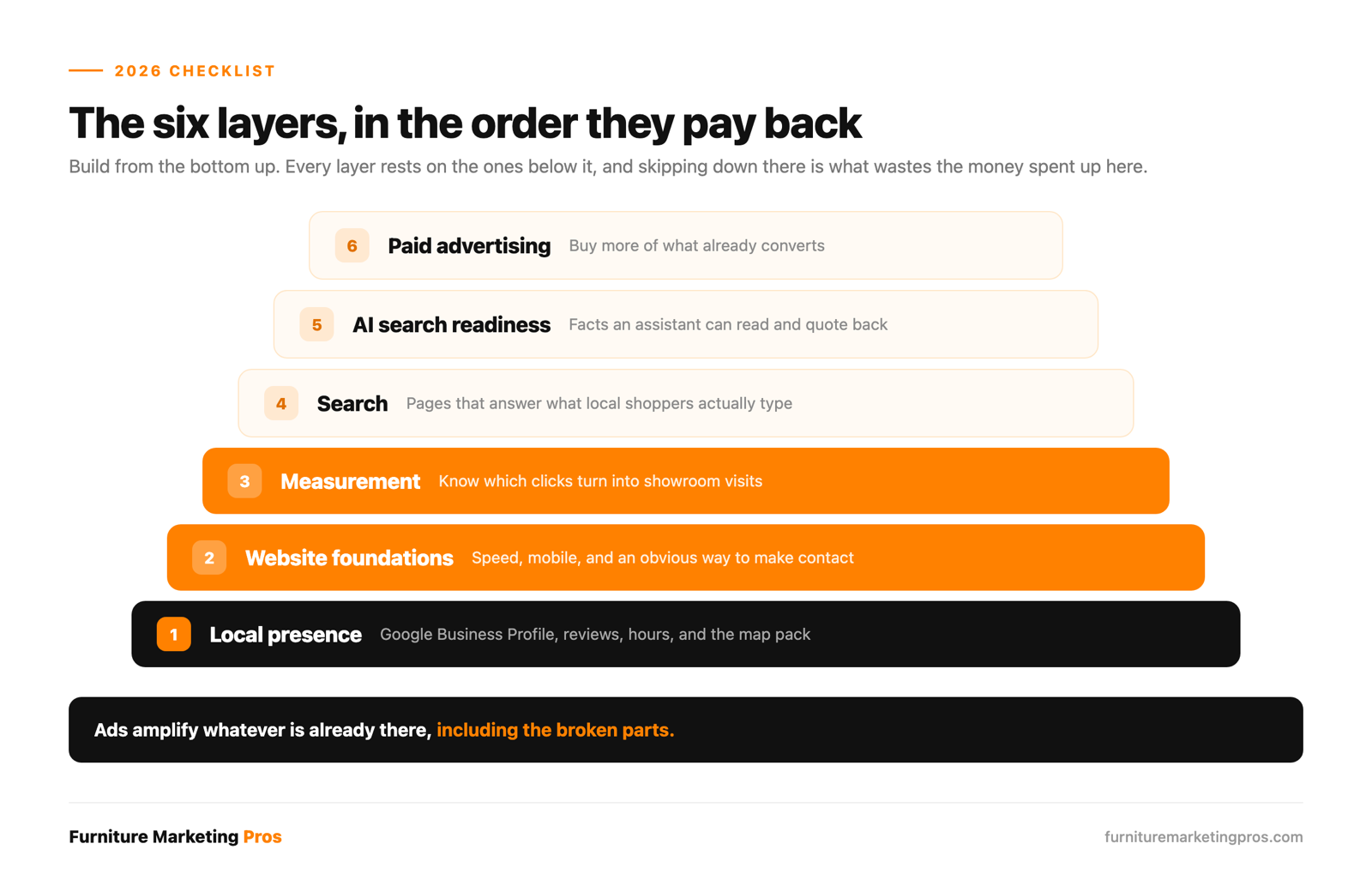
A furniture store's digital marketing is only as strong as its weakest foundation. Local presence, then website, then measurement, then paid channels, in that order. Spending on ads while your Google Business Profile is half built or your site takes eight seconds on a phone is paying to fill a leaking bucket.
Work top to bottom. The order matters more than the individual items.
1. Local presence
This is first because for a furniture store with a showroom, nothing else pays back as reliably.
- Google Business Profile claimed, and owned by the business rather than a former employee or agency
- Primary category set to the most accurate option, not the broadest
- Every legitimate secondary category added. A store selling mattresses that lists only Furniture Store is invisible for mattress searches, which is the most common and most costly error we find
- All fields complete, including attributes like delivery, assembly, financing, and wheelchair access
- Photo library rebuilt and added to monthly. Exterior so people recognise the building, interior for scale, product for what you actually stock
- Hours correct, including holiday hours, which nobody updates
- Products and services filled in with real items and realistic price ranges
- Posting weekly, or at minimum four times a month
- Duplicate and stale listings found and merged or removed
- Name, address and phone identical across your site, your profile, and directories
The full reasoning on this section is in the Google Business Profile fixes, and the mechanics live in our local SEO work.
2. Website foundations
- Loads in under three seconds on a mobile connection, tested on a real throttled phone rather than on your office wifi
- Every page has one h1 that says what the page is
- Titles under 60 characters and descriptions between 140 and 160, or search engines will rewrite and truncate them
- One canonical version of the site. Pick www or non www and 301 the other, and do not rely on canonical tags alone
- HTTPS everywhere with no mixed content
- Both sitemaps declared in robots.txt, including a blog sitemap if your blog runs on a separate system
- Structured data on every page type. Business entity with your postal address on the homepage, Article and FAQPage on posts, Breadcrumbs throughout
- Images compressed and correctly sized. We have found single logo files shipping at 95KB to be displayed 40 pixels tall
- Internal links that actually connect. If your service pages only receive navigation links, they are not accumulating any authority
- Contact details visible without scrolling on mobile
Our web development work covers the conversion side of this.
3. Measurement, before you spend anything
This section is out of order in most stores, and it is why their reporting flatters them.
- Analytics installed once, not twice. Duplicate tracking inflates everything
- Conversions defined as real business events. A booked appointment, a form, a call. Not scroll depth or time on page. We inherited an account where the previous agency counted page scrolls as conversions and the reports looked excellent while the store had no idea how many people walked in
- Store visit tracking switched on if you have a showroom. This is the number that matters most for furniture and the one most often missing
- Call tracking on the phone number, since a large share of furniture enquiries are calls
- Search Console connected and both sitemaps submitted
- One person who can say, from memory, what a lead costs you
4. Search
- A page for each service or category you want to be found for, not one page trying to cover everything
- Category and location pages for the markets you actually serve
- Brand plus category plus location pages for the lines you carry exclusively. Very low competition, very high intent
- Content answering the specific questions your sales staff answer daily
- An FAQ section on the pages where people hesitate, written as real questions
- Titles that lead with the keyword rather than your business name
- Referring domains being actively built. This is usually the ceiling. A well built page can sit on page three purely because the domain has no authority behind it
Our SEO work covers Google, Maps and AI search together, because they now feed each other.
5. AI search readiness
New enough that most stores have nothing here, which makes it cheap to lead.
- A clear, liftable one sentence answer near the top of every important page
- FAQPage markup on anything with real questions and answers
- Business entity markup with your address, so AI answers can place you
- An llms.txt file describing who you serve and linking your proof
- AI crawlers allowed rather than blocked. Check this if you sit behind a CDN, since some now block them by default
- Named, checkable outcomes published somewhere, because that is what models reach for when ordering recommendations
6. Paid advertising
Deliberately below the foundations. Ads amplify whatever is already there, including the problems.
- Bidding on your own brand name. It is the cheapest, highest converting inventory you will ever buy, and if you leave it open a competitor takes it
- Search campaigns on high intent terms rather than broad product terms
- Shopping running if you have a product feed. It is usually the most efficient entry point for furniture
- A product feed that is actually clean, with correct titles, prices and availability
- Negative keyword lists reviewed regularly, and checked so they are not blocking brands you legitimately carry
- Landing pages built for the ad rather than the homepage
- Retargeting running, given how long the furniture consideration cycle is
- Budget concentrated rather than spread. Below a channel's minimum viable spend you are buying data, not customers
Sizing all of this is covered in the marketing budget guide, and the execution side is our ads management.
7. Reviews and reputation
- A routine for asking, at delivery, when goodwill is highest
- Every review answered, positive and negative, within a few days
- Reviews that mention what the customer came in for, which reinforces relevance for those searches
- Never bought. The suspension risk dwarfs the benefit
More on this in reviews and reputation.
8. Email and SMS
The cheapest revenue in retail and the most neglected.
- A list you actually own, with consent
- A welcome sequence for new subscribers
- A post purchase sequence, because furniture buyers buy again in adjacent categories
- A win back for lapsed customers
- Segmentation by what they bought, at minimum
- Sending monthly at least. A list you never mail is a cost, not an asset
9. Social
Last for a reason. It supports the rest rather than replacing it.
- Real photography of your actual floor, not manufacturer studio shots everyone else is using
- Posting consistently rather than in bursts
- Messages answered, since social messages are increasingly first contact
- Paid social treated as demand creation and retargeting, not last click sales
How to use this
Do not attempt all nine sections. Go top to bottom, fix everything broken in a section before moving to the next, and expect the first two sections to take most of the effort. Local presence and website foundations are where the compounding happens.
If you only do one thing this week, do the categories on your Google Business Profile. It is fifteen minutes and it is the most common thing we find broken.
Key takeaways
- Fix in order: local presence, website, measurement, search, AI readiness, paid, reviews, email, social.
- Missing secondary categories on your Google Business Profile is the single most common and most costly error in furniture retail.
- Set up measurement before you spend on ads, or your reporting will flatter you while the business stays flat.
- Track verified store visits if you have a showroom. Online conversions alone understate everything for furniture.
- Ads amplify whatever already exists, including the broken parts. Foundations first.
- Referring domains are usually the real ceiling on organic. A well built page can sit on page three purely for lack of authority.
Frequently asked questions
What should a furniture store fix first in its digital marketing?
The Google Business Profile, specifically the categories. A store selling mattresses that lists only Furniture Store is invisible for mattress searches, and fixing it takes about fifteen minutes. Local presence pays back faster than anything else for a business with a showroom.
How do I know if my furniture store's marketing is actually working?
Define conversions as real business events, a booked appointment, a form, a call, and turn on store visit tracking if you have a showroom. If you are measuring scroll depth or time on page, your reports will look healthy regardless of what the business is doing.
Should a furniture store invest in SEO or paid ads first?
Get the local presence and website foundations right first, because ads amplify whatever is already there. After that both, doing different jobs: paid captures existing demand immediately, SEO compounds and keeps working after you stop paying.
What is AI search readiness for a furniture store?
Making your content easy for AI assistants to quote. A clear one sentence answer near the top of key pages, FAQPage markup, business entity markup with your address, an llms.txt file, and not blocking AI crawlers at the CDN. Most stores have none of it, which makes it cheap ground to take.
How long does this checklist take to work through?
The first two sections realistically take a few weeks of consistent effort, and that is where most of the value sits. Do not try to do all nine at once, and do not move to a new section while the previous one is still broken.
Where to start
If you would rather have someone run this checklist against your store and tell you what is broken, that is exactly what our first call covers, and we will tell you what we find whether or not you hire us.
Book a free strategy call and we will go through it with you, section by section. No pressure and no commitment.