




Every independent furniture retailer has had the same conversation. Someone points at Wayfair's ad budget, or the Ashley store that opened twenty minutes away, and concludes that the game is over for stores their size.
It is a reasonable conclusion and it is wrong. Not because independents have some scrappy underdog spirit, but for a specific structural reason: the searches that actually produce furniture sales are local, and local relevance is the one thing a national retailer cannot buy at scale.
The short answer
You cannot outspend Wayfair and you do not need to. National retailers compete on catalogue breadth and ad budget, which are contests you lose. Independent stores win on local relevance, real expertise, and inventory nobody else carries, and those are positions a national competitor structurally cannot take from you.
The stores that struggle are not losing because they are small. They are losing because they are marketing like a small version of a big box store instead of like the thing they actually are.
The contests you should refuse to enter
Before the advantages, it is worth naming the fights that are unwinnable, because most wasted budget goes into them.
Broad product keywords. Competing for "sectional sofa" against retailers with millions in monthly spend and enormous domain authority is expensive and it does not convert. The searcher is nowhere near a decision.
Price. A national chain buys container loads. If your marketing message is that you are cheaper, you have picked a fight on the one axis where scale wins automatically, and you have trained your market to wait for a discount.
Catalogue size. "We have everything" is both untrue for you and uninteresting from you. Breadth is their story.
Speed of delivery as the headline. Worth having, wrong to lead with, because it invites a comparison you will usually lose.
Every hour and dollar spent on those four is taken from the four below, where the maths is genuinely in your favour.
Advantage one: local intent cannot be bought at scale
This is the big one and it deserves the most attention.
When someone searches a category plus a place, or asks an AI assistant which stores near them carry a style, the algorithm is looking for the most locally relevant answer. A national retailer has one national presence. You have one deeply local one. On that specific query type, you are the better answer, and no budget changes that.
This is not theoretical. For Sullivan Outdoor Furniture we took a store with effectively no organic presence to roughly 2,900 ranking keywords through technical SEO, content, and monthly local profile work. For Saloni Furniture US, local buying intent terms now rank first in their market, and the campaigns we manage have driven 4,824 Google verified in store visits.
Neither store outspent anybody. They occupied a position their national competitors cannot contest.
If you do one thing after reading this, make it local SEO and your Google Business Profile.
Advantage two: expertise that no catalogue page can fake
A shopper choosing a $3,000 sectional has questions a product grid cannot answer. Which fabric survives a golden retriever. Whether the frame is hardwood or engineered. What actually fits through a 32 inch doorway with a turn at the top of the stairs.
Your sales team answers these every single day. That knowledge is a genuine content asset and almost every independent store leaves it entirely unpublished.
Publishing it does two things at once. It earns the search visibility that broad product terms never will, because these are the specific questions people actually type. And it is exactly the material AI assistants pull from when they explain a category to someone, which is increasingly where the shortlist gets built. We wrote about that shift in what GEO means for furniture stores.
There is a measurement point here too. Specific, intent heavy terms convert far better than broad ones. In one account we manage, branded and highly specific material keywords produced click through rates of 5.70 and 12.25 percent, against roughly 1 percent on broad product campaigns. Specificity is not a smaller version of reach. It is a different and better business.
Advantage three: inventory nobody else has
If you carry lines the national chains do not, that is a search position with almost no competition, and most stores never claim it.
Brand plus category plus location searches are low volume and extremely high intent. Someone searching a specific manufacturer near them is not browsing, they are buying. A page that clearly states you carry that line, in that market, will often be the only genuinely relevant result.
The mistake is treating those pages as inventory listings. Written properly, with real photographs of the pieces on your floor and a sentence about who the line suits, they become the highest converting pages on a furniture site.
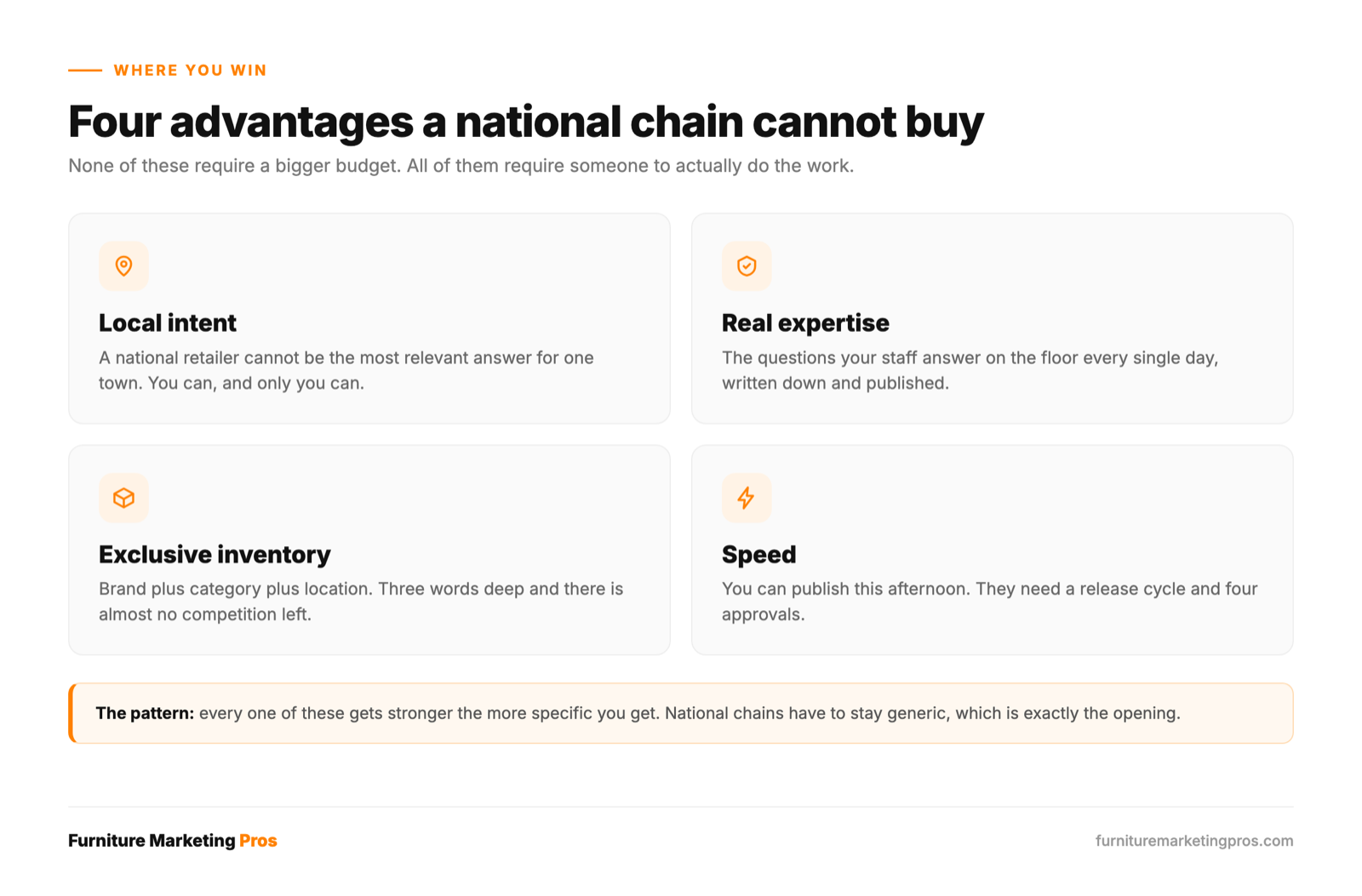
Advantage four: you can move faster than they can
A national retailer changes its site through a committee and a quarterly release cycle. You can publish a page this afternoon.
That matters more than it sounds. When a new AI assistant starts sending traffic, when a local competitor closes, when a manufacturer announces a line you carry, you can respond the same week. Speed is a real competitive asset when the ground is moving, and the ground is moving.
What this looks like as an actual plan
Concentrate rather than spread. A $3,000 monthly budget split across Google, Meta, TikTok and display will lose to the same $3,000 spent entirely on local search and high intent capture. Channels have minimum viable spends, and below them you are buying data, not customers.
Own your map presence before anything else. Categories, every field completed, real photographs, weekly posts, and a review routine. It is unglamorous and it compounds.
Publish the questions you answer in person. One page per real question, written the way you would say it to a customer standing in front of you.
Build pages for the lines you carry. Brand plus category plus your market, with your own photography.
Bid on your own name. If you are not, competitors are intercepting people who were specifically looking for you, and it is the cheapest inventory you will ever buy.
Measure store visits, not just clicks. Verified in store visits have run between $1.25 and $8.44 across campaign types in accounts we manage. Same store, same period, very different efficiency, which is exactly why you measure by channel rather than in aggregate.
Key takeaways
- You cannot outspend national retailers and you do not need to. Refuse the contests built on budget, breadth, and price.
- Local intent is structurally uncontestable at national scale. It is your strongest position and deserves your first dollar.
- Your staff's product expertise is an unpublished content asset that also feeds AI recommendations.
- Exclusive lines create brand plus category plus location searches with almost no competition and very high intent.
- Specific keywords out convert broad ones dramatically. In one account, 5.70 and 12.25 percent click through against roughly 1 percent on broad campaigns.
- Concentrate a small budget rather than spreading it. Below a channel's minimum viable spend you are buying data, not customers.
Frequently asked questions
Can a small furniture store really compete with Wayfair or Ashley online?
Yes, on local searches specifically. National retailers win on catalogue breadth and ad budget, but they cannot be the most locally relevant result for one town. That relevance is earned through your Google Business Profile, local content, and reviews, and it is not purchasable at national scale.
What keywords should an independent furniture store target?
Category plus location terms, the specific questions your customers actually ask, and the brands you carry combined with your market. Avoid broad product terms like "sectional sofa" where you are bidding against national budgets for searchers who are not close to deciding.
How much should an independent furniture store spend to compete online?
Less than you might think, if it is concentrated. A focused budget on local search and high intent capture beats the same amount spread across five channels, because most channels have a minimum spend below which they cannot gather enough data to work.
Is it worth bidding on my own store name?
Yes. It is usually the cheapest and highest converting inventory available, and if you leave it open, competitors will intercept people who were specifically searching for you.
Why does my exclusive inventory matter for SEO?
Because it creates searches almost nobody else can answer. Someone looking for a specific manufacturer in your area is close to buying, and a page that clearly states you carry that line locally will often be the only truly relevant result.
Where to start
If you want an honest read on where you can realistically beat the national retailers in your specific market, that is the first thing we map for every store we work with.
Book a free strategy call and we will look at your local position, your inventory advantages, and where your budget is currently going. No pressure and no commitment.