




Furniture store owners ask us the same question often: should we put AI chat on the website? Usually a software rep has just shown them a demo where a friendly bot answers everything and books an appointment in four messages. What the demo leaves out is an ordinary Tuesday night when a shopper asks whether the sectional fits through a narrow doorway.
Our honest answer: chat can increase furniture sales, but not by itself. It does not create shoppers. It converts the ones already on your site, and only if it answers their real questions, hands serious ones to a person quickly and is measured on booked visits and sales.
Here is what shoppers ask, the five jobs where AI chat earns its place, where it quietly costs you sales, and how to test it.
The short answer
AI chat increases sales on a furniture store website when it does five jobs well: answering hours and directions, explaining delivery, handling financing questions, answering product questions from real catalog data, and booking showroom visits. It costs sales when it guesses, blocks the page, traps shoppers in loops or never reaches a person. Disclose that it is AI, give it your written policies and product data, and route every serious shopper to a salesperson the same day. Then judge it on booked appointments, verified showroom visits and sales in your CRM, not on chat volume or the vendor's dashboard.
What shoppers actually ask a furniture store chat
Read the chat transcripts of almost any furniture retailer and the same practical questions repeat, asked while comparing stores late in the evening.
Are you open, and where are you? Hours, holiday hours, parking and whether a particular showroom carries the piece.
Do you deliver to me, and when? Delivery areas, fees, lead times, white glove setup and removal of the old sofa or mattress.
Can I pay over time? Which financing programs you offer, what the monthly payment looks like and whether applying affects their credit.
Is this in stock, and will it fit? Availability, dimensions, fabric options and whether a special order will arrive before the holidays.
Can I see it in person? Whether the piece is on the floor, and whether someone can meet them on Saturday.
Almost every question is answerable from information you already have: hours, delivery policy, financing partners, catalog and calendar. The shopper is close to a decision and wants a fact. As we cover in how the furniture shopper has changed, most of the decision is made online before anyone walks in, so these late night facts are often the last step before a visit.
Live chat, rule based bots and AI agents are different tools
Chat means three different things, and they do not perform the same way.
Live chat is a person answering in real time. It is the best experience when someone is there, and the worst when the widget says online and nobody replies. Staffing it through evenings and weekends, when shoppers research, is the hard part.
Rule based bots follow a decision tree: pick a button, get a canned answer. They are predictable and cheap, and they frustrate shoppers the moment a question falls outside the tree.
AI agents read the shopper's question in plain language and write an answer from the material you give them, such as your policies, FAQ and product data. They handle the long tail of questions at any hour. Their weakness is that when they do not know, some of them guess, and a confident wrong answer about delivery or financing is worse than no answer.
The setups that work for furniture retailers usually combine them. An AI agent answers immediately, around the clock, and a person picks up the conversation by text or phone as soon as the shopper shows real buying intent. Our broader look at whether AI can help furniture stores sell more reaches the same conclusion about AI tools in general: they are best at speed and coverage, and people are best at closing.
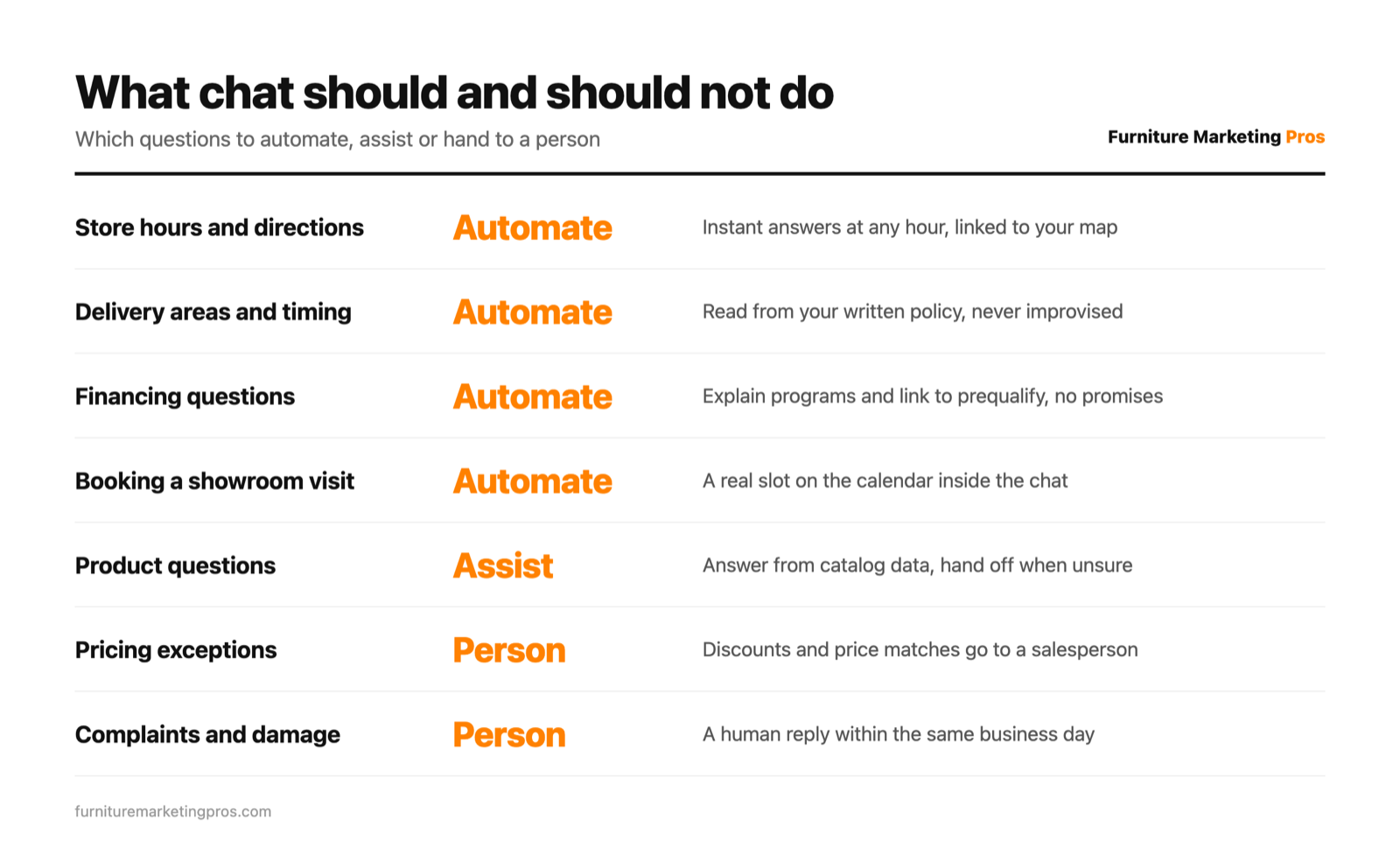
Five jobs where AI chat earns its place
1. Hours, directions and showroom details. The simplest job and still valuable. A shopper who gets an instant answer at ten at night about Sunday hours keeps the visit on the calendar. Link the answer to your map listing.
2. Delivery areas, timing and setup. Delivery is one of the biggest unspoken objections in furniture. Let the agent answer from your written delivery policy alone, and send anything unusual, like a third floor walk up or a rush date, to a person.
3. Financing questions. Shoppers ask about financing in chat because it feels less awkward than asking on the floor. The agent should name the programs you offer, explain the monthly payment idea in plain words, link to prequalification where your partner provides it, and never promise approval or quote terms you have not written down. The same rules apply as in your ads, which we cover in how to market furniture financing.
4. Product questions answered from real data. Dimensions, materials, fabric options, stock status and whether a piece is on the showroom floor. This is where AI agents beat decision trees, but only when they read from your actual catalog. An agent that answers from a generic description, or from what it assumes a sofa usually measures, will eventually tell a shopper something false.
5. Booking the showroom visit. This is the job that turns chat into revenue. When a shopper says they want to see the piece, the chat should offer real times from a real calendar, take a name and mobile number, and confirm who will meet them. A chat that ends with "call us during business hours" has wasted the best moment in the conversation.
Where chat costs you sales
Set up badly, chat loses shoppers invisibly, because nobody reports a sale that did not happen.
It blocks the page. A chat window that pops open on a phone over the product photos, or a widget heavy enough to slow the page, costs you shoppers. On mobile, chat should wait to be opened.
It guesses. An AI agent that improvises a delivery date or implies financing approval creates a promise your floor staff then has to break. That is worse than silence, and it can create a compliance problem with your financing partner.
It loops. Shoppers who get a menu of buttons back three times leave. Every bot needs an obvious way to reach a person.
It collects leads nobody follows up. The most common failure we see is not the bot. It is the chat lead that lands in an inbox nobody owns and gets a reply after the shopper has bought elsewhere.
It hides who it is. Shoppers do not mind talking to an AI assistant. They mind finding out later. Label it clearly. In California, a law in force since 2019 requires bots used to encourage a sale to disclose that they are bots, and clear disclosure is the right practice everywhere else too.
The handoff is the whole game
Chat is a front door, not a salesperson. Its job is to answer easy questions instantly and pass the serious shopper to a person while they are still warm.
Decide in advance what counts as buying intent: asking to see a piece in person, a quote on a room package, a specific delivery date or financing for a named product. When one appears, the chat should collect a name and mobile number and say exactly what happens next, such as a text from a named salesperson within the hour during opening times.
Moving the conversation to text is especially effective in furniture. Shoppers research over weeks, typically two to twelve from first search to purchase, and a text thread survives after they close the browser tab. Several chat tools are built around exactly that move from website to text.
Every chat lead then needs an owner, a follow up task and a record of the outcome. That is the job of a CRM built for furniture retail, which gathers chat, text, calls, forms and social messages into one place so nothing waits in a separate inbox over the weekend.
Feeding the AI the right answers
An AI agent is only as accurate as the material you give it. Before you switch one on, assemble five things.
Your policies in writing. Delivery, returns, warranties, special orders and price matching. A policy that only exists in a salesperson's head is useless to the agent.
Your financing details. The partners you use, the programs you actually advertise and the exact wording your partner approves.
Your product data. Dimensions, materials, options, stock status and showroom availability, kept current. A clean feed from your catalog does double duty here, as we explain in our guide to catalog integration for furniture retailers.
Your FAQ. The questions your floor staff answer every week, written once in plain language.
Your boundaries. A short list of topics the agent must never answer itself, such as discounts, price exceptions, damage claims and anything about a customer's existing order. Those go straight to a person.
Then read the transcripts every week for the first two months. It is the cheapest optimization you will ever run.
The platforms worth a look
Features and pricing change often, so treat this as a map of the options, not a ranking.
Chat built into your ecommerce platform. If your store runs on Shopify, Shopify Inbox is the simple starting point.
Text first webchat. Tools such as Podium start the conversation on your website and continue it by text message, which suits a showroom business where the goal is a visit. The conversation center in a furniture focused CRM does the same job inside the system that also holds your leads.
AI agents in support platforms. Tidio, Gorgias and Zendesk all offer AI agents that answer from your own content and hand off to a person. They suit stores with real online order volume and many order status questions.
Staffed chat services. An outside team answering in real time can work, but only when it knows your policies and books into your calendar rather than taking messages.
Whichever you choose, check four things before signing: whether it can book into your real calendar, whether it reads your actual product data, how cleanly it hands off to a person by text, and whether every chat lead lands in your CRM with its source.
How to test chat honestly
Vendors report conversations and leads captured. None of those is a sale, so measure chat like any other channel.
Track chat as a conversion. Every booked visit and every lead from chat should carry a chat source tag in your CRM, so you can follow it to a showroom visit and an order.
Compare like with like. Measure appointments and sales for a full period with chat against a comparable period without it, and account for seasonality. A chat launched before Labor Day will look brilliant for reasons that have nothing to do with chat.
Count the real cost. Software, setup time and the hours your team spends answering handoffs. Then compare that cost to the margin on the extra sales you can trace, using the same arithmetic we walk through in understanding ROAS, CPA and CAC.
Watch for harm. If phone calls drop without a matching rise in chat bookings, the widget may be getting in the way.
Be realistic. A site with little traffic will not be rescued by a chat window, and a site missing prices, dimensions or a booking path needs those fixed first. Chat amplifies a good website. It cannot replace one.
Making chat part of a working website
Chat works best as one piece of a site built to turn research into visits: clear prices and dimensions, financing shown as a monthly payment, a booking path on every page and fast follow up behind it. That is the kind of site our web development team builds for furniture and mattress retailers, with chat, booking and the CRM wired together from the start. If you are weighing a chat tool and want a second opinion on whether your site is ready for it, book a strategy call and we will look at it with you.
Key takeaways
- AI chat increases furniture sales by converting shoppers already on your site, not by creating new demand.
- The five jobs worth automating are hours and directions, delivery, financing questions, product questions from real data and booking showroom visits.
- Chat costs sales when it covers the page, guesses, loops, hides that it is AI or sends leads nobody follows up.
- The handoff to a person, ideally by text and the same day, matters more than the bot itself.
- Give the AI your written policies, financing wording, product data, FAQ and a list of topics it must never answer.
- Judge chat on booked appointments, verified showroom visits and sales tagged in your CRM, not on conversations.
- Fix missing prices, dimensions and booking paths first, because chat amplifies a good website and cannot replace one.
Frequently asked questions
Does AI chat increase sales for furniture stores?
It can, when it answers the practical questions shoppers ask, books showroom visits and hands serious buyers to a person quickly. It does not create new shoppers, so the gain depends on the traffic and the website you already have.
Is live chat better than an AI chatbot for a furniture store?
A person is better at closing, and an AI agent is better at answering instantly at any hour. Most furniture retailers get the best results by letting AI handle the first response and routing buying intent to a salesperson by text or phone.
What should a furniture store chatbot never do?
It should never invent delivery dates, promise financing approval, offer discounts or handle damage claims. Those answers belong to a person, and the bot should hand them off with the shopper's contact details.
How do I measure whether website chat is working?
Tag every chat lead and chat booking with its source in your CRM, then follow each one to a showroom visit and a sale. Compare a full period with chat against a comparable period without it, adjusted for the sale calendar.
Do I have to tell shoppers they are talking to AI?
You should, always. California requires bots used to encourage a sale to disclose that they are bots, and shoppers trust a clearly labeled assistant far more than one they discover later was not a person.