




Choosing an ecommerce platform is one of the few marketing decisions a furniture store lives with for years. It decides how your catalog gets loaded, whether a shopper sees what is really in stock, how financing appears at checkout, and who you call to change the homepage before Labor Day.
Four names come up again and again: Shopify, Blueport, MicroD and WooCommerce. Two are general platforms used by every kind of store. Two were built for furniture.
One disclosure before we go further. Furniture Marketing Pros builds furniture store websites on Shopify, so we are not neutral. To keep this fair, we describe each platform only by what its own website says in November 2026, we quote no prices, and where a site is silent we say "its site does not mention" rather than guess. Vendors update their sites, so confirm anything that matters directly.
The short answer
There is no single best ecommerce platform for a furniture store. Shopify is a general commerce platform sold by subscription, with themes, apps and a point of sale, and it suits retailers who want to own their design and marketing. Blueport says it is built for mid sized furniture retailers and connects the website to the point of sale, with hosting and maintenance included. MicroD, part of Revalize, sells websites with a large library of manufacturer catalogs plus room planning and 3D tools. WooCommerce is a free open source plugin for WordPress that gives full control and leaves hosting and upkeep to you. Match the platform to your catalog, your systems and your team.
What a furniture store actually needs from a platform
Before you compare vendors, write down what your store needs.
Large catalogs from manufacturer feeds. Someone has to load thousands of items from many brands and keep them current, as we explain in our guide to catalog integration for furniture retailers.
Variants for fabric and finish. A sectional can come in dozens of fabrics, several finishes, more than one size and a left or right orientation.
Delivery zones and white glove options. You need rates by zone, in home delivery and setup choices, and honest lead times.
Financing at checkout. A monthly payment moves a big ticket. See our post on how to market furniture financing.
Real inventory. In stock, on order and special order are three different promises.
Store pickup and the sales floor. Most furniture sales still close in person, so the website has to hand the shopper to the showroom cleanly. Our guide to the online to in store customer journey covers that handoff.
A connection to your point of sale or ERP. Orders, inventory and delivery scheduling live there.
Speed. Image heavy furniture pages get slow, and slow pages lose shoppers. See our page speed and Core Web Vitals fix guide.
SEO control. You need to edit titles, descriptions, URLs and collection copy, because ecommerce SEO is where long term traffic comes from.
Who maintains it. Know whether updates and changes fall to the vendor, an agency or your own staff, and what that costs.
Shopify
Shopify (shopify.com) describes itself as an all in one commerce platform "for anyone from entrepreneurs to enterprise". It is not built for furniture specifically and does not claim to be.
How it is sold. Shopify is a subscription, billed monthly or yearly, with several plan levels and card processing fees on top. Its site says transaction fees may apply when you use an outside payment provider. Themes and apps come free or paid, so the real cost is the subscription plus apps, theme and build.
What its site says it does. Its theme store offers free and paid designs, and its app store lists thousands of apps. Shopify POS, its site says, connects in store and online sales, updates inventory levels with every sale and supports buy online, pick up in store. For pay over time, Shop Pay Installments is offered in partnership with Affirm to merchants based in the United States who use Shopify Payments.
Furniture specifics. Its site does not mention manufacturer catalog libraries, furniture ERP connections or the store card and lease to own lenders many furniture stores use. Those come through apps, feeds or custom work. Shopify's help pages also say a product can have up to 2,048 variants across up to three options. A sectional with fabric, finish, size and orientation has four, which takes planning.
Blueport
Blueport (blueport.com) calls itself "the ecommerce platform built for furniture retail" and says it is built specifically for mid sized furniture retailers. Its site says it has built websites for furniture retailers since 2001.
How it is sold. Blueport sells packages under the name Essentials: Showroom, Ecom L1, Ecom L2 and OneView, with a custom front end option called C.O.R.E. Its site says one platform fee covers pieces most retailers buy separately. It publishes no prices.
What its site says it does. Its Catalog Content HUB merges vendor product data and images into one record, and its vendor page says most vendors update monthly. Its features page lists availability by the shopper's delivery region, messaging for in stock and special order items, delivery or in store pickup at checkout, and real delivery dates. For financing, it says the site shows retail, sale and financing pricing together, with a single application checkout across private label, second source and rent to own.
Sales floor. Its OneView product, which it describes as patented, moves carts, quotes and orders between the website and the store. Its site says a quote written in your point of sale can be finished online, and the salesperson who helped gets credit even when the order closes online. It says OneView works with any point of sale system that accepts sales order injection.
Maintenance. Every package includes hosting, security, maintenance and support, with platform upgrades at no additional cost. The pages we read do not address data export or what happens if you leave. Blueport also publishes its own comparison with Shopify, worth reading beside this one.
MicroD
MicroD (microdllc.com) presents itself as "MicroD from Revalize", part of a larger software company. Its site addresses both home furnishings retailers and manufacturers and cites more than 25 years in the industry.
How it is sold. Through a product demonstration or consultation. Its site publishes no prices.
What its site says it does. Its ecommerce platform page lists over 350 brand catalogs and 30 dynamic catalogs with ongoing updates. It also lists an ecommerce cart, a pricing manager, a coupon creator, a tax calculator, an RMS integration and a private catalog tool. Website features include a design center, collections pages, brand landing pages and an integrated room planner. The page mentions buy online, pick up in store.
Visualization. This is where MicroD's site says the most. It describes 3D product visualization, a cloud based room planner, fabric draping catalogs and tools to price a customized product. Its platform page also names a customer engagement product called iNGAGE and a commerce platform called OmniVue.
What its site does not mention. The pages we read do not mention financing at checkout, tools for salespeople, who hosts the site, or data export. Ask about each one in the demonstration.
WooCommerce
WooCommerce (woocommerce.com) describes itself as "the open source commerce platform for WordPress". It is a plugin, not a hosted service, and its site says it gives you full control of your checkout, your data and your costs.
How it is sold. The core plugin is free, with no monthly subscription. Its pricing page is clear about what you pay for instead: a host you choose, extensions added one at a time, your payment provider's processing fees, initial development and yearly maintenance.
What its site says it does. It supports product variations, accepts major credit cards out of the box, and offers a marketplace of hundreds of free and paid extensions. Its documentation describes shipping zones with flat rate, free shipping and local pickup built in, plus a product import and export tool. It lists point of sale among its extension categories.
Furniture specifics. Its site does not mention manufacturer catalogs, furniture lenders or furniture ERP connections. As with Shopify, those come from extensions or custom work.
Maintenance. Its site says open source means complete ownership of your store. Ownership also means hosting, updates, security and speed are your job or your developer's.
The side by side comparison
| Compared on | Shopify | Blueport | MicroD | WooCommerce |
|---|---|---|---|---|
| Best fit | Retailers who want to own design and marketing | Mid sized furniture retailers, per its site | Retailers carrying many brands | Retailers with a WordPress developer |
| How it is sold | Subscription plus apps, theme and build | Packages, one platform fee, no prices published | Demonstration, no prices published | Free plugin plus hosting, extensions and upkeep |
| Catalog and vendor data | Loaded by you or your agency | Catalog Content HUB with vendor data | Over 350 brand catalogs listed | Loaded by you or your developer |
| Financing | Shop Pay Installments with Affirm, others by app | Financing pricing and single application checkout | Its site does not mention | By extension |
| Omnichannel and sales floor | Shopify POS and store pickup | OneView links site, store and salesperson | Pickup in store listed, room planner | Local pickup built in, POS by extension |
| Design freedom | Free and paid themes, custom work | Templates, or custom with C.O.R.E. | Listed page types and features | Open source, fully open |
| Who maintains it | Shopify runs the platform, you run the store | Blueport, included in the package | Its site does not say | You or your developer |
| Lock in and data portability | Product export by CSV file | Its site does not address | Its site does not address | Open source, product export by CSV file |
Which type of retailer fits which platform
A single showroom or small group that wants marketing control. Shopify fits when you want to change pages and run promotions without a vendor ticket, and you have an agency or staff member to manage it.
A mid sized, multi store retailer with a furniture ERP. Blueport's site is written for you, above all if salesperson credit and quotes that move between store and website are the priority.
A retailer carrying many brands who wants catalogs ready on day one. MicroD's catalog library and room planner are its stated strengths. Blueport's catalog hub belongs on the same shortlist.
A retailer with a strong WordPress team. WooCommerce gives the most freedom and asks the most of you in return.
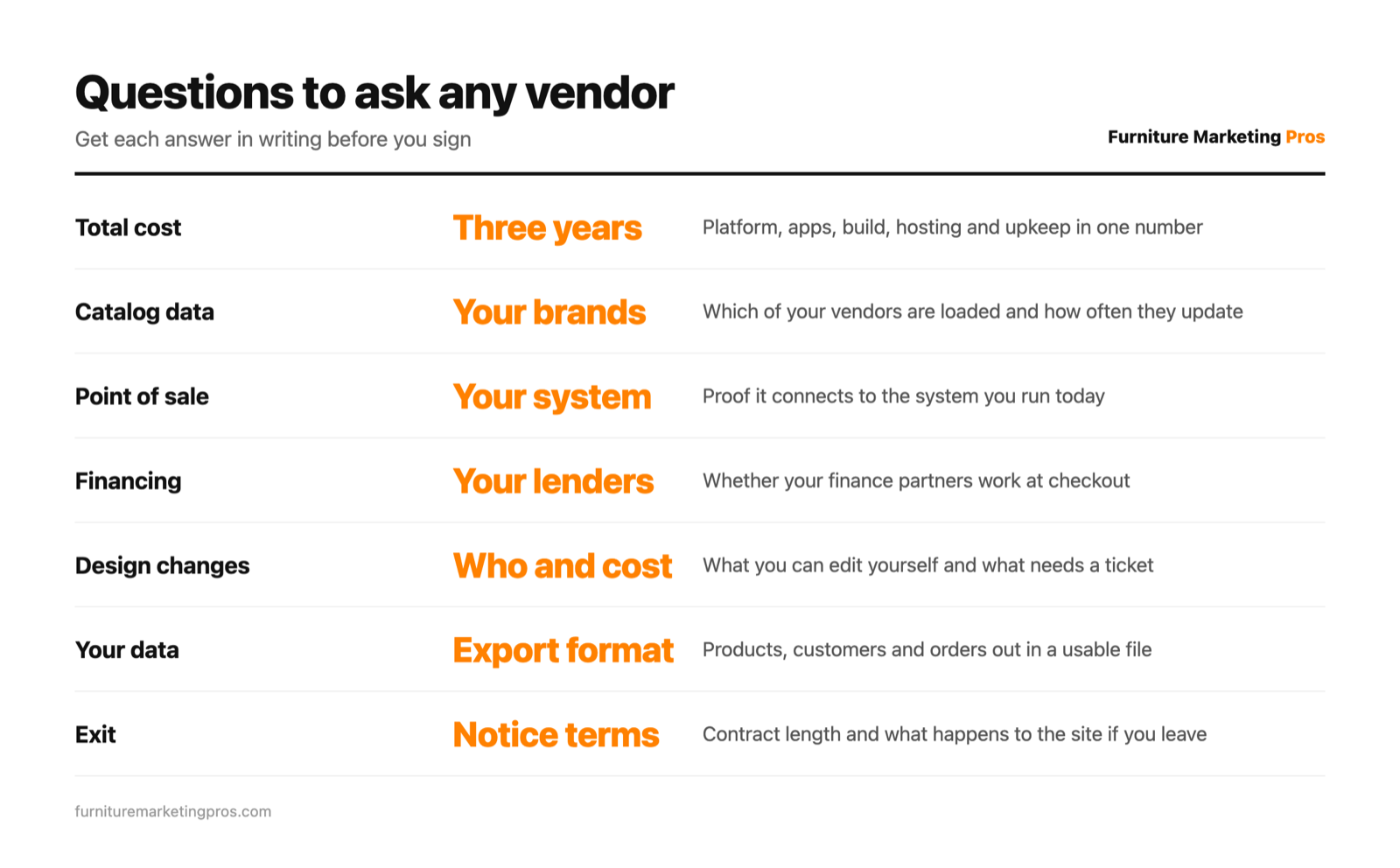
Questions to ask any vendor before signing
Ask every vendor, and every agency including us, in writing.
What is the total cost over three years? Platform, apps, build, hosting and ongoing changes, in one number.
Which of my brands are already loaded? Ask for the list, and ask how often each one updates.
Does it connect to my point of sale? Name your system and ask for a retailer who runs that connection.
Which of my financing partners work at checkout? Name them.
What can I change myself? Ask what needs a ticket and what a ticket costs.
How do I get my data out? Products, customers and order history, in what format, at what price.
What does the contract say about leaving? Term, notice period, and whether the design and content are yours.
What migration involves, in brief
Moving platforms is a project, not a switch, and the design gets rebuilt whichever direction you move.
Start with the data: products, variants, images, customers and order history, exported and mapped to the new system. Then the URLs. Every old address with rankings or links needs a redirect, or you lose search traffic you already earned.
After that come the connections: point of sale or ERP, financing, payments, tax, delivery rules, email and SMS, analytics and ad tracking. Test each one before launch with real test orders, then run a full check after launch. Our 25 point furniture website audit works well as that checklist.
Avoid launching in the weeks before a major sale window.
Our view
The platform matters less than how well it is set up and who looks after it.
We build on Shopify because the retailer owns the store, can change it quickly and can connect the marketing tools we run. The trade is that catalog data, financing and point of sale connections have to be assembled, not switched on.
The furniture platforms make the opposite trade. More arrives ready, and more depends on one vendor. If a deep point of sale connection is your first requirement, one of them may be the better choice, and we will say so.
Where Furniture Marketing Pros fits
We design and build furniture store websites on Shopify and connect them to the search, ads, email and SMS that bring shoppers in. Our web development service page shows how we work, and you can book a strategy call to talk through your catalog, your systems and which platform fits, even if the answer is not ours.
Key takeaways
- No platform is best for every furniture store, so start from your catalog, systems and team.
- Shopify and WooCommerce are general platforms where furniture features come from apps, extensions or custom work.
- Blueport and MicroD are built for furniture and publish no prices, so expect a sales conversation.
- Blueport's site leads with its point of sale connection, and MicroD's leads with manufacturer catalogs and visualization tools.
- Ask every vendor about three year cost, your brands, your point of sale, your lenders, your data and your exit.
Frequently asked questions
What is the best ecommerce platform for a furniture store?
It depends on the store. Retailers who want control of design and marketing often choose Shopify, while multi store retailers who need a deep point of sale connection often look at furniture platforms such as Blueport or MicroD. WooCommerce suits retailers with a WordPress developer.
Is Shopify good for furniture stores?
Yes, with planning. Shopify's site does not list furniture specific features, so manufacturer catalogs, furniture lenders and point of sale connections are added with apps or custom work. Its help pages say a product can have up to three options, which matters for furniture.
How is Blueport different from Shopify?
Blueport's site says it is built for furniture retail and includes vendor catalog data, hosting and maintenance in its packages, with point of sale connection at the higher levels. Shopify is a general platform sold by subscription that you or your agency configure.
Is there an alternative to MicroD for a furniture website?
Blueport is the other furniture specific platform in this comparison, and Shopify and WooCommerce are the general options. Before switching, list the MicroD features you rely on, such as brand catalogs or the room planner, and ask how each alternative replaces them.
How long does it take to move a furniture store to a new platform?
It varies with catalog size and the number of systems to connect. Blueport's site says its onboarding runs a few months, and longer with point of sale integration. Plan around your sale calendar and do not launch just before a major holiday.