




Every furniture store owner knows reviews matter. Far fewer run reviews as a system. The ask happens when someone remembers, the replies come in a burst when a bad one stings, and the monthly count is whatever it happens to be. Meanwhile the store two exits down with a steady stream of recent, specific reviews holds the map pack spot and gets described in detail by every AI assistant a shopper asks.
Reviews are among the few local ranking signals a furniture store directly controls. You cannot move your building closer to the searcher, but you can decide when every customer is asked, how, by whom, and what happens when the review arrives. Our earlier post on getting more positive reviews for your furniture store covers the basics, so this one goes deeper on the mechanics.
The short answer
Get more Google reviews by asking every customer after delivery, not at the sale, with an automated text and email sequence that sends a one tap link, reminds once and then stops. Back it up on the floor, where the salesperson plants the idea and the delivery crew confirms it, and with QR codes where customers wait. Reply to every review within a business day, naming the product, and recover bad deliveries with a phone call before any public reply. Never gate, incentivize or buy reviews. Then measure review velocity, the rating of your newest reviews and the products your reviews mention, because that is what feeds the map pack and AI answers.
Why reviews are the local signal you control
Google describes local ranking as a mix of relevance, distance and prominence. Relevance is mostly your categories and profile content. Distance you cannot move. Prominence is how well known and well regarded the business appears to be, and reviews are its most visible part: how many, how recent, how positive and what they say.
For a furniture store, prominence is where the race is run. Shoppers will drive across a metro to sit on a sectional, so you compete over a wide radius against stores that sit closer to many searchers, and a steady flow of recent reviews is the lever that offsets distance. Reviews are also the verification step: the shopper opens each shortlisted profile looking for a reason to eliminate one, and forty old reviews under an unanswered complaint is that reason.
The profile has to be complete for any of this to count. If categories, hours, photos and products are not right, fix them first with our guide to the Google Business Profile gaps costing furniture stores sales. Reviews then become the ongoing work inside local SEO for furniture stores.
Time the ask to delivery, then automate it
The sale is the wrong moment to ask, because the thing the customer would review is still a promise. The delivery is the right moment: the piece is in the room, the crew has just left, and relief has turned into satisfaction.
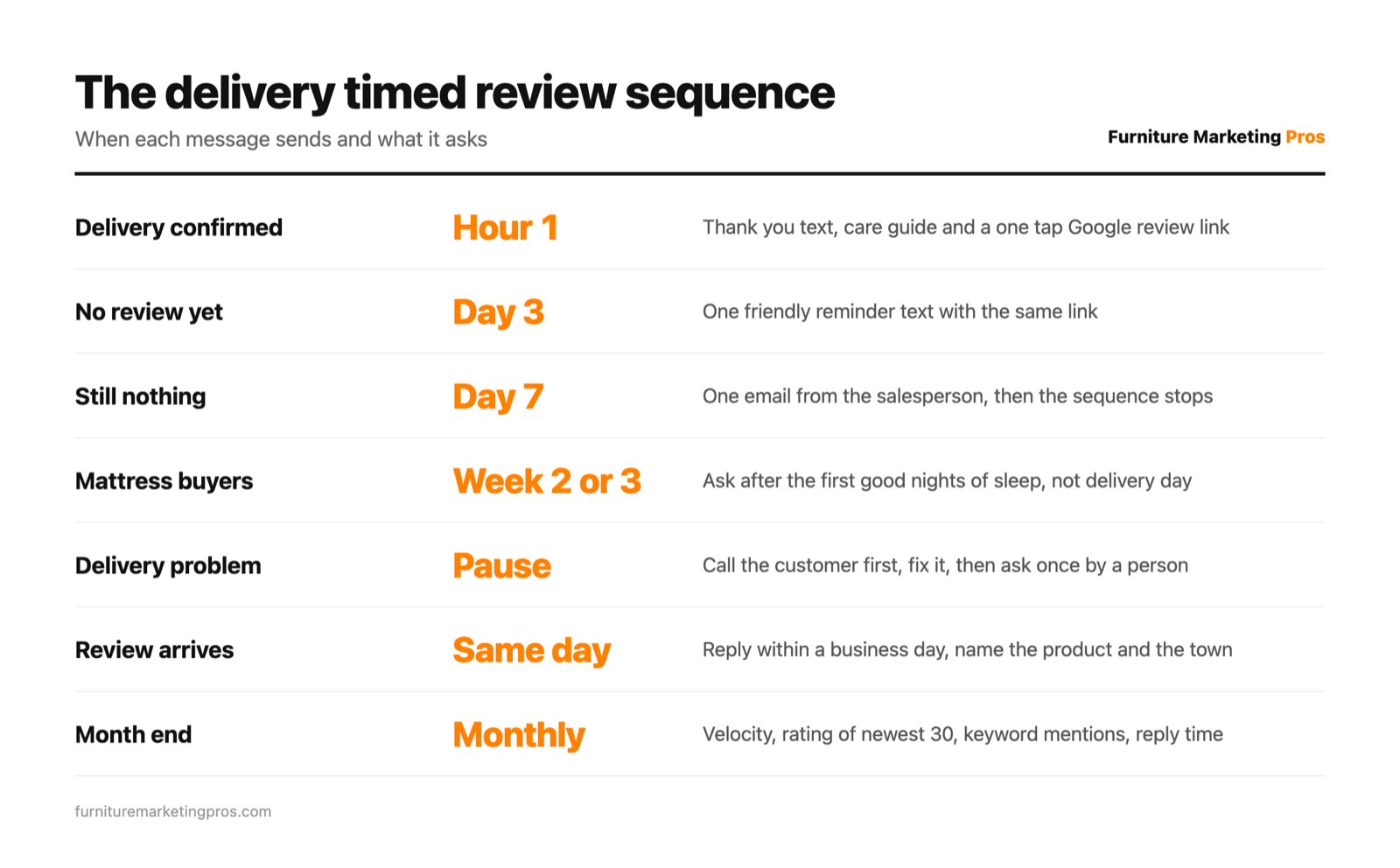
Hour one. When the delivery is marked complete, a text goes to the customer: a thank you, the care guide for what they bought and the short review link Google provides for your Business Profile, so the form opens in one tap. No survey in front of it.
Day three. If no review has arrived, one short reminder with the same link: hope the new sectional is settling in, and if we did a good job, a quick Google review helps us more than you would guess.
Day seven. One email from the salesperson's name with the link again and nothing else to sell. Then the sequence stops.
Mattress buyers get a different clock. A mattress is not loved on delivery day, and most sleep shops tell customers to allow a few weeks to adjust. Send the care text at delivery and make the review ask in the second or third week, once the customer has slept well enough to say so. If you sell both, branch the sequence on category.
All of this runs from the customer record without anyone remembering to send it. A CRM built for furniture retail ties the delivery status to the message so the ask goes out every time.
Who asks on the floor, and where the QR codes go
Automation puts the link in front of the customer. People get the customer to tap it, and two stores with identical sequences and very different review counts usually differ on the floor.
The salesperson plants it at the sale without asking for it. When the paperwork is done: after the delivery you will get a text from us with a care guide, and there is a review link in it. If the crew and I did right by you, I would really appreciate it. That ties the review to real people and asks for nothing today.
The delivery crew closes the loop. As they finish: you will get a text from the store within the hour, and if we did a good job a review would mean a lot to us. The crew are the people most reviews mention by name, so make the line part of the delivery checklist. Nobody asks for five stars. Asking for a rating reads as pressure and sits close to the line Google draws around steering reviews.
QR codes go where people wait with a phone in hand. A code on the front door gets scanned by nobody. Put it at the financing desk, where a customer waits for an approval and has already decided to buy, at the pickup counter and on the delivery paperwork. No review tablet at the counter: many reviews from one device on one network look like manipulation to Google, and legitimate reviews get filtered with them.
How to respond to positive, mixed and angry reviews
Every review gets a reply within one business day, written for the next shopper reading it, not for the reviewer. These are examples to adapt, not scripts to paste.
A positive review says the power reclining sectional arrived on time and the crew set it up. The reply: Thank you, Maria. We are glad the power reclining sectional is working out in the family room, and Luis and the crew will be happy to hear they got a mention. One tip: run each recliner through its full range once a week so the mechanisms stay smooth. Enjoy it, and thank you for choosing us over the bigger stores in Fairfax.
That reply puts the product and the town into the text of your profile, and nothing in it could be pasted under any other review.
A mixed review, three stars, says the dining set is beautiful but the delivery came two days late and nobody called. The reply: Thank you for the honest review, James, and we are glad the dining set looks the way you hoped. You are right about the delivery. The truck was rescheduled and you should have had a call from us the same day, and you did not. We have changed how reschedules are handled so a customer hears from a person. If the set needs anything as you live with it, call the store and ask for Dana.
An angry review, one star, says the sofa arrived with a torn cushion and the store has been impossible to reach. The first move is a phone call, within hours, from someone with the authority to fix it. The public reply comes after that call: Mr. Ortiz, I am sorry about the torn cushion and sorrier that you could not reach us when you called. That is not the standard we hold our deliveries or our phones to. Dana spoke with you this morning, and a replacement cushion is on order with a delivery date you now have in writing. If that slips, my direct line is in your email. Thank you for the chance to make it right.
Our guide to handling a bad review, a delivery complaint or a viral post covers the harder cases.
Review recovery after a bad delivery
Furniture generates a particular kind of bad review: damaged piece, late truck, stretched backorder. Most of those customers are waiting to see what you do.
Pause the automated ask. The moment a delivery is flagged with a problem, the sequence stops for that customer. Asking while the cushion is still torn turns a two star review into a one star review.
Call before you type. A person calls the same day, listens and commits to a fix with a date. Then beat that date, because an early replacement is when most customers revise their opinion.
Ask again, once, by a person. After the fix is confirmed, a short personal message: we are glad the replacement is in, and if the way we handled it deserves a mention, an updated review would mean a lot. Never ask the customer to remove a review, never offer anything for changing one, and never mention it if the customer is still unhappy. A review describing a problem solved is worth more to the next reader than one with no problem at all.
What Google's review policies forbid
Google's rules are short and the penalties blunt: offending reviews are removed, sometimes along with legitimate ones.
No gating. You may not steer happy customers to Google and unhappy ones to a private form, and a survey that only shows the Google link to people who answer well is exactly that. Ask everyone the same way.
No incentives. No gift card, discount, drawing entry or free pillow for a review, and none for changing or removing one. The rule is about the offer, not the outcome.
No bought or fake reviews. No purchased reviews, no reviews from staff or family, no reviews from a store device and none from people who did not buy. The practical rule: if you would not be comfortable explaining the method to the customer who wrote the review, do not use it.
How reviews feed the map pack and AI answers
Ranking. Volume, recency, rating and response activity all feed prominence. Velocity matters more than the total, because a store adding reviews every week looks busy and a store sitting on an old total looks like it stopped trying.
What the listing shows. Google reads the text of reviews, and it sometimes notes under a listing that a product was mentioned in them or groups a profile's reviews by the words that come up most. Reviews that name sectionals, mattresses, delivery and financing give Google a richer picture of what you sell than fifty that say great store. You cannot write the reviews, but the hour one text can say that a line about the piece and the delivery helps other shoppers most, and that nudge changes what people write.
AI answers. When a shopper asks an assistant which furniture store near them is worth visiting, the answer is assembled largely from reviews: what customers said, how recently and how the store responded. Your replies are part of that record.
The same reviews belong on product pages, in emails and in ads. Our post on five ways furniture stores build a reputation that sells covers that distribution and the other platforms furniture buyers check.
How to measure it
Review velocity. New Google reviews this month against last month, and against deliveries made. If deliveries went up and reviews did not, the sequence stopped firing or the floor stopped mentioning it.
Rating trend. The average rating of your newest thirty reviews, not the lifetime average, which moves slowly and hides a problem. The rolling average shows a delivery issue within weeks.
Keyword mentions. Count how many of this month's reviews name a product category, a salesperson, the crew, financing or your town. That share is the quality of your review stream.
Response time. Every review answered, and the typical time to answer. Once a quarter, note the review count, rating and most recent review date of the stores in your map pack, because the gap tells you how much velocity you need.
Building the review system
A review system is a routine: the request tied to delivery, the line on the floor, the reply within a day, the recovery when a delivery goes wrong and the numbers at month end. That is what our reviews and reputation service for furniture stores builds and runs, timed to your deliveries and your sales floor. To see how your review profile compares with the stores in your map pack, book a strategy call.
Key takeaways
- Ask after delivery, not at the sale: one text, one reminder, one email, then stop.
- The salesperson plants the ask at the sale and the delivery crew confirms it, and nobody asks for five stars.
- QR codes go where customers wait with a phone in hand, and mattress buyers are asked in the second or third week.
- Reply to every review within a business day, name the product and the town, and call before replying to an angry one.
- Never gate, incentivize, buy or write reviews, and never offer anything to change one.
- Measure review velocity, the rating of your newest thirty reviews, keyword mentions and response time monthly.
Frequently asked questions
How do I get more Google reviews for my furniture store?
Ask every customer after delivery, by text, with Google's short review link, then one reminder and one email. Have the salesperson and the delivery crew both mention it, and put QR codes where customers wait.
When should a mattress store ask for a review?
Not on delivery day. Send the care message at delivery and make the review ask in the second or third week, once the customer has adjusted to the mattress. A day one request tends to produce a lukewarm review.
Should a furniture store respond to every Google review?
Yes, within a business day, including the positive ones. Name the product and the town, because the reply is read by far more shoppers than the review and its text becomes part of your profile.
Can I offer a discount or gift for a Google review?
No. Google's policies forbid offering anything in exchange for a review, and the same rule covers offers to change or remove one. Reviews that break the rules get removed, sometimes along with legitimate ones.
Do Google reviews help a furniture store rank on Google Maps?
Yes. Review volume, recency, rating and your responses feed prominence, one of Google's three local ranking factors, and the words in reviews help Google understand what you sell.