




Search for furniture advice on Google and there is a good chance the first thing on the page is not a link. It is a paragraph or two written by Google's AI, summarizing an answer and, for some local searches, naming specific stores. Google calls this an AI Overview, and for a furniture retailer it changes the question from "do I rank" to "am I named".
Owners feel this in two ways. Traffic to buying guides softens as shoppers get their answer on the results page. At the same time, a store named in the answer gets a recommendation no blue link ever gave, in front of a shopper who is close to deciding. The showroom still gets the sale. The route to it has changed.
This post explains what an AI Overview tends to include for local furniture searches, which signals Google draws on when it names a store, what that changes for an owner, what to do this quarter, and what not to panic about.
The short answer
Google AI Overviews are AI written summaries at the top of some results pages. For local furniture searches, they tend to summarize what matters when choosing a store and, where Google is confident, name a few local businesses with a line about each, drawn from Google Business Profile data, review language, website content and how consistent those sources are. The change for an owner is that informational queries send fewer clicks while being named carries more weight, and the profile and review data do most of the work. The response is to make your store the easiest one for Google to describe accurately, then measure branded searches, profile actions and showroom visits.
What an AI Overview is, and when furniture searches get one
An AI Overview is a generated answer that sits above the classic results and cites the pages it drew from. Google shows it on some searches and not others, and the pattern shifts, so nobody can promise which queries will carry one next month. In furniture, the searches most likely to get one ask a question: how to choose a sectional for a small room, whether a hybrid mattress suits a side sleeper, what to look for in solid wood dining furniture.
Plain local searches like "furniture stores near me" often still lead with the map pack, the familiar three listings with a map. But as soon as the shopper adds a judgment word, such as best, affordable, quality or reviews, or asks in a full sentence, an AI written answer becomes more likely, and that answer may name stores. We covered the broader shift in Google's AI powered search results and what furniture retailers must know. Here the focus is narrower: the local answer and who gets into it.
An illustrative answer for "furniture stores near me"
What follows is illustrative. It is not what Google shows for any real city, and the stores are invented. It is the shape an answer tends to take.
Imagine a shopper in a mid sized city asks for the best furniture stores near them. The overview opens with a sentence of framing, such as the area having a mix of independent showrooms and national chains, with the right choice depending on budget, style and delivery needs. Then it names a few stores. One line might read that Northside Home Furnishings is a family owned showroom known for solid wood bedroom and dining furniture, with reviews that mention helpful staff and on time delivery. Another might say Lakeview Mattress Gallery offers a sleep trial and carries several hybrid brands. A third might note that a regional chain has the widest selection and financing options. It closes with a suggestion to check hours and current reviews, and it cites the profiles and pages it used.
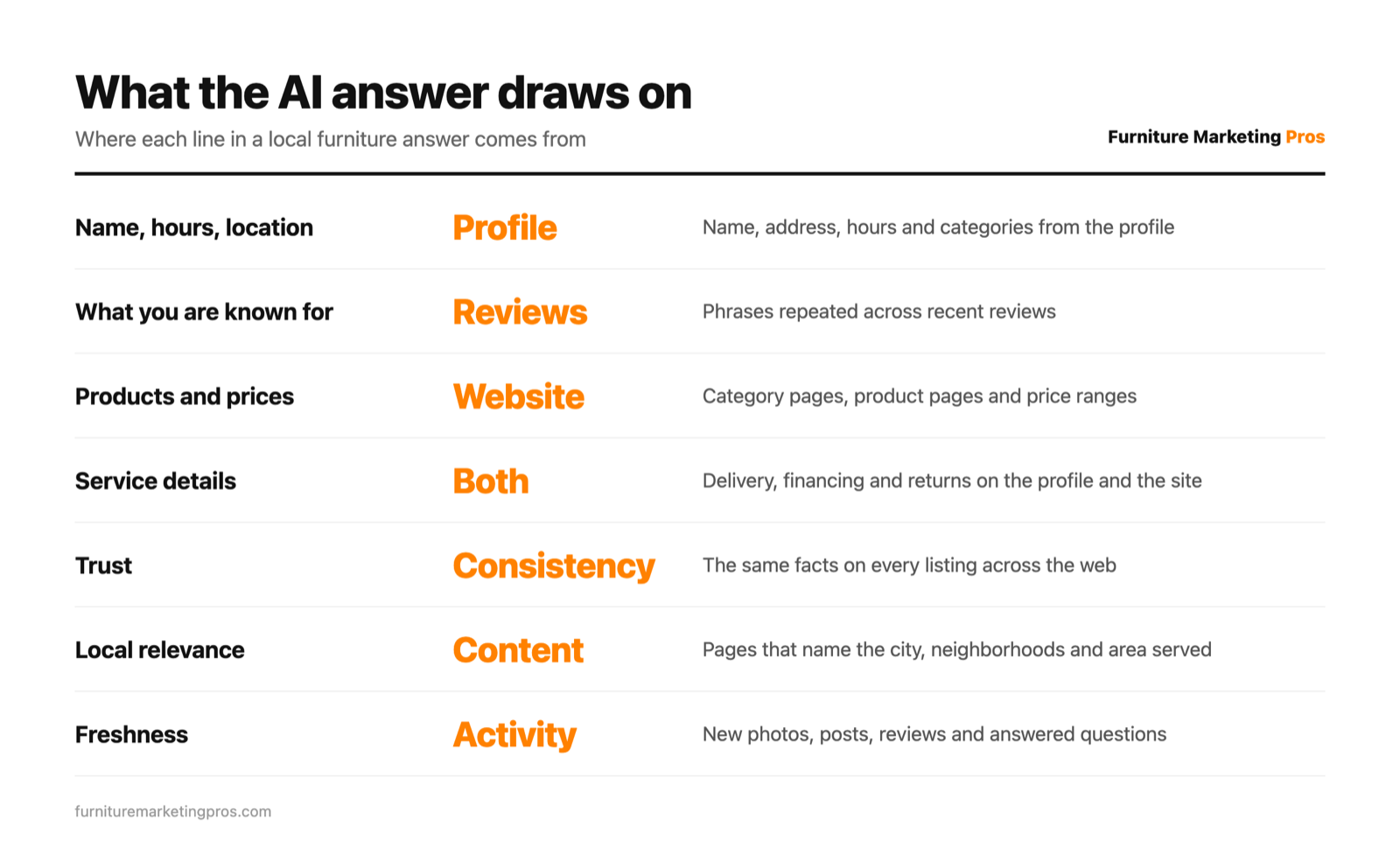
Read that back as an owner and notice where every phrase came from. "Family owned", "solid wood bedroom and dining", "sleep trial" and "financing options" are profile and website facts. "Helpful staff" and "on time delivery" are review language. Nothing in the answer was written by the store, and all of it was written from what the store put out there.
An illustrative answer for "best sectional sofa store in your city"
Add a product and the answer gets more specific and more demanding. Again, this is a shape, not a real result.
For a query like "best sectional sofa store in" followed by a city, the overview tends to start with buying advice: measure the room, decide between a chaise and a corner layout, consider fabric for pets and children, and ask about lead times. Then it names stores that it can connect to sectionals specifically. A store whose website has a real sectional category page with named collections, fabric options, price ranges and photos in rooms is easy to name. A store whose site has a single "living room" page with a stock photo is not. The answer may add that one store offers custom configurations, another has quick ship sectionals in stock, and a third has reviews praising its delivery crew. It may also mention a national online brand if local options are thin.
The lesson is the same one at a finer grain. Google names the store it can describe. If your sectional page says nothing specific, there is nothing for the answer to say about you, and the slot goes to a store that gave Google more to work with.
The signals Google draws on to name a store
Google does not publish a recipe for which businesses an AI Overview names. What follows is what we see across the furniture stores we work with, on top of what Google says about local results in general: relevance, distance and prominence.
Profile data. The Google Business Profile supplies the facts an answer states as facts: name, address, hours, categories, attributes, products and the description. Our post on why your Google Business Profile is costing you furniture sales walks through the profile field by field. The point for AI Overviews is that an incomplete profile gives Google an incomplete store to describe.
Review language. The phrases that recur across recent reviews become the phrases the answer uses about you. Reviews that mention specific products, the delivery and the people who helped are worth far more than a rating alone. Managing that flow is what our reviews and reputation service handles for stores.
Website content. Category pages, product pages, location pages and buying guides are where Google finds specifics: collections, materials, price ranges, services and the city you serve. Thin pages produce thin descriptions.
Consistency across the web. When the profile, the website, the maps apps and the directories agree, Google can describe the store with confidence. When they disagree on the name, address or hours, the store becomes a risky thing to name, and risky businesses get left out.
Activity. Fresh photos, recent reviews, answered questions and current posts tell Google the store is open and cared for. A profile that went quiet a year ago reads as a store that might have closed.
What changes for the owner
Fewer clicks on informational queries. A buying guide that used to bring steady traffic may now be summarized on the results page, with the shopper never reaching your site. That hurts page views. It does not have to hurt sales, because that shopper was early in a two to twelve week decision, and the guide's job was to put your name in their head, which it still does if the overview cites it.
More weight on being named. When a shopper near the end of the decision asks where to buy, a short list of named stores is the whole result. Being in it is worth more than ranking fourth in a list of ten ever was. Being out of it is invisible.
The profile and reviews do the work. The answer is assembled from your profile and your reviews more than from your homepage copy. Owners who treated the profile as a formality and reviews as a vanity score now find those two assets deciding whether they are mentioned.
The showroom visit is still the conversion. The furniture buying decision is made during online research, and the showroom visit confirms it. AI Overviews move more of the research onto the results page, which makes the moment of being named more decisive, not less. Our post on how the furniture shopper has changed explains why most of the decision already happens before the visit.
What to do this quarter
This is a quarter of work, in a deliberate order.
Week one: see what Google says about you. Search the questions your customers ask, from inside your trading area, with the judgment words shoppers use. Note whether an overview appears, whether you are named, what it says, and which competitors are named instead. This is your baseline.
Weeks two and three: correct the facts. Every wrong or missing fact in those answers traces back to a source. Fix the profile, then the website, then every listing that disagrees. If you are not showing up at all, our post on why your furniture store is not showing up in Google AI Overviews is the diagnostic to run first.
Weeks four to eight: give Google specifics. Rewrite the category pages the answers care about, sectionals, bedroom, dining, mattresses, so each names collections, materials, price ranges, services and the city. Ask for reviews at delivery and reply to every one with specifics.
Weeks nine to twelve: repeat the check and measure. Run the same searches again and compare. Then look at the measures below.
What not to panic about
Not every search gets an overview. Many local furniture searches still lead with the map pack and classic results. Keep the map pack work going.
A drop in blog traffic is not a drop in sales. Judge the quarter on inquiries, booked appointments and showroom visits in your CRM, not on page views for informational posts.
You do not need to rewrite your whole site for AI. Google is reading the same pages it always read, and specific, honest, current content is what it rewards. Pages written to game a summary do nothing.
You do not need a new tool. The sources are your profile, your reviews and your website, and you already control all three. Tools that promise to place you in AI answers cannot change what those sources say.
Online brands will sometimes be named beside you. For product queries, national brands have deep product pages and thousands of reviews. Your advantage is the showroom, the trial, the delivery crew and the local reviews, and the answer can only mention those if your pages and profile say them plainly. For how generative engines pick businesses more broadly, see what GEO is and why every furniture store needs it.
How to tell whether it is working
Page views are the wrong gauge for this. Watch four things instead.
Branded searches. Search Console shows how often people search your store's name. A store that is being named in answers sees branded searches rise, because the shopper reads the answer and then looks you up.
Profile actions. Calls, direction requests and website clicks from the profile are the closest thing local search offers to a showroom traffic measure, and they are where being named shows up first.
The named check. Run your baseline searches monthly and record whether you are named and what is said. Treat a wrong fact in the answer as a bug to fix at the source.
Showroom conversations. Train the floor to ask how people found the store, and listen for "Google said" or "the AI suggested". It is unscientific, and it is often the first signal.
Being the store the answer names
AI Overviews reward the furniture stores that are easiest to describe accurately: a complete profile, reviews full of specifics, pages that say what you sell and where, and the same facts everywhere. That is the work our generative engine optimization for furniture stores service does, from the baseline check through the fixes and the monthly measurement. If you would like to know what Google's answer currently says about your store, book a strategy call and we will run the searches with you.
Key takeaways
- Google AI Overviews summarize an answer at the top of some searches and, for local furniture queries, may name specific stores.
- The answer is assembled from Google Business Profile data, review language, website content and how consistently those sources agree.
- Informational queries send fewer clicks, while being named near the end of the decision carries more weight than any ranking did.
- The showroom visit is still the conversion, so judge the shift on appointments and visits, not blog page views.
- This quarter, baseline what Google says about you, correct the facts at the source, give category pages specifics and ask for detailed reviews.
- Measure branded searches, profile calls and direction requests, and a monthly named check rather than traffic alone.
Frequently asked questions
Do Google AI Overviews show up for furniture store searches?
They appear on some furniture searches and not others, most often when the shopper asks a question or adds a judgment word like best or affordable. Plain "near me" searches often still lead with the map pack.
How does Google decide which local furniture stores to name in an AI Overview?
Google does not publish a formula, but the answers draw on the Google Business Profile, the language in recent reviews, the specifics on your website and how consistently every listing agrees. Stores that are easy to describe accurately are the ones that get named.
Will AI Overviews reduce traffic to my furniture store website?
Visits to informational pages such as buying guides often fall, because the shopper gets the summary on the results page. Sales do not have to fall with them, since the decision still ends in a showroom visit and being named can send a better qualified shopper.
Can I pay to be included in a Google AI Overview?
Not into the written answer itself. Google sells ads on the results page, including around AI Overviews, but the stores named inside the generated answer are not paid placements. The route in is a complete profile, detailed reviews, specific pages and consistent facts across the web.
How often should I check what Google's AI says about my store?
Monthly is enough for most stores. Run the same set of searches from inside your trading area, record whether you are named and what is said, and fix any wrong facts at the source before the next check.