




Furniture is one of the most visual categories on Facebook and Instagram. A well shot sectional in a real living room stops a thumb in a way that a software screenshot never will. That is the good news.
The confusing news is that Meta has spent the last three years replacing most of the levers advertisers used to pull with automation under the Advantage+ name, and the guidance furniture store owners hear is contradictory. Turn everything on and trust the machine. Turn everything off because it wastes money. Neither is right, and this article explains what the automation actually does, what it needs from a furniture retailer to work, and what the numbers look like in furniture accounts we manage.
The short answer
Advantage+ is Meta's name for letting its system make decisions you used to make by hand: who sees the ad, where it runs, which creative variation shows, and how budget moves between them. It works well when you give it strong inputs: a catalog, a clean conversion signal from your website, and a lot of good creative. It works badly when you hand it a boosted post and a broad budget and hope.
Most furniture stores are still doing the second thing. That is the opportunity.
What Advantage+ actually automates
It helps to separate the pieces, because they are turned on in different places and have different consequences.
Advantage+ audience replaces detailed interest targeting with a suggestion. You tell Meta who you think your customer is, and it treats that as a starting point rather than a boundary. In furniture this is mostly a good trade. The people buying a dining set are not defined by an interest in "home decor"; they are defined by having just moved, renovated or had a child, and Meta sees those signals better than a targeting menu does.
Advantage+ placements run the ad wherever Meta thinks it will perform, across Facebook and Instagram feeds, Stories, Reels, Marketplace, and the Audience Network of third party apps. We turn Audience Network off in every furniture account. The clicks are cheap because they are accidental, and a furniture buyer is not made by a misclick in a mobile game.
Advantage+ creative makes automatic enhancements to your ad: brightness and contrast, image cropping per placement, text overlays, music on video, and increasingly AI generated backgrounds and image expansion. Some of these are fine. Some will put your sofa on a background that does not exist and crop your product out of the frame. Review each enhancement individually rather than accepting the bundle.
Advantage+ sales campaigns, previously called Advantage+ shopping campaigns, are the full package: one campaign, minimal targeting, Meta deciding everything toward a purchase or add to cart signal from your pixel and Conversions API, usually with your product catalog attached so it can show each person the products they are most likely to buy.
Advantage+ catalog ads, previously dynamic product ads, pull images, prices and names from your catalog and assemble the ad per viewer. These are the workhorse of furniture retargeting and we cover them in depth in retargeting for furniture stores.
The honest state of furniture on Meta right now
Here is what we see across the furniture ad accounts we manage, looking at the ninety days to early September 2026.
Almost none of them are running Advantage+ sales campaigns optimized for purchases. Two accounts have Advantage+ shopping campaigns built by previous agencies that have been dormant for more than a year. What is actually running is traffic campaigns, message campaigns and boosted posts.
That is not laziness. It reflects a real constraint. Advantage+ sales optimization needs a steady stream of purchase events to learn from, and Meta's own guidance is roughly fifty optimization events a week per ad set. A local showroom selling a few dozen big ticket items a month, mostly in person, does not generate that signal online. Handing Meta a purchase goal it cannot learn from produces an expensive campaign that never leaves the learning phase.
So the question for a furniture store is not "should I turn on Advantage+" but "what signal can I actually give it." The answer is usually one of these, in order of preference: online purchases if you sell enough online, add to cart or initiate checkout as a proxy, quote or appointment requests through a form, and messaging conversations or qualified calls as a floor.
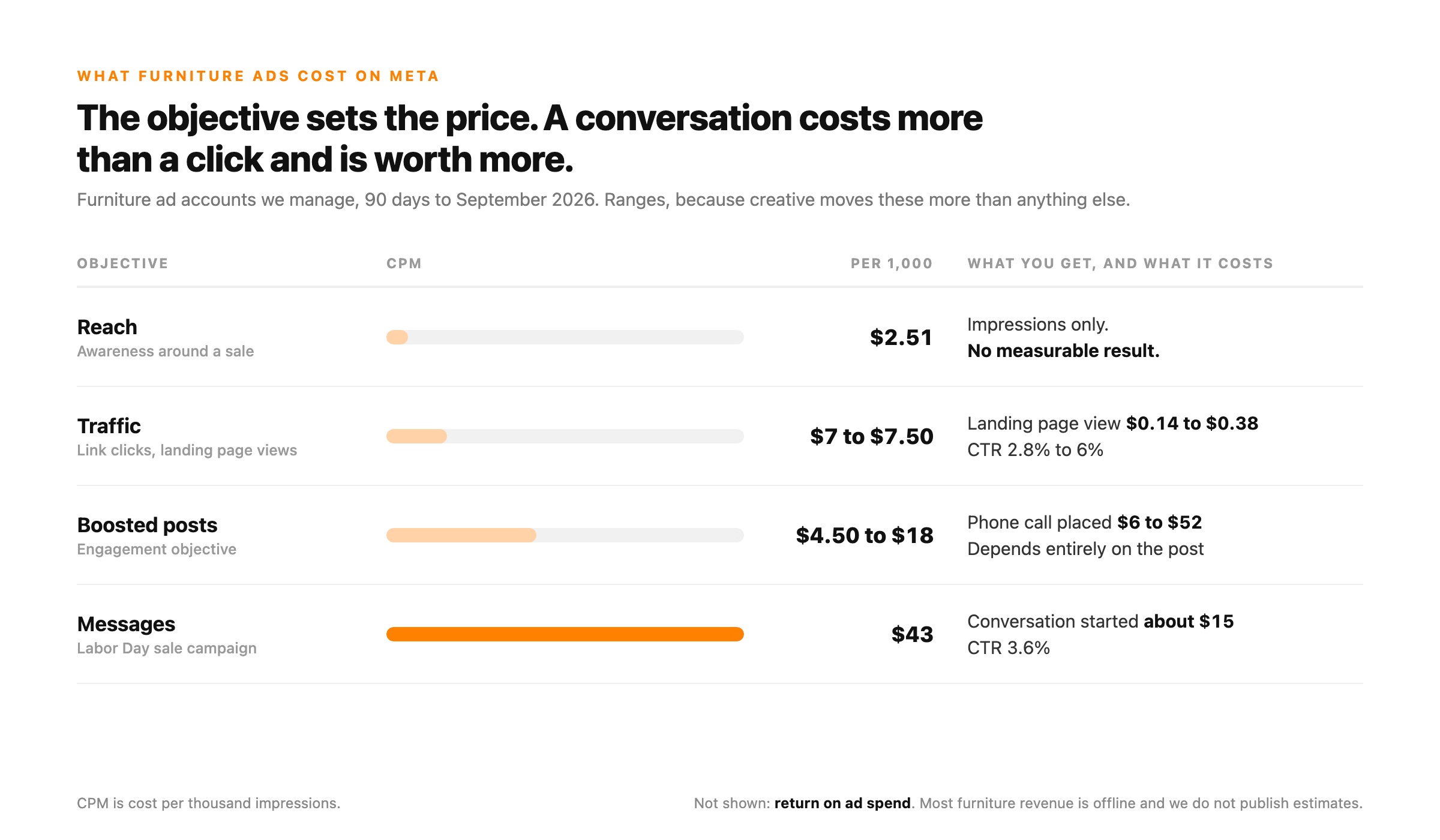
What furniture ads cost on Meta
Same accounts, same ninety days. These are ranges, because the objective you choose changes the price more than anything else.
Reach and awareness ran at about 2.50 dollars per thousand impressions. Very cheap, very passive. Fine for keeping a showroom's name in front of a local audience around a sale, useless as a measure of anything.
Traffic campaigns ran at 7 to 7.50 dollars per thousand impressions, with link clicks at 26 to 27 cents and landing page views at 14 to 38 cents. Click through rates between 2.8 and 6 percent. This is the cheapest way to get a furniture shopper onto a product page, and it is also the objective most likely to fill your site with visitors who never intended to buy.
Boosted posts with an engagement objective ran anywhere from 4.50 to 18 dollars per thousand, depending entirely on the creative. Phone calls placed directly from those ads cost between 6 and 52 dollars each. That spread is the whole story of boosting: the same budget on a strong video with a clear offer and on a flat product photo produce results ten times apart.
Message campaigns for a Labor Day sale ran at 43 dollars per thousand impressions with a 3.6 percent click through rate and a cost of about 15 dollars per conversation started. Expensive per impression, and often the best objective for a showroom because a conversation with a real person is closer to a sale than a click is.
Notice what is missing from that list: return on ad spend. We do not publish it, and we would be cautious of any agency that quotes one for a showroom business, because most furniture revenue happens offline and the attribution is an estimate. Judge Meta on cost per qualified conversation, cost per quote and cost per showroom visit you can actually count.
Creative is now the targeting
When Meta decides who sees the ad, the creative becomes the only thing that decides who responds to it. A video of a reclining sectional in a family room attracts families with a living room to furnish. A close up of a solid walnut dining table attracts a different buyer. You are targeting through what you show, whether you mean to or not.
This is where furniture has an advantage over almost every other category, and where most furniture stores throw it away with manufacturer photography on white backgrounds.
What works, consistently, across the accounts above and the ones before them:
Real rooms, real light. A sofa in an actual living room, shot on a phone if necessary, outperforms the catalog render. Shoppers are trying to imagine the piece in their own home, and a real room helps them do it.
Short video with a person in it. Someone sitting down on the sofa, reclining the recliner, opening the drawer, pulling out the sleeper. Ten to fifteen seconds. The 23 year anniversary post in one of our accounts drew a 13.5 percent click through rate at 3 cents a click on a modest budget, because it was a real person and a real story rather than a product.
The offer in the first frame. Financing terms, the sale, delivery included, in stock now. Furniture shoppers respond to reasons to act now because the default is to wait. Our piece on how the furniture shopper has changed explains why that waiting happens and what breaks it.
Volume of variations. Advantage+ works by testing combinations. Give it six images and three videos and four pieces of copy and it has something to optimize. Give it one image and it has nothing.
Local proof. The store name, the city, the delivery radius, a review. Meta is a local medium for a furniture store, and an ad that looks like a national brand's loses the one thing a local showroom has.
The setup that works for a single showroom
Keep it to three campaigns.
- One Advantage+ campaign with the best conversion signal you can generate: purchases if you have volume, otherwise quote or appointment form submissions, otherwise messaging conversations. Catalog attached if you sell online. Advantage+ audience on, Audience Network off, creative enhancements reviewed one by one. Six or more images and three or more videos per ad set.
- One retargeting campaign using Advantage+ catalog ads to show website visitors the products they viewed, with a separate budget so prospecting cannot starve it.
- One local awareness or reach campaign around each major sale window, cheap impressions to your delivery radius, turned off between sales.
Connect the pixel and the Conversions API before any of it launches. Since Apple's tracking changes, the pixel alone misses a large share of iPhone users, and the Conversions API sends the events from your server instead. Without it your campaigns are learning from a fraction of the truth.
Where Meta fits with Google
Meta creates demand. Google captures it. A furniture shopper sees your sectional on Instagram on Tuesday, searches your store name on Saturday and visits on Sunday. If you only measure the Google click you will conclude Meta did nothing, and cut the campaign that started the sale.
That is why we run them together and read them together, which is what paid ads management for furniture stores means in practice. The companion article on Google Ads for furniture stores covers the other half. And the organic side, the content that makes a page worth following between sales, is its own discipline, covered under social media marketing for furniture brands.
One more thing lands on your site rather than on Meta. A 14 cent landing page view is only cheap if the page it lands on can hold a visitor and produce a quote request. A slow product page with no price, no dimensions and no way to ask a question turns cheap traffic into an expensive bounce. Fix the website before scaling the ads into it.
Key takeaways
- Advantage+ is a set of separate automations. Turn on audience expansion, turn off Audience Network, and review creative enhancements one at a time.
- The automation needs a conversion signal it can learn from. Most showrooms cannot feed it fifty purchases a week, so optimize for quotes, appointments or conversations instead.
- In our furniture accounts, traffic runs at about 7 dollars per thousand impressions, message campaigns at about 43, and a conversation started costs roughly 15 dollars.
- Creative is the targeting now. Real rooms, real people, short video, the offer up front, and enough variations for the system to test.
- Connect the Conversions API before launch, and judge Meta on conversations, quotes and visits you can count rather than on a return figure you cannot.
Frequently asked questions
Should a furniture store use Advantage+ shopping campaigns?
Only if you sell enough online to generate a steady purchase signal, roughly fifty a week per ad set. Most local showrooms should run an Advantage+ campaign optimized for quote requests, appointments or messaging conversations instead, and keep the catalog for retargeting.
What is a good cost per click for furniture ads on Facebook and Instagram?
In our furniture accounts, traffic campaigns produce link clicks at 26 to 27 cents and landing page views at 14 to 38 cents. A cheap click is not the goal, though. A 15 dollar messaging conversation with a real buyer is usually worth more than fifty 30 cent clicks.
Do boosted posts work for furniture stores?
Sometimes, and the spread is enormous. In one account, phone calls from boosted posts cost between 6 and 52 dollars depending on the post. Boosting a strong video with an offer can work. Boosting a product photo with no offer is usually the most expensive thing in the account.
Should I turn on Advantage+ creative enhancements?
Review them one by one. Cropping per placement and brightness adjustments are usually fine. AI generated backgrounds and image expansion can misrepresent the product, and for furniture the product is the whole ad.
How much should a furniture store spend on Meta ads?
Enough to run a prospecting campaign and a retargeting campaign with separate budgets and still get through learning, which in practice starts around 1,500 to 2,500 dollars a month for a single showroom, rising sharply around sale windows. Split it with Google according to where your buyers actually start their search.