




Somewhere between 97 and 99 percent of the people who visit a furniture website leave without buying or asking a question. That is not a failure of the website. It is what furniture shopping is. A sofa is a two to twelve week decision involving measurements, a partner, a paint color and a paycheck, and almost nobody makes it on the first visit.
Retargeting is how you stay in that decision. It is the cheapest traffic you will ever buy, because the people seeing the ads already know who you are and already wanted something you sell, and it is the part of the paid media plan most furniture stores either skip or run as a single generic ad that follows people around for a month. This is the furniture specific version.
The short answer
Retargeting means showing ads, emails or messages to people who have already interacted with your store online: visited a product page, added to cart, started a quote, watched a video, opened an email. In furniture it should be built around the length of the consideration cycle, with different messages at different points, across Meta, Google, email and SMS, and it should stop when the person buys.
The rest of this article is how.
Why furniture retargeting is different
Most retargeting advice assumes a short purchase window and a cart. Furniture has neither for most of its buyers.
The cycle is long. Two weeks for a mattress, twelve or more for a full living room. A retargeting window of seven days, which is the default in many setups, gives up on the buyer before they have measured the wall.
The purchase is often offline. A shopper researches online, retargeting brings them back twice, and they buy in the showroom on a Saturday. Your ad platform never sees the sale, so it reports the campaign as a failure. Judging furniture retargeting on online conversions alone will make you cut the thing that works.
Two people decide. The person browsing sectionals at lunch is not always the person who signs. Retargeting that reaches the household, through shared devices and email, does more than retargeting that follows one browser.
The product is the message. A generic "come back and save" ad is weak. An ad showing the exact sectional they looked at, in the fabric they clicked, with the price and the financing, is strong. That is what dynamic catalog ads do, and it is why the catalog feed matters as much here as it does for Shopping. See catalog integration for furniture retailers for what breaks in furniture feeds.
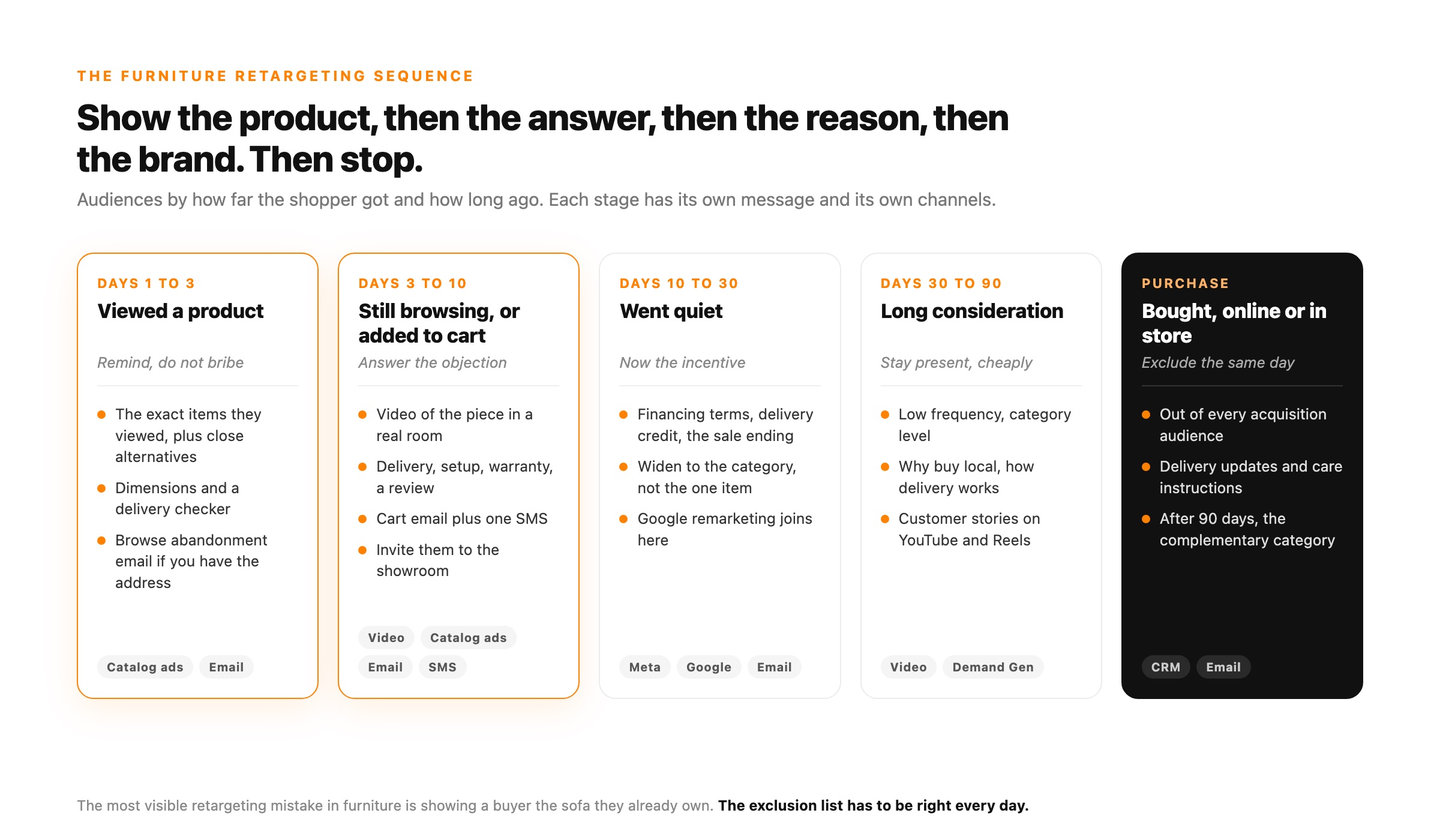
The sequence: what to show and when
Build audiences by how far the shopper got and how long ago, then give each one a message that fits.
Days 1 to 3, viewed a product. Show them the product. Dynamic catalog ads on Meta, the same items they viewed plus close alternatives. No discount yet; you are reminding, not bribing. If they left an email at any point, a browse abandonment email with the item, its dimensions and a link to check delivery to their zip code.
Days 3 to 10, still browsing or added to cart. Answer the objection. Furniture buyers stall on fit, delivery, quality and price, in that order. Show a short video of the piece in a real room, a delivery and setup explainer, the warranty, a review. Cart abandoners get an email and, if they opted in, one SMS with a direct link back. This is also the moment to offer a showroom visit or a design consultation, because a conversation closes what an ad cannot.
Days 10 to 30, went quiet. Now the incentive. Financing terms, a delivery credit, the sale that is ending. Widen the creative to the category rather than the single item, because they may have moved on from that sofa but not from needing a sofa.
Days 30 to 90, long consideration. Lower frequency, category level, brand and trust content. Why buy from a local store, how the delivery works, what customers say. Cheap impressions to keep the name present until the paycheck or the paint arrives.
After a purchase, stop. Exclude buyers from every acquisition audience the day the order lands, and move them to a post purchase sequence: delivery updates, care instructions, and after ninety days, the complementary category. Someone who bought a bedroom set buys a mattress; someone who bought a sofa buys a rug and a lamp. Showing a buyer the sofa they already own for another month is the most common and most visible retargeting mistake in furniture.
The channels, and what each is for
Meta dynamic catalog ads are the core. Connect the catalog, connect the pixel and the Conversions API, and build product sets for viewed, added to cart and purchased. Meta assembles the ad per person. Keep retargeting in its own campaign with its own budget so the prospecting campaign cannot absorb it. In the accounts we manage, retargeting audiences consistently produce the cheapest landing page views and the highest rate of conversations per impression, which is what you expect when the audience already wanted the product. The companion piece on Meta AI ads for furniture stores covers the campaign side.
Google remarketing reaches the same people while they read the news, watch YouTube and search. Performance Max includes your site visitors as an audience signal automatically, and a Demand Gen campaign with a remarketing audience gives you YouTube and Discover placements at very low cost per thousand. Layer your visitor lists onto Search as observation audiences, so you can bid more when someone who already visited searches "sectional near me" again. The Google Ads playbook covers the account structure this fits into.
Video retargeting is the underused one. A person who watched a product video for ten seconds is a warmer audience than a visitor who bounced in two, and both Meta and YouTube let you build audiences from video engagement. Show them the next video: the room shot, the delivery explainer, the customer story. Furniture is a category people need to see moving, and video retargeting is how you let them.
Email sequences are the highest return channel in the whole plan and the one most dependent on capturing the address in the first place. Quote forms, room planner tools, delivery checkers, financing pre approval, sale notifications: every one of them is a reason to ask for an email, and every email address you capture is a retargeting audience you own and do not pay a platform to reach. Browse abandonment, cart abandonment, quote follow up and post purchase are the four sequences every furniture store should have running. Our piece on turning your website into a lead machine is about the capture side; email and SMS marketing for furniture stores is the sequence side.
SMS is for one or two messages, with consent, at the moments that matter: the cart they left, the sale that ends tonight, the delivery slot. It is too intrusive for a long sequence and too effective to skip entirely.
The CRM ties it together. When a quote request, a showroom visit, a phone call and an online cart are all the same person, you can stop the ads when they buy in store, and you can send the salesperson a note that their lead just looked at the dining table again. That is the job of a CRM built for furniture retail, and without it the channels above each run blind.
Cross device, and what privacy changes did to it
The furniture shopper browses on a phone at lunch, measures the room with a laptop open in the evening and buys on a Saturday in the store. Following that person across devices used to rely on third party cookies and mobile ad identifiers. Both are weaker than they were.
Apple's App Tracking Transparency, since 2021, means a large share of iPhone users are invisible to the Meta pixel alone. Safari and Firefox block third party cookies by default. Google decided in 2025 to keep third party cookies in Chrome after years of announcing their removal, which helps, but a plan that depends on them is a plan built on one browser.
What still works, and what to build on:
- Logged in identity on the platforms. Meta and Google match people across devices through their own accounts, not cookies. Retargeting inside their systems is still cross device by default.
- The Conversions API and server side tagging. Sending events from your server rather than the browser recovers much of what the pixel misses, and it is the single highest impact technical fix for retargeting in 2026.
- First party data. Every email and phone number you capture with consent is a cross device audience you own. Upload the lists to Meta and Google as customer match audiences and they reach the same people on every device they are logged into.
- Frequency caps and exclusions. Privacy rules aside, showing the same ad forty times is how retargeting earns its reputation for being creepy. Cap frequency at a few impressions a week per stage, and exclude buyers immediately.
What to measure
Not online conversions alone. For a showroom business, measure retargeting on assisted conversions and on the conversations, quote requests, appointment bookings and direction requests it produces, and match store sales back to the CRM where you can. Watch the cost per landing page view against prospecting as a sanity check; retargeting should be several times cheaper. Watch frequency; if it climbs past ten a week the audience is too small for the budget. And watch the exclusion lists, because the day the purchase exclusion breaks is the day customers start asking why you are advertising their own sofa to them.
Running this across Meta, Google, email and SMS, with the audiences and exclusions kept in sync, is the unglamorous part of paid ads management. The strategy is on this page. The results come from the exclusion list being right every single day.
Key takeaways
- Furniture buyers take two to twelve weeks to decide. Retargeting windows and sequences should be built for that, not for a seven day default.
- Show the product they looked at, then the answer to their objection, then the incentive, then the brand. Stop the day they buy.
- Dynamic catalog ads on Meta are the core, Google remarketing and video extend the reach, and email is the highest return channel you own.
- The Conversions API, first party lists and platform logged in identity are what make cross device retargeting work after the privacy changes.
- Measure on conversations, quotes and showroom visits, not online sales alone, or you will cut the campaign that started the sale.
Frequently asked questions
How long should a furniture store retarget website visitors?
Up to ninety days for most categories, with the message changing at roughly three, ten and thirty days. Mattresses can run shorter, full room purchases longer. Exclude anyone who buys, on any channel, the day they do.
What are dynamic product ads and do they work for furniture?
Ads assembled automatically from your product catalog, showing each person the items they viewed or close alternatives. They are the most effective retargeting format in furniture because the product itself is the message, and they depend entirely on a clean catalog feed.
Is retargeting creepy? Will it annoy my customers?
It is creepy when it is done badly: the same ad dozens of times, for a product they already bought. Cap frequency, change the message over time, and exclude buyers immediately, and it reads as helpful rather than intrusive. Most shoppers expect to see a product again after looking at it.
How much of my ad budget should go to retargeting?
Typically 15 to 25 percent of paid media, in its own campaigns with its own budgets. Too little and warm shoppers go cold; too much and you exhaust a small audience with high frequency. Scale it in step with the prospecting that feeds it.
Can I retarget people who visited my showroom but not my website?
Partly. Anyone who gave an email or phone number in store can be reached through customer match audiences and email. Wifi and foot traffic based audiences exist but are limited and privacy constrained. The practical answer is to capture contact details at every showroom visit and run the sequence from the CRM.