




Google Ads is the one channel where a furniture shopper tells you exactly what they want, in their own words, at the moment they want it. "Sectional with chaise near me", "queen mattress sale", "solid wood dining table 8 seats". Nobody types those for entertainment.
It is also the channel where furniture retailers waste the most money, because most Google Ads guidance is written for software companies and apparel brands, and furniture breaks its assumptions. Long consideration cycles, high ticket, delivery radius, catalogs with thousands of variants and no barcodes. This playbook is written for furniture specifically, and the numbers in it come from furniture accounts we manage, not from a generic industry report.
The short answer
A furniture store in 2026 should run four things: a Performance Max campaign fed by a clean product catalog, a Search campaign that owns your brand and your highest intent category terms, a Shopping presence through that same feed, and local extensions that put your showroom address and hours on every ad. Budget moves between them with the season, not on a flat monthly number.
Everything else in this article is the detail of how to make each of those work in furniture.
What the numbers actually look like in furniture
Across eight furniture and mattress accounts we manage, roughly 340,000 dollars of spend in the ninety days to early September 2026, this is what the channel types cost:
Performance Max took 46 percent of spend. Median cost per click was 1.22 dollars, ranging from under 10 cents in a value focused account to 2.37 dollars in a premium one. Median click through rate was 4.5 percent.
Search took 15 percent of spend. Median cost per click was 2.10 dollars, ranging from 85 cents to 7.27 dollars depending on the market and the category. Median click through rate was 6.3 percent, which is what you expect when the ad matches a query that specific.
Standard Shopping in a premium outdoor account ran at more than 10 dollars per click. That only works when the average order is in the thousands, and it is a reminder that a Shopping click is not cheap by default. It is cheap when the feed is good and the competition is thin.
Demand Gen and Video together took less than 2 percent of spend. Cheap impressions, almost no direct response. Useful as retargeting and awareness layers, not as a primary channel for a store that needs sales this month.
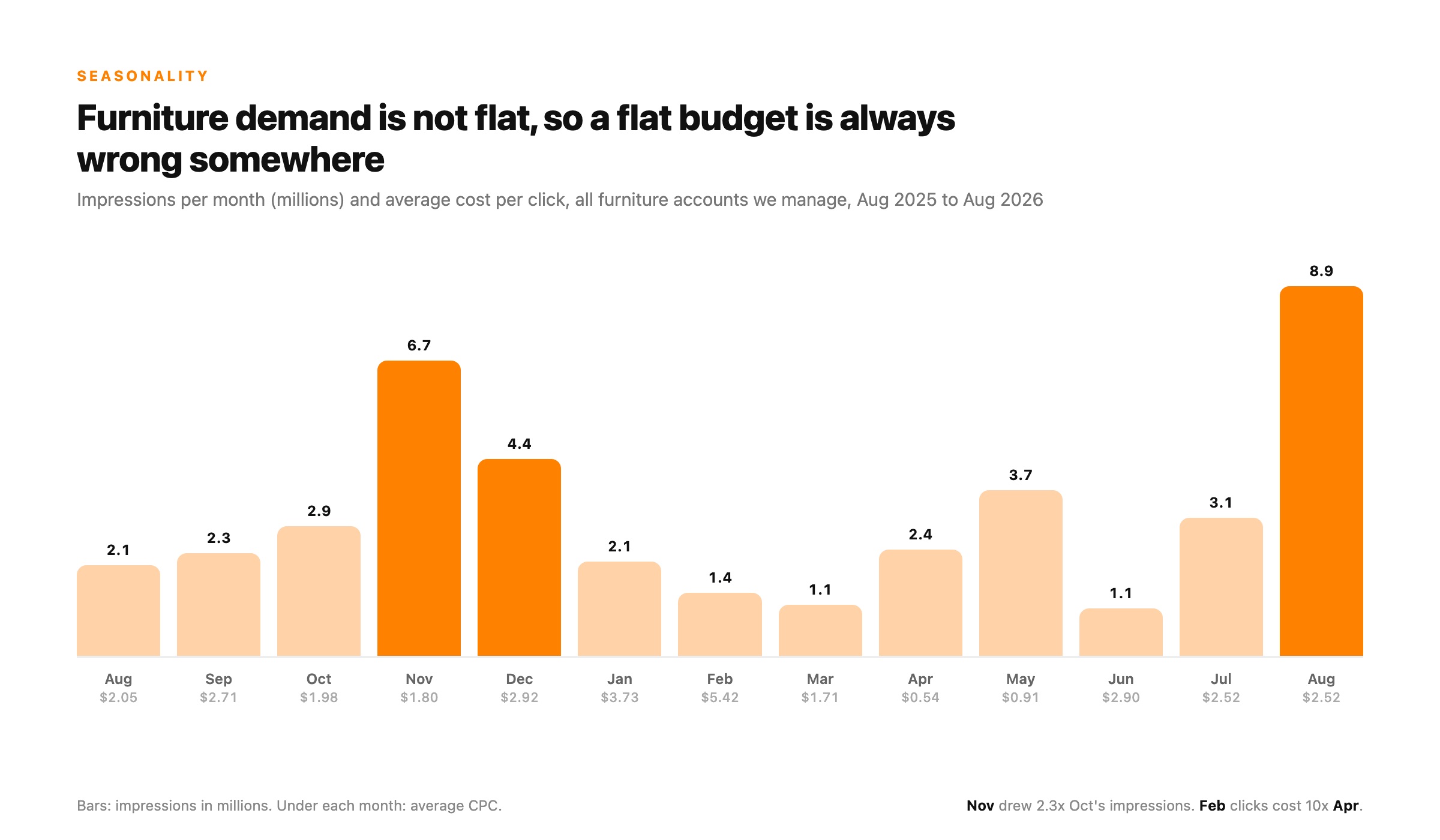
Seasonality is the biggest lever you are probably not pulling
The same accounts, month by month, show how uneven furniture demand really is. November delivered 2.3 times the impressions of October on 1.8 times the spend. The most expensive clicks of the year came in January and February, averaging 3.73 and 5.42 dollars, when tax refund and Presidents Day promotions crowd the auction. The cheapest came in April at 54 cents.
A flat monthly budget means you are underfunded in November and overpaying in February. The fix is a budget calendar: plan the year around Presidents Day, Memorial Day, the Fourth of July, Labor Day and the November to December stretch, raise budgets two weeks before each window so the campaigns have data when demand arrives, and let them settle in the quiet weeks. Our furniture marketing budget guide covers how much to put in overall. This is about when.
Performance Max: what it is good at and what it needs from you
Performance Max is Google's automated campaign type. You give it a budget, a goal, a product feed and creative assets, and it decides where the ads run across Search, Shopping, YouTube, Display, Gmail, Maps and Discover. For most furniture stores it should be the largest campaign in the account, and the accounts above bear that out.
It works when you feed it three things.
A clean feed. Performance Max is only as good as the catalog behind it. Titles built for matching, correct availability, dimensions in structured fields, variants published as variants. We covered the furniture specific failures in catalog integration for furniture retailers. If half your catalog is disapproved in Merchant Center, Performance Max is running with half an inventory and you will never see an error about it.
Real conversion data. It optimizes toward whatever you tell it is a conversion. If that is a page view, you will get page views. Set up purchase tracking for online orders, and for a showroom business set up quote requests, phone calls of a meaningful length, direction requests and financing applications as conversions with values attached. A phone call that leads to a 3,000 dollar sectional sale is worth teaching the algorithm about.
Audience signals, not audience targeting. Performance Max lets you suggest who to show ads to. Give it your customer list, your website visitors and in market segments for home furnishings. It will expand from there. Do not expect it to obey; expect it to learn faster.
Two settings matter more than the rest. Use asset groups by category, so sofas, bedroom, dining and mattresses each have their own creative and feed filter, and turn on the final URL expansion exclusion for pages you do not want traffic on, like your careers page or your blog. Both are one time jobs that pay off for the life of the campaign.
Search: own your brand and your highest intent terms
Search still matters in furniture for two reasons.
The first is your brand. When someone searches your store name, you want your ad and your organic listing both on the page, with sitelinks to sales, financing and directions. Brand clicks are the cheapest in the account and competitors will bid on your name if you do not.
The second is high intent category terms. "Sectional sofa near me", "mattress store open now", "dining set clearance". Exact and phrase match, in tight ad groups, with responsive search ads that mention your city, your delivery area and your financing. Median click through rate in our accounts on these campaigns is more than 6 percent because the ad and the query match closely, and that match is what you are paying for.
Where Search goes wrong in furniture is broad match on generic terms with no negative keywords. "Furniture" alone will spend your budget on people looking for office furniture, dollhouse furniture, furniture repair and jobs. Review the search terms report weekly and add negatives every time. We keep a shared negative list across every furniture account we manage for exactly this reason, and it is one of the highest return hours of the month.
Shopping: the feed does the work
Shopping ads are the product image, price and store name that appear when someone searches for a specific item. In 2026 you reach them two ways: through Performance Max, which includes Shopping placements automatically, or through a standard Shopping campaign where you control bids by product group.
For most stores Performance Max covers it. Run a standard Shopping campaign separately when you have a specific reason, for example a clearance product set you want to bid on aggressively, or a premium line where you want to cap the bid and protect margin.
Either way the feed is the whole game, and it is the same feed that determines whether your products appear in Google's free listings and in AI generated shopping answers. That overlap is why we treat feed work as part of ecommerce SEO for furniture rather than as an ads task alone.
Local: put the showroom on every ad
Most furniture is still bought in person after being researched online, so every campaign in the account should carry the showroom.
Link your Google Business Profile to the ads account so location assets show your address, hours and directions on Search and Maps placements. Add call assets with a tracked number. Set location targeting to your realistic delivery radius rather than the whole state, and bid up in the zip codes your sales data says you actually sell to. If you run more than one showroom, give each its own location asset and its own budget so a slow store cannot hide behind a strong one.
Store visits and direction requests are conversions. Count them.
The account structure that works for a single store
Keep it simple enough that you can read it in five minutes.
- One Performance Max campaign, asset groups by product category, product feed connected, audience signals from your customer list and site visitors.
- One Search campaign for brand terms.
- One Search campaign for non brand high intent terms, ad groups by category, phrase and exact match, shared negative list.
- One standard Shopping campaign only if you have a product set that needs its own bidding.
- Location, call, sitelink, price and promotion assets on everything.
- Conversion actions with values for purchases, quote requests, qualified calls, direction requests and financing applications.
A multi location retailer adds a Performance Max and Search pair per market, not per store, unless the stores are far enough apart to have different delivery areas.
What to check every week
The accounts that perform are the ones someone looks at. Every week: search terms for new negatives, Merchant Center for new disapprovals, budget pacing against the seasonal calendar, and conversion tracking for anything that has quietly broken, because a tag that stops firing turns Performance Max into a campaign optimizing for nothing. Every month: asset performance in Performance Max so weak images and headlines get replaced, and a review of which product categories are actually driving revenue versus spend.
This is the work that Google Ads management for furniture stores consists of. The strategy above fits on a page. The results come from running it every week.
Where Google Ads fits with everything else
Google captures demand that already exists. It does not create it. That is why it pairs with Meta, which is where a furniture shopper first sees the sofa they later search for, and with retargeting, which brings back the 97 percent of visitors who did not buy on their first visit. The next two articles in this series cover both: Meta AI ads for furniture stores and retargeting for furniture stores.
And all of it lands on your website. If the site is slow, the product pages are thin or the quote form is buried, a well run campaign just delivers disappointed visitors faster. That is where website and conversion work comes in, and it is usually the first thing we look at before scaling any ad budget.
Key takeaways
- Performance Max should be the largest campaign for most furniture stores, and it is only as good as the product feed and conversion data behind it.
- In our furniture accounts, Performance Max clicks run at a median of 1.22 dollars and Search at 2.10 dollars. Premium categories cost more and that can still be correct.
- Demand is not flat. November drew 2.3 times October's impressions and February clicks cost ten times April's. Budget on a seasonal calendar.
- Search exists to own your brand and your highest intent category terms. Broad match without negatives is where the waste lives.
- Put the showroom on every ad and count store visits, calls and direction requests as conversions.
Frequently asked questions
How much should a furniture store spend on Google Ads?
Enough to exit the learning phase, which in practice means a budget that produces at least 30 conversions a month. For a single showroom that usually starts around 2,000 to 3,000 dollars a month and scales from there. Our budget guide covers the split with other channels.
Is Performance Max better than Shopping for furniture?
For most stores yes, because it includes Shopping placements and adds Search, YouTube and Maps on top with one budget. Run standard Shopping alongside it only when you need bid control on a specific product set.
Do I need a product feed if I only have a showroom?
You should still have one. It powers Shopping and Performance Max, and it powers the free listings and AI shopping answers where people research before they visit. Mark items as available in store and let Google show them to nearby shoppers.
Why are my furniture Google Ads clicks so expensive?
Usually one of three things: broad match on generic terms, bidding in the most expensive weeks of the year on a flat budget, or a feed problem that limits Performance Max to a small set of products. Check the search terms report and Merchant Center first.
How long before Google Ads works for a furniture store?
Expect four to six weeks for Performance Max to learn, provided the conversion tracking is right from day one. Search on brand and high intent terms produces results in the first week. Judge the account on a full quarter, not a month, because furniture demand swings so much by season.