




A shopper in your city types "furniture stores near me" or asks an assistant where to try a mattress before buying one. A few years ago the answer was ten links and a map with three pins. Today it is often a short written answer that names a handful of stores and says what each is known for. If your showroom is not in that answer, the shopper may never see your name.
Local SEO has always been about being found by people within driving distance. What changed is who does the finding. Google's AI Overviews, Gemini, ChatGPT and Perplexity read the same local data, decide which stores are worth naming and write the answer themselves. The work that gets you named is still local SEO, done to a higher standard of consistency, evidence and clarity than a map pin ever demanded.
This guide is built only for furniture and mattress retailers. It walks through the eight layers that decide whether your store is named, in the order we build them, and ends with how to measure the result.
The short answer
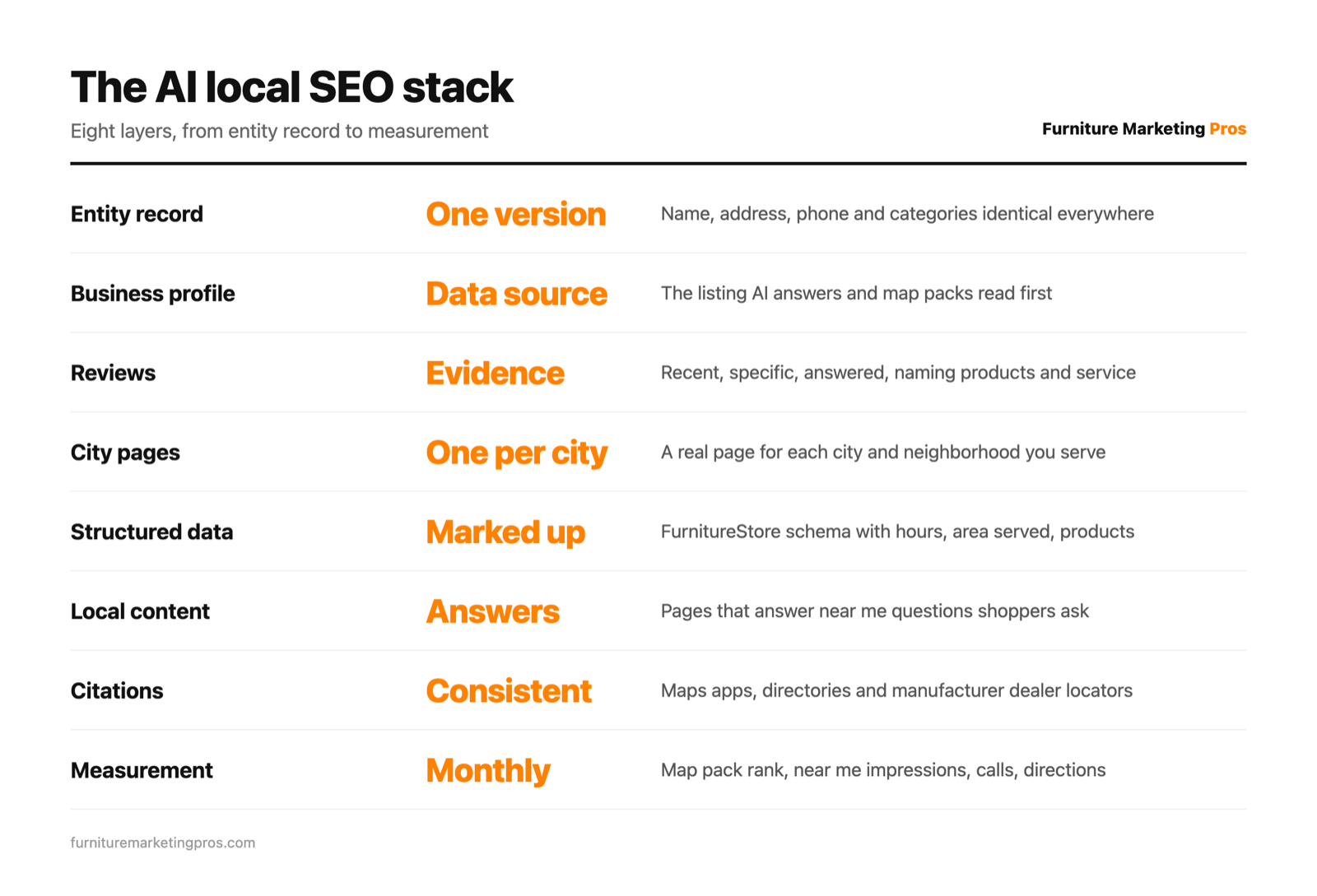
AI local SEO is the work of making your furniture store the clearest, most consistent and best evidenced local entity in its category, so that map packs, Google AI Overviews and AI assistants name it when someone nearby asks where to shop. It rests on eight layers: one version of your name, address, phone and categories everywhere, a complete Google Business Profile, reviews that read as evidence, a real page for every city and neighborhood you serve, structured data that says what you are, content that answers near me style questions, consistent citations beyond Google, and a monthly read of map pack position, near me impressions, calls, direction requests and assistant mentions.
Why local furniture search is now an answer, not a list
Furniture is a considered purchase. The decision typically takes two to twelve weeks from first search to purchase, and most of it is made during online research. The showroom visit confirms it. That research now runs through AI answers as much as classic results, and a shopper who asks which stores near them deliver this week expects a name, not a reading list.
Google describes local results in terms of relevance, distance and prominence, and AI answers push the same logic further. They read your profile, your reviews, your website and every other mention of your store, reconcile them, and decide whether you are a safe recommendation. Any disagreement between those sources makes you a riskier answer, and risky answers get left out. For the wider picture of how generative engines choose businesses, see what GEO is and why every furniture store needs it. This guide stays local.
Layer one: one version of your store everywhere
Think of the work as a stack of eight layers, where each makes the next more credible, and skip none. The bottom layer is the entity record. AI systems treat your store as an entity, a single thing with a name, a place and a set of facts, and the first job is to make sure there is only one version of it.
Pick the exact customer facing name you want everywhere and write it down. Decide once whether it is "Street" or "St", whether the suite number appears, and which phone number is primary. Then make every listing match, from your website footer and profile to every directory and dealer locator you appear on.
Furniture stores break this rule in predictable ways. A mattress gallery inside the showroom gets its own listing under a slightly different name. A clearance outlet shares a phone number with the main store. A location that closed years ago is still live on two directories. A call tracking number from an old campaign became the primary phone on a listing nobody remembers creating. Each is a second version of your entity, and each gives a machine a reason to hesitate. Categories belong to the record too: furniture store, mattress store and outdoor furniture store are different things, and they should be chosen the same way on every platform.
Layer two: the profile is the data source
Your Google Business Profile is the record map packs and AI Overviews consult first, and the authority on hours, location and what you sell. We have already published a full diagnosis of the gaps in your Google Business Profile is costing you furniture sales, so this guide does not repeat the fix list.
What matters for AI answers is specificity. An answer that says a store "offers financing, same week delivery and a mattress trial" got those facts from somewhere, and the profile is the most reliable somewhere. Write the description as plain statements about what you sell and who you serve, load products with real names and price ranges, and answer the questions in the profile's question and answer section yourself. Every field you leave blank is a sentence an answer cannot write about you.
Layer three: reviews are the evidence
When an AI answer says a store is "known for helpful staff and fast delivery", it is paraphrasing reviews. Volume and rating still matter for the map pack, but for generated answers the content matters more, because that is where the quotable language lives.
The reviews that do the most work name products, rooms and services. "We bought a reclining sectional and it was delivered and set up in four days" gives an answer four usable facts. "Great store" gives it nothing. You cannot script what customers write, but you can ask at delivery, when the piece is in the room, and reply to every review with specifics of your own. Our guide to getting more positive reviews for your furniture store covers the routine. Thin evidence makes you a weak recommendation.
Layer four: city and neighborhood pages that deserve to exist
Geo targeted landing pages go wrong in one of two directions. Either a store has no city pages and expects one homepage to rank everywhere within an hour's drive, or it generates dozens of near identical pages that swap the city name and nothing else. The first leaves demand on the table. The second is a page search engines have discouraged for years and AI answers have no reason to trust.
A city page earns its place when it would be useful to a person standing in that city. For every city and larger neighborhood you genuinely serve, write one page that says how far the showroom is, what delivery to that area looks like and costs, which collections that market tends to buy, and what quick ship options exist. Add photos of deliveries there, reviews from customers who live there, and the exact address and hours. Link it from a service area section so it is not an orphan.
For a single showroom, five to fifteen honest pages usually cover the real trading area. A multi location retailer needs a location page per showroom, with the city pages hanging off the nearest one. Our post on how furniture stores can dominate Google Maps goes deeper on the map side.
Layer five: structured data that names what you are
Structured data is the part of a page written for machines. The essential piece for a retailer is FurnitureStore schema, a specific type under LocalBusiness in the schema.org vocabulary, on every location page. It should carry the same name, address and phone as the entity record, plus coordinates, opening hours, area served and links to your profile so machines can connect the records.
Product schema on product pages gives answers names, prices and availability to work with. Keep every value identical to the profile, because markup that disagrees with it is worse than none. Markup alone wins nothing. Its job is to remove ambiguity, which is exactly what an answer needs before it commits to naming you.
Layer six: content that answers near me questions
Shoppers ask local questions in full sentences now: "where can I try a mattress near me before buying", "furniture stores open on Sunday near me", "who delivers a sofa this week in my area". The store with a clear, honest page answering each question gives the assistant something to cite.
Start with the questions your sales floor hears every week and write one page or section per question, with the city named naturally and the answer in the first paragraph. Include trial policies, delivery windows, financing and what to bring to the showroom. Pair these with buying guides that are local in detail, such as a mattress guide that names the brands on your floor. We showed the pattern in how mattress stores can win best mattress for back pain searches in your city.
Layer seven: citations beyond Google
AI assistants do not read only Google. They browse the open web and weigh how often, and how consistently, your store appears. Each matching mention is a vote that the entity is real.
Claim and align the listings that matter for a showroom: Apple Business Connect, Bing Places, Yelp, Facebook, the Better Business Bureau and your chamber of commerce. Then go after the citations specific to furniture: the dealer locators on your manufacturers' websites, among the most trusted mentions a store can earn because the brand itself is vouching for you. Quantity matters less than agreement. Ten listings that match beat fifty that argue.
Layer eight: how to measure it
Local SEO fails quietly when nobody measures it, so review five numbers monthly.
Map pack position. Check your rank for your core terms from several points across the trading area, because results change with the searcher's location.
Near me impressions in Search Console. Filter the performance report for queries containing "near me" and your city names, and watch impressions month over month. Search Console does not offer a separate AI Overview report today, so rising impressions on these queries are your sign you are being shown more often, whatever the format.
Direction requests and calls from the profile. The profile's performance view shows direction requests, calls and website clicks, the closest thing to a showroom traffic measure local search offers.
Store visits in Google Ads. If you run ads with a linked, verified profile and enough volume, store visit conversions give a second read on foot traffic.
AI assistant mentions. Once a month, ask ChatGPT, Perplexity, Gemini and Google the questions your shoppers ask, from inside your trading area, and record whether you are named and what is said. This is the measure that tells you whether the stack is working.
Saloni Furniture, a Virginia showroom we work with, ranks number one for "furniture stores leesburg va", a result built from these same layers. The Saloni Furniture case study shows the sequence.
A ninety day order of operations
In the first month, fix the entity record and the profile: audit every listing, merge duplicates, align name, address, phone and categories, complete every profile field and start the review routine at delivery.
In the second month, build the pages: the location page with FurnitureStore schema, the first five city pages for your strongest markets and the first five question pages drawn from the sales floor.
In the third month, extend outward: claim the remaining citations and dealer locators, add the next set of pages and run a full measurement month to set your baseline. From there the work is monthly: new reviews, fresh photos, a new page or two and the measurement review.
Making your showroom the store the answer names
Every layer in this guide is work your team can start this week. The hard part is doing it consistently across dozens of listings, pages and questions while running a store. That is what our local SEO for furniture stores service does, building and maintaining the full stack for showrooms and reporting the numbers above every month. To see how your store shows up today in the map pack and in AI answers for your city, book a strategy call and we will run the check together.
Key takeaways
- Local furniture search now returns written answers that name a few stores, built from your profile, reviews, website and citations.
- Keep one version of your name, address, phone and categories everywhere, and retire duplicate listings for galleries, outlets and closed locations.
- Treat the Google Business Profile as the data source AI answers read first, and fill every field.
- Reviews that name products, rooms and delivery experiences are the evidence an answer quotes.
- Build one honest page per city and neighborhood you serve, with FurnitureStore schema that matches the profile exactly.
- Measure map pack position, near me impressions, direction requests, calls and monthly AI assistant mentions.
Frequently asked questions
What is AI local SEO for a furniture store?
It is local SEO done to the standard AI answers require: one consistent entity record, a complete Google Business Profile, specific reviews, real city pages, structured data and content that answers local questions, so that you are the store named when a nearby shopper asks where to buy.
Do I still need city pages if I have a good Google Business Profile?
Yes, if you genuinely serve more than the city the showroom sits in. The profile anchors one address, while honest city pages give search engines and assistants a reason to show you to shoppers in surrounding towns.
How do I check whether AI assistants mention my store?
Once a month, ask ChatGPT, Perplexity, Gemini and Google the questions your customers ask, from inside your trading area, and record whether you are named and what is said. Fix any wrong facts at the source.
Does structured data make a furniture store rank higher?
Not on its own. FurnitureStore and Product schema remove ambiguity about what you are, where you are and what you sell, which makes you an easier store for a machine to name with confidence, and only when every value matches your profile.
How long does AI local SEO take to show results?
Profile and entity fixes can change map pack visibility within weeks, while city pages, citations and review depth build over a few months. Furniture buyers take two to twelve weeks to decide, so judge the work on a full quarter of direction requests, calls and assistant mentions rather than a single month.