




A furniture shopper cannot sit on a photo. They cannot feel the fabric, open the drawer or see how the walnut looks at four in the afternoon. For most of the weeks they spend deciding, your images are the product.
So the argument about which kind of image is best misses the point. White background photos, lifestyle photos, detail shots and now AI generated room scenes are not competing styles. Each does a different job, and each can damage trust when it is asked to do a job it was not built for.
The short answer
Furniture shoppers trust images that match what arrives. White background photos do the comparison work and belong in product feeds, marketplaces and category grids. Lifestyle photos create desire and show scale and style, so they lead in social ads, email and the product gallery. Detail shots prove quality. AI room scenes help when a real photograph of the real product is placed into varied rooms, and hurt when the tool changes proportions, fabric, finish or color. The honesty rule is simple: the product itself must be a real photograph or an accurate render, rendered scenes get labeled where it matters, and you never show a configuration you cannot deliver. Then test on ten products and measure conversion, complaints and ad response.
Why images carry more weight in furniture
Furniture is a considered purchase. From first search to sale typically takes two to twelve weeks, with mattresses at the short end and full rooms at the long end. During that window the shopper returns to the same few product pages again and again.
Those pictures have to answer what a salesperson would answer on the floor. Will it fit. Is it the gray that leans blue or the gray that leans brown. Is it built well. Does it suit a house like mine. One image cannot answer all four.
There is also a cost after the sale. A sofa that arrives looking different from its picture is not a small disappointment. It is a delivery crew, a return trip, a restocking problem and very often a public review.
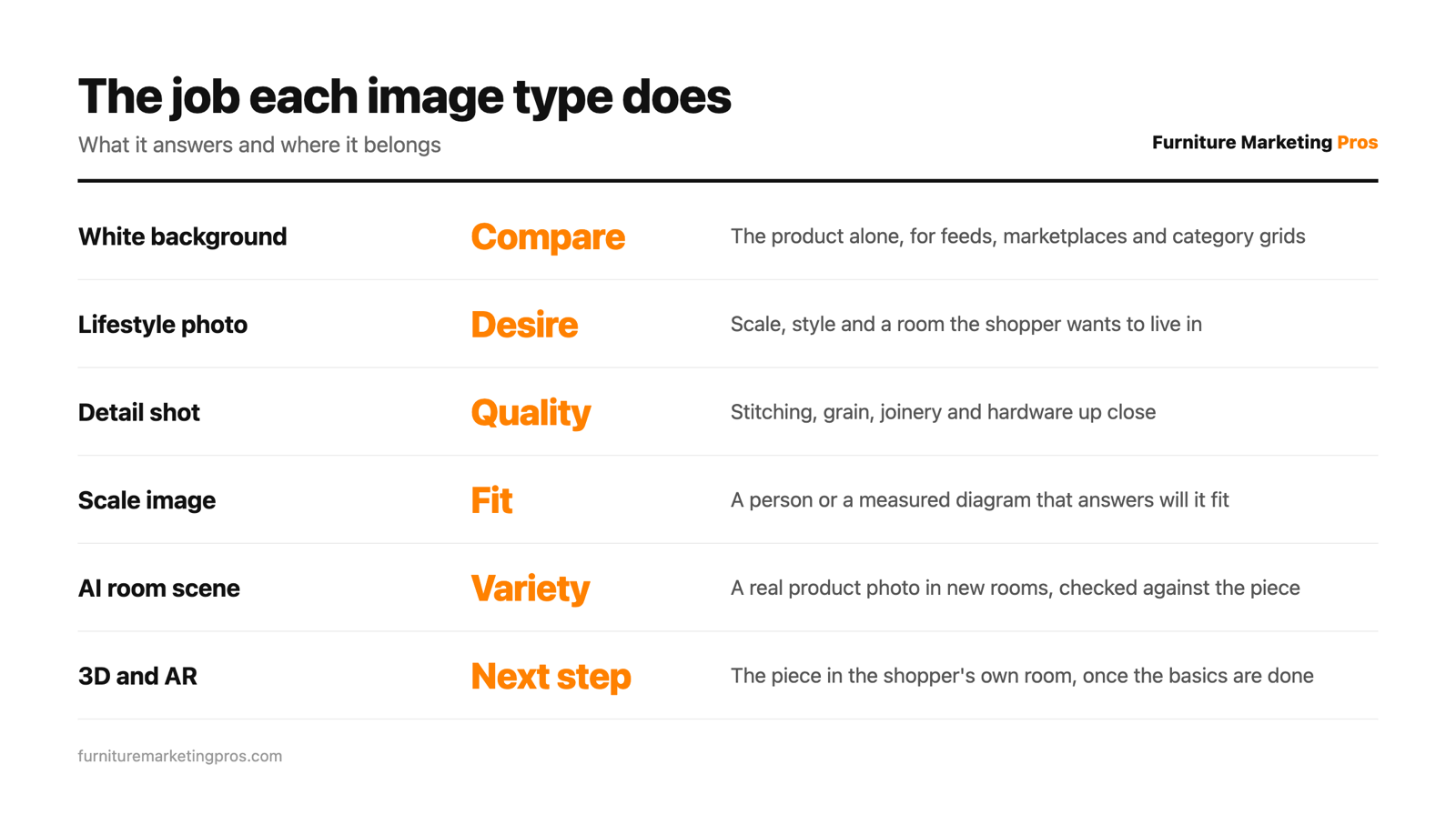
The job each image type does
White background photos compare. The product alone, evenly lit, on a clean background. The shopper can read the silhouette and the color and hold it against the next product in the grid. It is not exciting and it is not supposed to be.
Lifestyle photos create desire and show scale and style. The same piece in a room, with a rug, a lamp and a window. It answers what a cutout cannot: how the piece sits in a space, what it pairs with, and whether it belongs in a home like the shopper's.
Detail shots prove quality. The stitching on the seam, the grain on the tabletop, the drawer joint, the weave of the fabric close enough to see texture. If your prices sit above the big box stores, these images justify them.
Scale images answer will it fit. A person seated on the sofa, or a clean diagram with width, depth, height and seat height marked.
Many furniture product pages are missing at least one of the four, most often detail or scale.
Where each image belongs
Category pages. White background, consistently framed, so the grid reads as a clean comparison. A grid that mixes cutouts with room scenes looks chaotic.
The main product image. For most stores, white background first, because the shopper arriving from a grid or a feed expects the image they clicked.
Google Shopping and product feeds. The main image should be the product alone on a clean background, free of promotional text, borders and watermarks. Lifestyle images can go in as additional images where your feed supports them. We cover feeds in catalog integration for furniture retailers.
Marketplaces. Marketplaces set their own main image rules, and a plain white background is the usual requirement. Read the current policy for each one before you upload.
Meta and Pinterest ads. Lifestyle leads. These are discovery placements where nobody is searching for your product and the image has to earn attention on its own. On Meta the creative does most of the audience finding, which we explain in our guide to Meta AI ads for furniture stores. Pinterest is where people collect rooms, so a product floating on white looks out of place.
Email. A lifestyle image as the lead to set the mood, then clean product images below it for the pieces you want clicked.
How to sequence a product gallery
The order of a gallery should follow the order of the shopper's questions. This is our starting point.
- White background, front or three quarter angle. Confirms this is the piece they clicked.
- Lifestyle photo. Shows it in a room and gives a first sense of size and style.
- A second angle on white. Side or back, because a sofa that floats in a room is seen from behind.
- Scale image. A person on it or a dimension diagram.
- Detail shots. Two or three, covering fabric or finish, construction and any feature worth paying for.
- Function. The recliner open, the leaf extended, the sleeper pulled out.
- Options. The other colors or configurations, each shown as it will be delivered.
The gallery works with the words beside it. Our post on writing product descriptions that sell furniture online covers that half, and our guide to building a furniture store website that converts covers the rest of the page.
AI room scenes: where they help
AI image tools can take a photograph of a product and place it into a generated room. Used with discipline, that solves real problems.
Placing a real product photo into varied rooms. One good photograph of a sofa can appear in a bright coastal living room, a darker city apartment and a family room with toys on the floor. Different shoppers see themselves in different rooms.
Seasonal refreshes. The same dining table set for a holiday meal in November and a spring brunch in April, without moving the table twice.
Products that never got a shoot. Most stores carry a long list of items with nothing but a supplier cutout. A room scene built from that cutout is an improvement, provided the cutout is accurate.
The pattern in every good use is the same. The product is real and unchanged. Only the room around it is generated.
AI room scenes: where they hurt trust
The trouble starts when the tool redraws the product instead of placing it, and the errors are subtle enough to pass a quick look.
Wrong proportions. The sofa comes out a little longer, the arms slimmer, the legs taller.
Invented fabrics and finishes. A generated image may smooth a textured weave, add a sheen to matte leather, or give an oak veneer a grain that does not exist.
Colors that do not match what is delivered. Generated lighting shifts color. A warm sunset scene turns a cool gray into a beige.
Details that change. Tufting buttons multiply, a nailhead trim disappears, a three seat cushion becomes two. A shopper who zooms in and finds two images that disagree stops trusting all of them.
The cost shows up after the sale: returns, refused deliveries, service calls and reviews that say not as pictured. A review like that sits beside your star rating for years, and our guide to Google reviews for furniture stores explains how much weight reviews carry.
A simple honesty rule for every image
The product itself must be a real photograph or an accurate render. The piece the shopper is buying is never invented or altered by a tool. An accurate render is built from the manufacturer's real dimensions and materials.
Label rendered scenes where it matters. On the product page, a short note that the room is digitally rendered and the product is shown as sold is enough. Advertising platforms and marketplaces publish their own policies on AI generated imagery, and those change, so check the current rules before you upload.
Never show a configuration you cannot deliver. Not a fabric you do not stock, not a sectional layout the manufacturer does not make, not a discontinued finish.
Then add one habit. Before a generated scene is published, someone who knows the piece compares it side by side with the real product photograph and checks shape, color, material and detail. If anything differs, it does not go live.
3D and AR as the next step
3D furniture visualization takes the idea further. A 3D model can be rotated, shown in every fabric, and placed in the shopper's own room through a phone camera. That answers the fit question better than any photograph. We look at how retailers apply it in three ways furniture stores are using AR.
It is a real investment, and it is the next step, not the first. A store is ready when these are true.
- The basic galleries are complete on the products that matter most.
- A meaningful share of sales comes from configurable pieces such as sectionals, custom upholstery or modular storage.
- Accurate models are available from your manufacturers, or you have the budget to build them properly.
- Your website is fast enough on a phone to carry the extra weight.
A 3D viewer on a page with two poor photographs is decoration.
A test plan you can run on ten products
Pick ten products. Choose pieces with steady traffic and steady sales across a few categories.
Record a baseline. For each product, note the current gallery, recent product page conversion and any returns or complaints on file.
Change five, hold five. On five products, rebuild the gallery in the sequence above. Leave the other five untouched as a comparison group, so a busy sale week does not fool you into crediting the photos.
Run an ad test alongside it. For two or three of the products, run the same ad with the same copy to the same audience in three versions: white background, real lifestyle photo and AI room scene. Change nothing except the image.
Give it time. Furniture decisions take weeks, so a test that runs for a few days tells you very little. Keep prices and promotions equal across both groups.
How to measure what shoppers trust
Product page conversion. For an ecommerce store that means add to cart and purchase. For a showroom led store it means a stock question, a quote request, an appointment booking or a call.
Return and complaint reasons. This is the trust measure, and few stores track it by cause. Tag every return, refused delivery and complaint with a reason, and watch the ones that point at imagery: color not as shown, smaller or larger than expected, material not as pictured. If a new image style lifts conversion and also lifts these reasons, it is borrowing sales from your reputation.
Ad click through by image type. Click through tells you which image earns attention, not which image sells furniture. Follow the clicks through to inquiries and sales before you declare a winner.
Getting the pictures and the page to work together
Good imagery only pays when the page around it is built to use it, with fast galleries, a consistent grid, images that flow cleanly into your product feed and tracking that shows what shoppers do next. That is the work our web development team does for furniture and mattress retailers. If you would like a second set of eyes on your product pages, book a strategy call and we will walk through them with you.
Key takeaways
- Each image type has one job: white background compares, lifestyle creates desire, detail proves quality and a scale image answers fit.
- White background images belong in category grids, product feeds and marketplaces, while lifestyle images lead in Meta ads, Pinterest ads and email.
- AI room scenes help when a real product photograph is placed into new rooms and hurt when the tool changes proportions, fabric, finish or color.
- The product must be a real photograph or an accurate render, rendered scenes should be labeled where it matters, and no image should show a configuration you cannot deliver.
- 3D and AR are worth the investment once the basic galleries are complete and configurable pieces are a real share of sales.
- Test on ten products and judge the result on conversion and complaint reasons together, not on clicks alone.
Frequently asked questions
Should the main furniture product image be a white background or a lifestyle photo?
For most stores, white background. It matches what the shopper clicked in a grid or a shopping result and makes comparison easy. Put the lifestyle photo second in the gallery.
Do furniture shoppers trust AI generated room scenes?
They trust images that match what arrives. A generated room around a real, unaltered product photograph can work well. Trust breaks when the tool changes the size, fabric, finish or color of the product itself.
Can I use AI product photography instead of a photo shoot?
Use it to extend a shoot, not to replace the product. Start from a real photograph or an accurate render of the piece and generate only the setting.
When is a furniture store ready for 3D visualization and AR?
When the basic galleries are complete, configurable pieces are a meaningful share of sales, accurate models are available and the website is fast on a phone. Until then, better photographs will do more for you than a 3D viewer.
How do I know whether new product images are working?
Compare product page conversion on changed products against a group you left alone over the same period. Then check return and complaint reasons for anything that points at imagery, such as color or size not as shown.