




Every ad platform asks the same question early in the setup: where should your ads show? For a furniture store with a showroom, the answer decides more about your results than almost any bid, keyword or creative choice.
Some owners have a website that takes orders and wonder why they should limit themselves to one metro area. Others discover, months into a campaign, that part of their budget went to people several states away who were never going to buy a sectional from them.
Both are the same decision. This guide walks through how we make it for the furniture and mattress retailers we work with.
The short answer
A furniture store with a showroom should run local paid ads first and treat nationwide campaigns as a separate, limited test. Most furniture is bought within driving distance of the store, delivery cost limits how far a store can sell profitably, and the showroom visit is the conversion. Put the full catalog into local campaigns shaped by your delivery zones and your customer zip codes. Go national only for products that ship by parcel or through a freight partner, for brands people search by name, or for items with enough margin to absorb shipping. Give the national campaign its own budget, its own target and clear stop rules.
Why local is the default for a showroom
People buy big furniture close to home. A sofa, a bedroom set or a mattress is something most shoppers want to sit on, lie on or at least see in person. The decision is largely made during online research, but the showroom visit confirms it. A person who cannot drive to you loses the main reason to choose you over Wayfair, IKEA or Amazon.
Delivery sets a hard edge. Your trucks and your white glove service cover a real area. Beyond it, every order needs a freight carrier, more handling, more damage risk and a harder return. Margin that looks healthy near the store can disappear across the country.
The showroom is where your advantage lives. Your sales team, your floor and your financing desk are local assets. An ad shown outside your market cannot use any of them.
Unless you have a specific reason to sell farther, every dollar should reach people who can visit, buy and take delivery.
How to draw your real local footprint
"Local" is not a circle on a map. A flat radius treats a neighborhood across a river the same as one ten minutes up the highway. Build the footprint from evidence instead.
Start with your delivery zones. List every zip code you deliver to at your standard fee, then the ones you serve at a surcharge. The first list is your core. The second is your outer ring.
Think in drive time, not distance. Shoppers measure a trip in minutes. Expect the footprint to stretch along highways and shrink across congestion. Ad platforms target by radius, city, county and zip code rather than by minutes, so translate drive time into a list of zip codes.
Pull the truth from your point of sale. Export a year or two of sales by customer zip code and rank the zip codes by revenue and by orders. Most stores find a concentrated core and a long, thin tail.
The result is a tiered list: core zip codes, an outer ring, and everywhere else.
The settings that keep your ads local on Google and Meta
Target the list, not the state. In Google Ads, add your zip codes, cities or a radius around the store as included locations, and exclude places inside a radius that you do not serve.
Choose presence, not interest. Google Ads location options let you reach people who are in or regularly in your targeted locations, or widen that to people who have shown interest in them. For a showroom, choose presence. Interest can reach someone in another state who simply searched your city's name.
Bid by tier. Location bid adjustments let you bid more in your core zip codes and less in the outer ring. They apply when you set bids manually. Automated bidding largely sets its own bids, so there express the difference through separate campaigns or budgets.
Count store visits where you can. Google Ads offers store visits conversions to accounts with a linked, verified Google Business Profile and enough volume. Our Google Ads playbook for furniture stores covers the campaign structure, and the profile needs to be in good order first, as covered in our guide to fixing your Google Business Profile.
On Meta, pin the store. Meta lets you target by a radius around an address, by city or by zip code. Set the location around the showroom and your delivery area in every ad set, and confirm it after each duplication. The creative should say where you are, as we explain in our guide to Meta ads for furniture stores.
What goes wrong when a showroom store runs nationwide by accident
Almost no showroom store chooses to advertise bedroom sets to the whole country. It happens through defaults.
A new campaign keeps the whole country as its location because nobody changed it. The location option is left on the wider presence or interest setting. A Shopping or Performance Max campaign follows Merchant Center shipping settings that say you ship everywhere. A Meta ad set is duplicated from a template with a broad location.
The cost is quiet. Clicks arrive, so the campaign looks busy. Some visitors even fill in a form, and your sales team spends time on a lead who lives a thousand miles away. Meanwhile the platform's automation learns from those clicks and looks for more people like them.
The signs are easy to check. Open the location report in Google Ads and see where clicks and spend came from, by state and by city. Do the same in Meta's breakdown by region. Spend outside your tiers with no sales behind it is budget you can move back home this week.
When nationwide campaigns make sense
There are real cases for selling beyond your market. Each rests on a product or an operation that travels well.
Products that ship by parcel. Decor, rugs, lighting, pillows, throws, mirrors and small accent pieces go in a box with a standard carrier. The shipping cost is known, damage is manageable and a return is a label, not a truck.
A real ecommerce operation with freight partners. With negotiated freight rates, a packing process for large items, delivery partners in other regions and a returns policy you can honor, large pieces can travel too. The website has to quote shipping by zip code at checkout. Our comparison of the ecommerce platforms furniture stores use covers that side.
Exclusive or own brand lines people search by name. If you are one of few dealers for a sought after brand, or you sell a line under your own name, shoppers elsewhere search for it directly, and a tightly matched Search or Shopping campaign can capture that demand.
High margin items that absorb freight. Some luxury and custom pieces carry enough margin that a long distance delivery still leaves a profit.
If none of these describes you, the answer is local only.
The middle path most stores should run
Most showroom stores with a working website fit neither extreme. The structure we recommend keeps the two jobs apart, so one cannot hide the other.
Local campaigns carry the full catalog. Search, Performance Max and Meta campaigns target your tiers, show every category and aim at showroom visits, calls and inquiries.
One national campaign carries only shippable products. Build a separate Shopping or Performance Max campaign limited to the products that can ship. Mark them with a label in your product feed and filter the campaign to that label, so a sectional can never appear in it. Make sure the Merchant Center shipping settings match what you can truly deliver.
Separate budgets and separate targets. The national campaign gets its own small daily budget and its own target based on shipped margin. Never let the two share a budget, because automation drifts toward wherever clicks are cheapest, and that is rarely where your showroom is.
Separate reporting. Blended, a profitable local program can hide a losing national one. Keep them on separate lines of every report.
How to measure each side
Local is judged on showroom outcomes. Count calls, direction requests, form inquiries, booked appointments, store visits where the platform reports them, and above all sales recorded in your CRM or point of sale with the customer's zip code. Platform reported revenue understates a showroom's results, because most of the sale happens in the building.
National is judged on shipped orders after costs. Take the revenue from orders shipped outside your delivery area, then subtract product cost, shipping, packaging, damage claims, returns and the ad spend. A national campaign can report attractive revenue and still lose money on every box.
Work out your own break even from your own ticket and margin. The right target for a store selling rugs by parcel has little in common with the right target for one freighting dining tables.
How to test national with a small budget and stop rules
Treat the first national campaign as an experiment with an end date.
Pick a narrow product set. Choose shippable items with good margin, stock on hand and a shipping cost you know.
Set a budget you can afford to lose. Keep it small and leave the local budget untouched.
Write the stop rules before launch. Decide the test length, the spend at which you stop if no orders arrive, and the cost per shipped order, after freight and returns, above which the campaign ends.
Narrow before you widen. If the whole country loses money, look at which states produced orders. A regional campaign may be the version that works.
Scale slowly. If the numbers hold after returns have had time to come back, raise the budget in steps.
How seasonality changes both
Across the furniture Google Ads accounts we manage, November drew about 2.5 times the impressions of the median month at an average click cost of $1.80, and August, the Labor Day run up, drew 3.31 times the median. A February click cost about eight times what an April click cost, $4.93 against $0.60. The median click across eight of our furniture accounts cost $2.10 on Search and $1.22 on Performance Max.
For local campaigns, raise budgets about two weeks before each sale window and ease back between them. Our seasonal paid ad calendar lays out the full year.
For a national test, two cautions apply. Those figures come from accounts that are mostly local showroom campaigns, so treat them as a guide to timing, not a forecast for national auctions. And a December click in our accounts cost about 45 percent more than an October click. Start a national test in a calm, cheap month such as April or October.
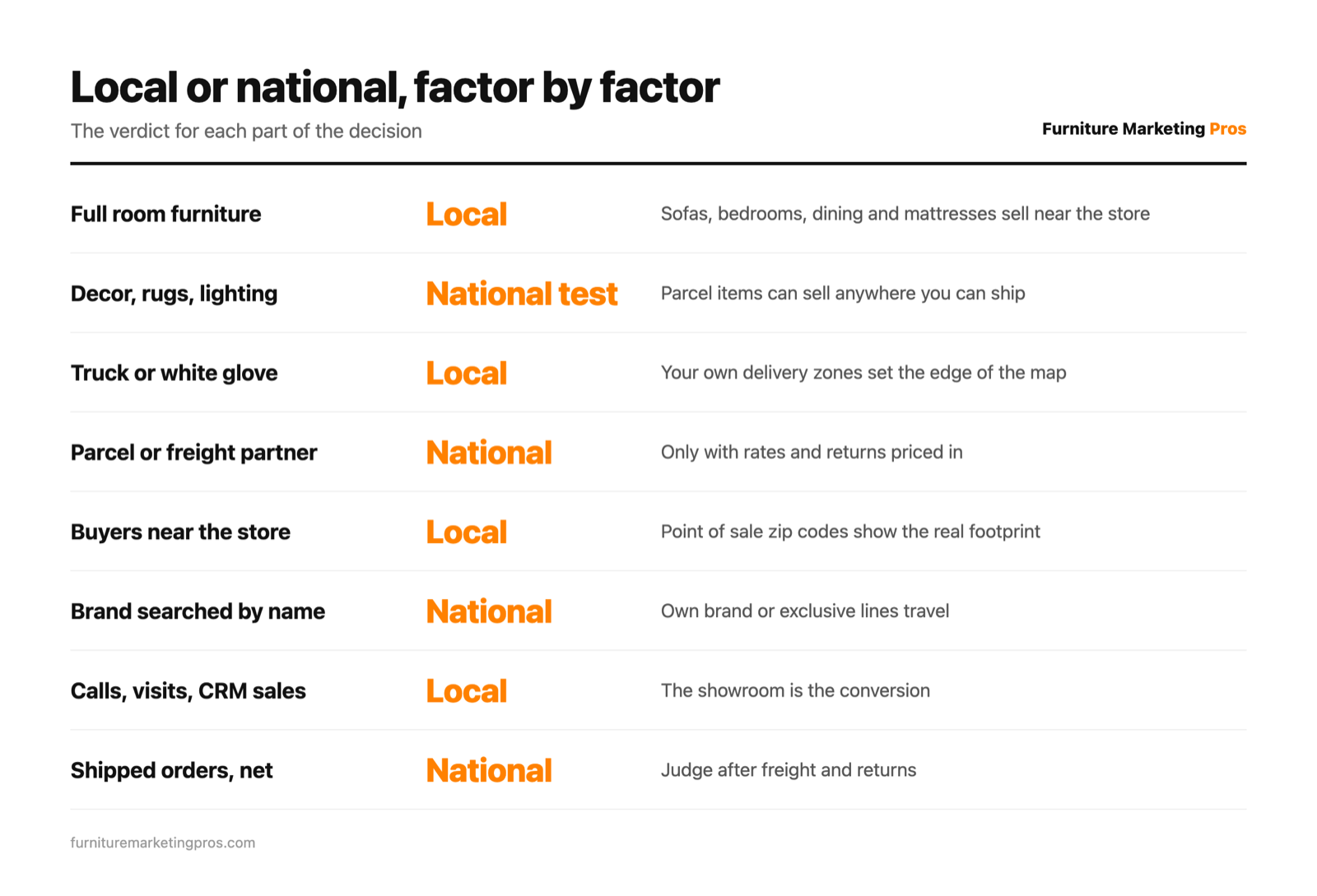
The decision checklist
- What do you sell? Full room furniture and mattresses point local. Parcel sized decor, rugs and lighting can go national.
- How does it ship? Your own trucks and white glove delivery point local. A parcel carrier or a contracted freight partner opens national.
- Where do your buyers come from? Zip codes clustered around the store point local. Orders already arriving from other states are evidence for a test.
- Do people search your brand by name? An own brand or exclusive line supports national Search and Shopping.
- Does the margin survive freight and returns? If not, stay local for that product.
- Can you measure it? Local needs calls, CRM sales and zip codes. National needs profit per shipped order.
- Is the national budget separate? If it would come out of the local budget, wait.
If a few answers point national, run the middle path. Otherwise run local only.
Getting the footprint right with help
Deciding where ads run is the first thing we settle on a new account, before keywords or creative. Building the tiers from your delivery zones and sales data and reporting local and national separately is part of the ads management we do for furniture and mattress retailers. Mattress stores face a sharper version of this choice, covered in our guide to paid advertising for mattress stores. If you would like us to look at where your budget is going today, book a strategy call.
Key takeaways
- A furniture store with a showroom should advertise locally first, because the visit and the delivery are both local.
- Build the local footprint from delivery zones, drive time and point of sale zip codes, not from a flat circle.
- Choose the presence location option in Google Ads and check location reports for spend outside your market.
- Nationwide campaigns suit parcel shippable products, real freight operations, brands searched by name and items with margin to absorb shipping.
- Run national as a separate campaign with its own products, budget, target and reporting.
- Judge local on calls, visits and CRM sales, and national on shipped orders after freight and returns, with stop rules written before launch.
Frequently asked questions
Should a furniture store with a showroom run local ads or nationwide campaigns?
Local ads first. Most large furniture is bought within driving distance, delivery cost limits how far you can sell at a profit, and the showroom visit confirms the sale. Add a national campaign only as a separate, limited test for products that ship well.
What radius should a furniture store target with ads?
There is no single correct number. Use your delivery zones and the zip codes your customers actually come from, shaped by drive time, and split them into a core area and an outer ring.
What is the difference between presence and interest in Google Ads location targeting?
Presence reaches people who are in or regularly in the locations you target. The wider option also reaches people who have shown interest in those locations, wherever they are. A showroom store should choose presence so the budget goes to people who can visit.
Can a local furniture store sell nationwide with Google Shopping?
Yes, for the right products. Limit a separate Shopping or Performance Max campaign to items that ship by parcel or through a freight partner, and judge it on profit after freight and returns.
How do I know if my ads are showing outside my delivery area?
Check the location report in Google Ads and the region breakdown in Meta for where clicks and spend came from. Spend in places you cannot serve usually traces back to a default setting that was never changed.