




Most furniture store owners describe their market the same way: the towns within about a half hour drive, give or take. Shoppers will travel that far to sit on a sofa. The question is whether they find your showroom or the one closer to home.
Local SEO advice usually arrives as a long, flat list, as if every item mattered equally. It does not. Some tactics move showroom traffic within weeks, some take a season, and a few will get your listing suspended.
This post ranks the tactics by how reliably they bring people through the door from inside a 30 mile radius, with what to do this week, how long each takes to show and how to measure it.
The short answer
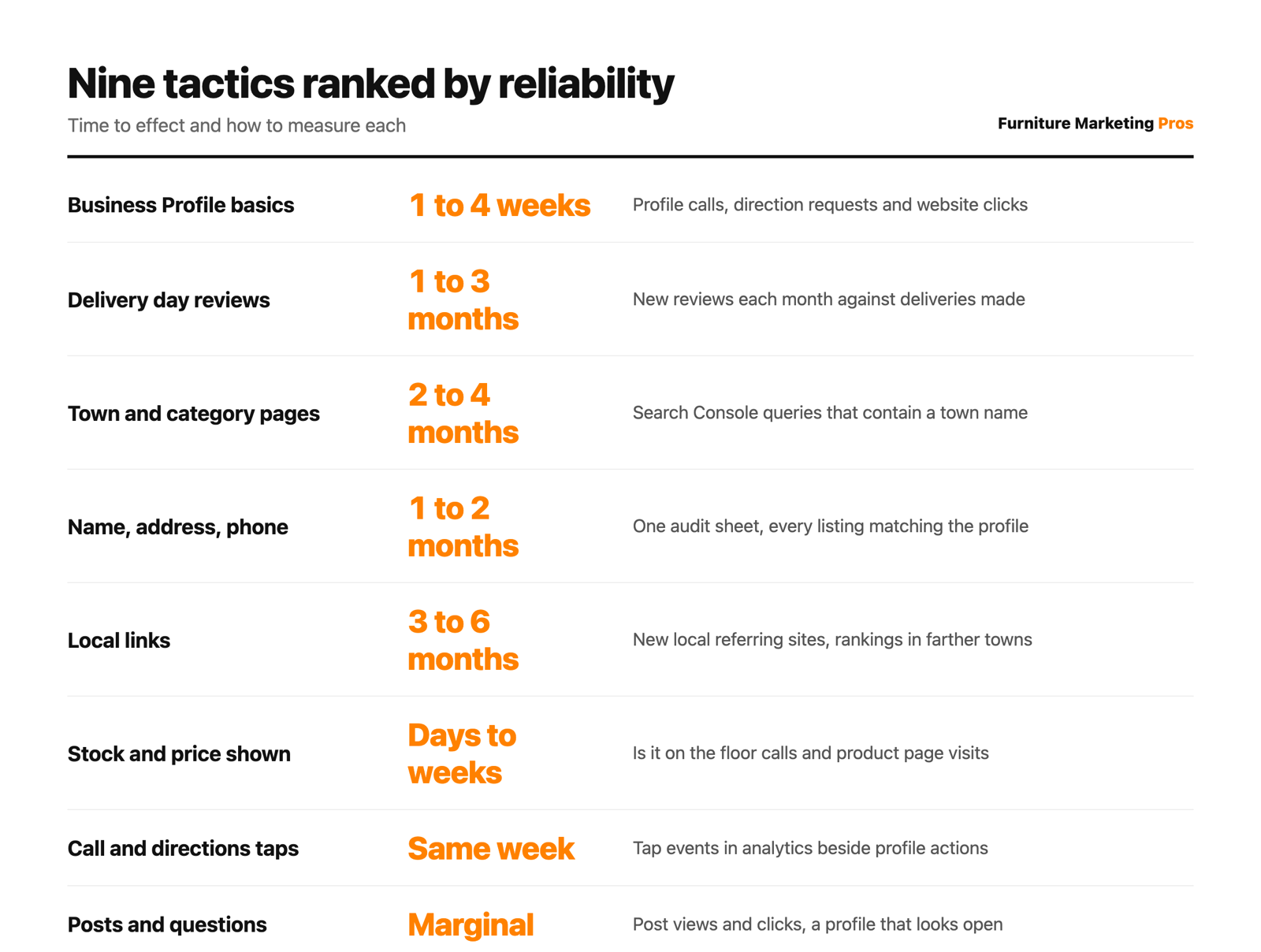
The local SEO tactics that most reliably raise in store visits for a furniture retailer within 30 miles are, in order: a complete and accurate Google Business Profile, a steady review routine tied to delivery day, real town and delivery area pages, category pages that match local searches, consistent name, address and phone everywhere, local links from real community ties, stock and price information that answers "can I see it today", easy call and directions buttons on a phone, and current profile posts. Proximity limits the map pack to the area near your store, so the towns farther out are won with organic pages. Measure direction requests, calls and what walk in shoppers tell you.
How proximity really works, and what a 30 mile goal means
Google says local results rest on three things: relevance, distance and prominence. Relevance is how well your listing matches the search. Distance is how far your store sits from the searcher, or from the place named in the search. Prominence is how well known and well regarded the business appears.
Distance is the one you cannot change. The map pack, the block of three listings with a map, leans hard on it. A shopper two miles from your door can see you there. A shopper 25 miles away, searching "furniture store near me" from home, usually sees the stores around them instead. No amount of optimization moves your building.
So a 30 mile goal splits into two jobs.
Close in, win the map pack. In your own town and the ones next to it, the profile, the reviews and your prominence decide whether you are one of the three.
Farther out, win the organic results and the brand search. Below the map pack sit the regular website results, and those are not tied to distance in the same way. A good page about delivery to a town 20 miles away can rank for searches from that town. Then, when the shopper searches your store name, your Business Profile appears in full with your reviews, photos and hours.
Our AI local SEO guide for furniture stores covers the full foundation, including structured data. This post is about priority: every tactic below serves one of those two jobs.
The most reliable two: the profile and the review routine
1. A complete and accurate Google Business Profile. This is the highest return hour in local SEO, because the profile is what the map pack shows. The primary category carries the most weight, so set it to furniture store, or mattress store if that is what you are. Add the secondary categories that match your floor, load products with photos and prices, upload recent photos of the real showroom and keep hours exact, including holiday hours.
This week: check the primary category, fix the hours and add ten current photos. Shows in: one to four weeks in the accounts we manage. Measure: calls, direction requests and website clicks in the profile's performance report. Our post on the Google Business Profile gaps that cost furniture stores sales walks through every field.
2. A steady review routine tied to delivery day. Reviews are the part of prominence you control, and steady beats a burst. Ask every customer once the furniture is in the room, and reply to every review.
This week: put the review link in a text that sends when a delivery is marked complete. Shows in: one to three months, as recent reviews build up. Measure: new reviews each month against deliveries made, alongside direction requests. The full system, with scripts and reply examples, is in our guide to Google reviews for furniture stores.
Reliable but slower: town pages and category pages
These two do the work the map pack cannot do: they reach the towns 15 to 30 miles out.
3. Town and delivery area pages that are real. One page for each town you truly serve, written so it could not be about any other town. Say what you deliver there, the usual lead time and the delivery fee. Give the drive to the showroom from a landmark locals know, and name the neighborhoods where your trucks already go.
Start with the three or four largest towns inside your radius, not thirty. If the only thing that changes between two pages is the town name, they are doorway pages, and Google's spam policies say so.
This week: write the first one, for the largest town you do not currently rank in. Shows in: two to four months. Measure: Search Console queries that contain the town name, and the clicks to that page.
4. Category pages that match local searches. People search "sectionals in" followed by their town. You do not need a separate sectionals page for every town. You need one strong sectionals page that names the showroom location and the delivery area, shows what is on the floor and is linked from your town pages. Each town page links to sectionals, mattresses and dining, and each category page links back to the delivery area pages. Content and internal links carry the local meaning. Thin clones do not.
This week: add a short paragraph to your top three category pages that names the showroom and the towns you deliver to. Shows in: two to four months. Measure: Search Console queries that pair a category with a town.
Supporting tactics: consistent details and local links
5. The same name, address and phone everywhere. This rarely wins a ranking by itself, but it removes doubt. When your profile, website, Facebook page, map apps, directories and manufacturer dealer locators all agree, Google and shoppers both trust the record. An old phone number or a former address still sends some shoppers to the wrong place.
This week: list every place your store appears in one sheet and correct the mismatches, starting with map apps and dealer locators. Shows in: one to two months as listings update. Measure: the share of listings in your sheet that match the profile exactly.
6. Local links from real community ties. Links from other local websites raise prominence, and they help the organic pages that reach the farther towns. The ones that count come from things you actually do: a youth team you sponsor, a charity event in the store, a story in the local paper, a designer's or home builder's site naming you as their furniture source. Pick ties in the towns you want to reach, not only your own.
This week: list the organizations you already support and the designers and builders who already send you customers, and ask each for a link to your site. Shows in: three to six months. Measure: new local sites linking to you, and rankings in the farther towns.
The last step before the drive: stock, price and one tap actions
Ranking gets you seen. These three turn being seen into a visit.
7. Stock and price information that answers "can I see it today". A shopper will not drive 25 miles on a guess. Show a price or an honest price range, and mark the pieces that are on the showroom floor. If your inventory system can supply it, Google's Merchant Center accepts local inventory data so a listing can show that an item is available in a nearby store. Our guide to the online to in store journey covers how the website should match the floor.
This week: add an "on display in our showroom" label to the pieces that are. Shows in: days to weeks, in conversion more than in rankings. Measure: calls that ask whether a piece is on the floor, and visits to labeled product pages.
8. Call, directions and booking actions that are easy to tap. A shopper looking for directions is usually on a phone. Put a tap to call number, a directions link that opens the map app and a booking link at the top of every page. Add your appointment link to the profile too.
This week: open your own site on your phone and count the taps to get directions. Shows in: the same week. Measure: tap events in analytics, beside profile calls and direction requests.
9. Profile posts and questions kept current. This one is marginal. It is on the list because it is cheap, and because a profile with a post from this month looks open. Post each sale window, new arrival and event. Google has been changing how questions and answers appear on profiles, so look at what yours shows today, and answer the common questions about delivery, financing and hours on your website as well. Our post on Google AI Overviews and local furniture stores explains why those answers matter.
This week: publish one post. Shows in: little direct ranking effect. Measure: post views and clicks in the profile.
What does not work, or breaks Google's guidelines
Keyword stuffed business names. Your profile name must be your real name as it appears on your sign. Adding "best furniture and mattress store" plus a town invites a competitor's edit or a suspension.
Fake addresses and virtual offices. A profile needs a real location that is staffed during its stated hours. A rented mailbox in a town 20 miles away is not a showroom, and listings like that get removed.
Bought or incentivized reviews. They violate Google's policies, and when Google removes them it often takes real reviews with them.
Mass produced city pages. Fifty pages that differ only by town name are doorway pages, and at best they are ignored.
How to measure showroom visits honestly
No single report shows a walk in, so use four sources together.
Profile actions. Direction requests and calls in the Business Profile performance report are the closest free signal of intent to visit.
Search Console queries with town names. Filter the performance report by each town in your radius. Growth there shows your reach widening.
Store visits where available. Google Ads reports store visits conversions for accounts with a linked, verified Business Profile and enough volume. It is an ads measure and an estimate, but useful where you have it.
Ask every walk in. Have whoever greets the customer ask how they found you and what town they drove from, and record both in the CRM or on a clipboard.
A worked example: Saloni Furniture
Saloni Furniture is a Virginia showroom we work with. It ranks number one for "furniture stores leesburg va". That is a town name search of exactly the kind this post is about: the shopper names a place, and the store that is the clear answer for that place gets the visit. The Saloni Furniture case study shows the work.
A 30 day plan
Week one. Fix the profile: primary category, secondary categories, hours, products and ten new photos. Check the call, directions and booking buttons on a phone. Start asking every walk in how they found you.
Week two. Turn on the delivery day review text. Reply to every existing review. Build the name, address and phone sheet and correct the worst mismatches.
Week three. Publish the first two town pages for the largest towns in your radius. Add the showroom and delivery area paragraph to your top category pages, and link the pages to each other.
Week four. Label floor models on product pages. Ask three community partners for a link. Publish a profile post. Record your baseline: direction requests, calls, town name queries and walk in sources.
Then repeat weeks two to four every month.
Putting the radius to work
Ranking in your own town is the start. Building the profile, the review routine, the town pages and the local links in the right order is the core of our local SEO service for furniture and mattress retailers. If you would like to see where your store shows up across the towns in your radius today, book a strategy call.
Key takeaways
- Google ranks local results on relevance, distance and prominence, and distance keeps the map pack close to your real location.
- A 30 mile goal means winning the map pack near the store and winning organic results and brand searches in the towns farther out.
- A complete Google Business Profile and a review routine tied to delivery day are the most reliable tactics and the fastest to show.
- Real town pages and locally relevant category pages reach the farther towns, and they take two to four months.
- Stuffed business names, fake addresses, bought reviews and cloned city pages risk the listing you depend on.
- Measure direction requests, calls, town name queries and what every walk in tells you.
Frequently asked questions
Which local SEO tactic brings the most in store visits for a furniture store?
A complete and accurate Google Business Profile, followed by a steady flow of recent reviews. The profile is what the map pack displays, and reviews are the part of prominence a store controls.
Can my furniture store rank in the map pack in a town 30 miles away?
Usually not, because distance from the searcher is one of Google's three local ranking factors. You reach that town with organic pages about delivery there and with a strong profile that appears when the shopper searches your store name.
How long does local SEO take to increase showroom traffic?
Profile fixes and easier tap actions can show within weeks. Reviews build over one to three months. Town pages, category pages and local links usually take two to six months.
Are city pages bad for SEO?
Only the mass produced kind. A page with real delivery details and lead times for a town you serve is useful. Dozens of pages that differ only by town name are doorway pages under Google's spam policies.
How do I know whether local SEO is bringing people into my store?
Watch direction requests and calls in your Business Profile, and Search Console queries that include town names. Then ask every walk in how they found you and where they drove from, and record the answers.